

A traditional flatbread becomes part of everyday life in Xinjiang, Shan Juan and Mao Weihua report.
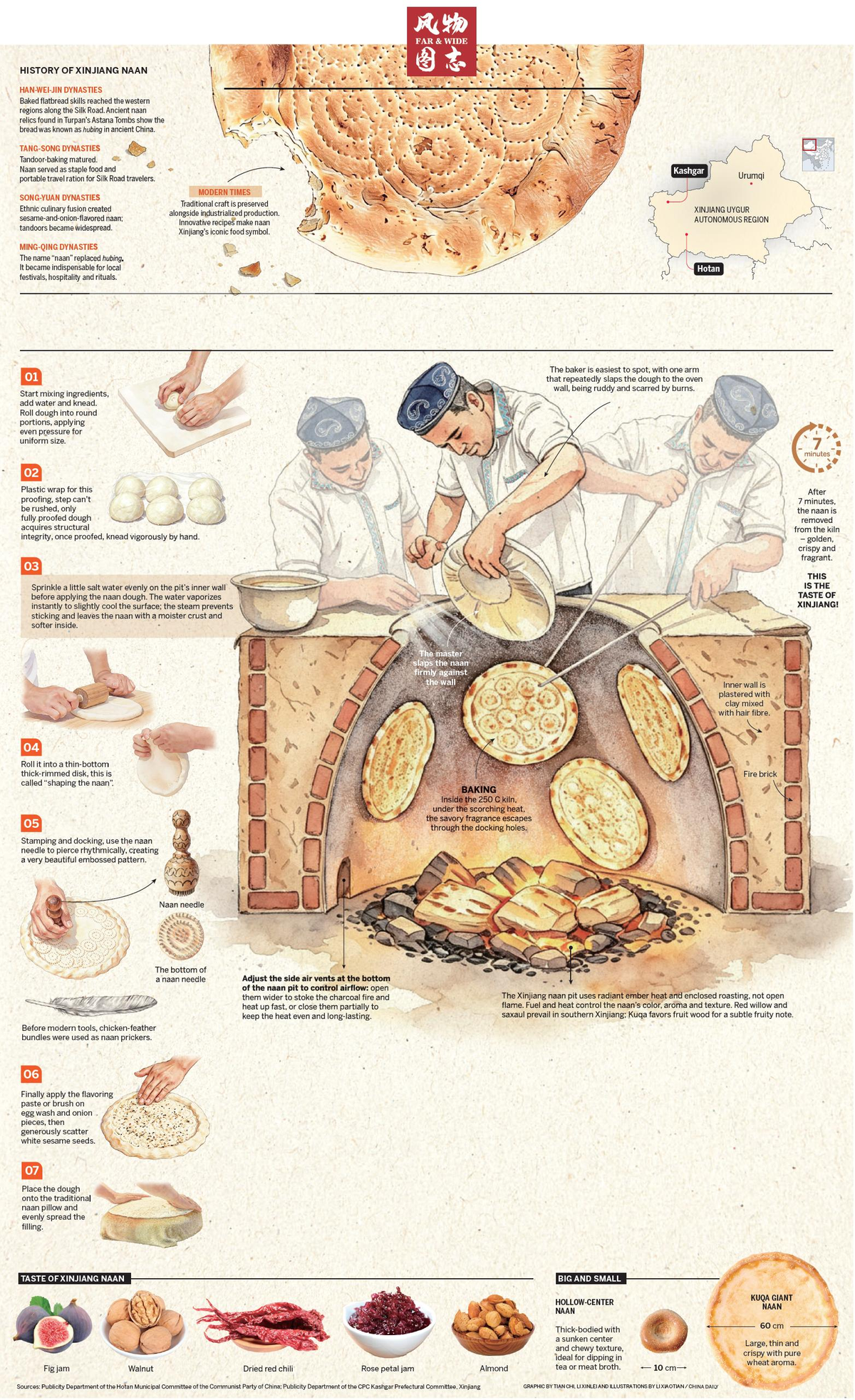
Editor's Note: Using a blend of words and visuals, this series explores unique communities and reveals the heart of China through food, architecture, craftsmanship, landscapes and traditions.
In the Xinjiang Uygur autonomous region, no other food represents local culture and cuisine better than its traditional flatbread, called naan. Fresh from the tandoor — a cylindrical clay oven heated by coal or wood — the bread glows golden brown, flecked with dark blisters where the dough kissed the oven wall. The thin center remains pale, but the thick rim darkens to amber.
All in all, it looks like a portrait of the sun.
The uneven texture makes eating it an adventure, from the crispy center to the thick rim. It's a gourmet treat, even for the experienced food connoisseur.
READ MORE: More than daily bread
A day after baking, the bread turns tough, but once dipped in milk tea or torn into lamb stew, it softens into something new. Options include deep frying with mutton or turning it into a pizza base. Above all, it's a bread built for the road: it can be stored for long periods without spoiling. It's simple, honest and never tiresome. During his journey to the West, the Buddhist monk Xuanzang carried naan across the Moheyan Desert and over frozen mountain passes.
The history of naan in Xinjiang is nearly as old as wheat itself. Remnants of ancient flatbreads dating back 3,000 years have been unearthed in the Hami Wubao Ancient Tombs. In early dynasties, it was called hubing — which translates to "foreign bread". Eventually, baking advances brought pit ovens to regions that traditionally relied on steaming or griddle-cooking.
Naan is now an essential food item in Xinjiang. More than 200 distinct varieties can be counted — ranging from the giant Kuqa naan to small bread rings. The craft has been recognized as a national intangible cultural heritage.
A stroll through most neighborhoods in Xinjiang is likely to result in passing by a naan stand, which usually includes a small room for mixing dough beside a large outdoor brick oven.
Because procedures can be physically demanding, stalls are usually staffed by at least two men: One makes the dough and the other bakes it. The baker is easiest to spot: one arm — the one that repeatedly slaps the dough against the hot oven wall and retrieves the finished product — is ruddy and scarred by burns.
ALSO READ: China's shaobing has turned into a hot commodity overseas
Women have traditionally sold or delivered the bread, but they are now becoming more engaged in the production process — particularly for the newly developed stuffed naan. Some women workers are increasingly involved in making stuffed naan, a process that requires nimble handling to tuck the filling into the dough and seal the seam.
Residents of Xinjiang jokingly say a person can go without meat for three days, but even one day without naan may prove fatal. The bread that was built for the road, it turns out, became bread made for everyday life.
Contact the writer at shanjuan@chinadaily.com.cn
