

New book meticulously re-creates the 34-year-long journey of a geographer 400 years ago, bringing ink illustrations, research and highlights from his own travelogue into a comprehensible text, Yang Yang reports.
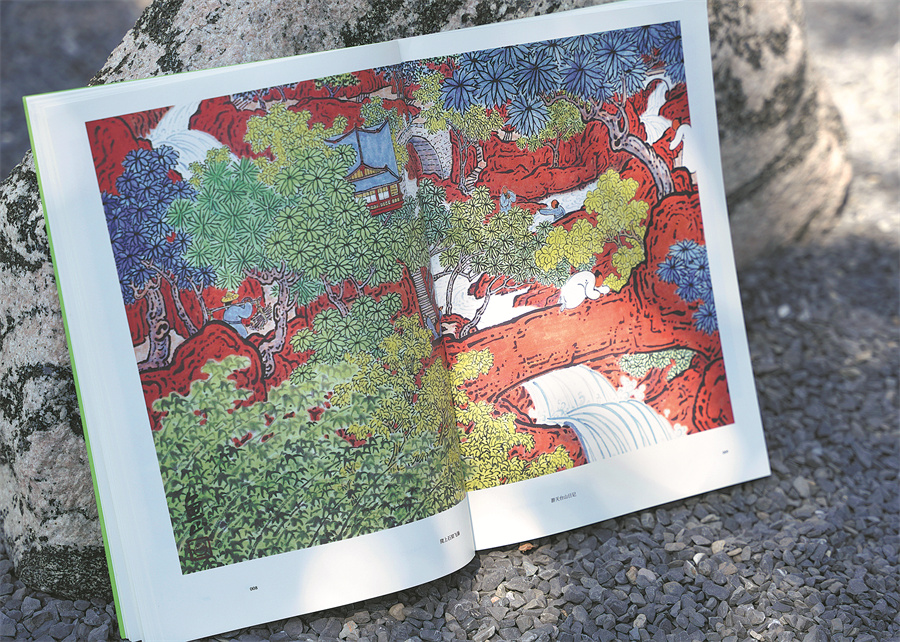
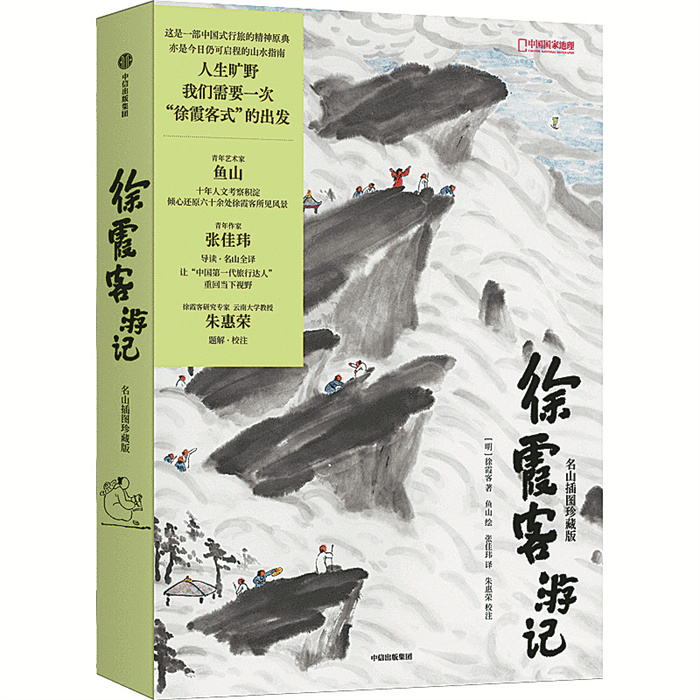
Four hundred years ago, Xu Xiake (1587-1641), a geographer, explorer and literary scholar, spent 34 years traveling around China, covering 100,000 li (50,000 kilometers) on foot. The new illustrated book Xu Xiake's Travels to Famous Mountains was recently released at Lushan Library located at Lushan Mountain in East China's Jiangxi province.
The book, published by China National Geography Books, includes 16 chapters of Xu's travels to famous mountains, including Lushan Mountain, Huangshan Mountain, Tiantai Mountain, Songshan Mountain, and Hengshan Mountain.
The pages feature over 60 ink landscape illustrations meticulously created by artist Zeng Renzhen, who is known in the art world as Yushan, a contemporary Chinese artist and architect. Chinese writer Zhang Jiawei provides the introduction and translation, while Zhu Huirong, an expert on Xu Xiake research, offers commentary and annotations. The book also includes 17 specially drawn maps of Xu's travel routes to these famous mountains.
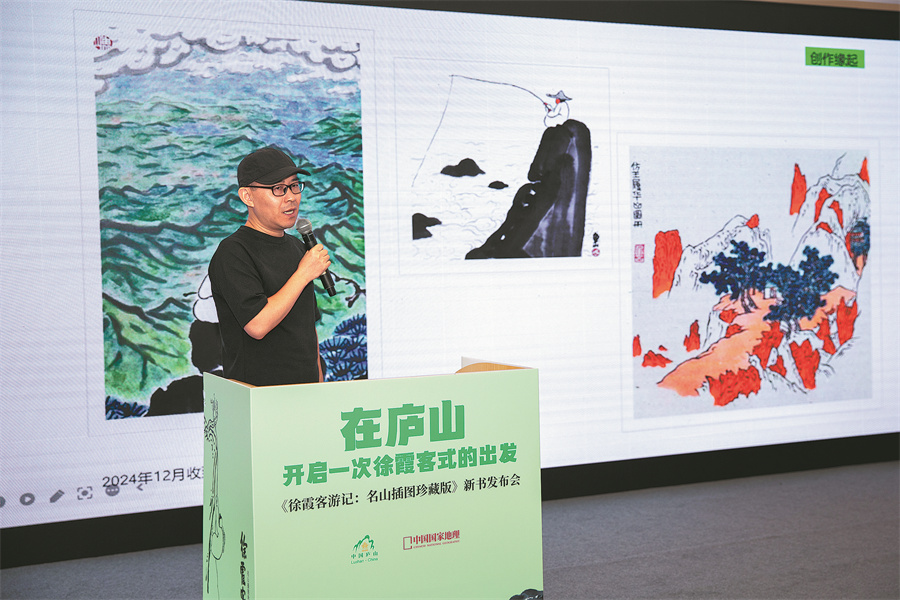
Chen Yihuan, general manager of China National Geography Books, explains that the book aims to transform the classic work from 400 years ago into a travel text that is "readable, appreciable, and referable". It is designed to be readable with selected chapters on famous mountains featuring introductions and modern translations; appreciable, with artist Yushan retracing Xu's routes to create over 60 landscape illustrations; and referable, by connecting Xu's paths with today's renowned mountain sites.
In 1618, Xu embarked on a journey along the Yangtze River, stopping in Jiujiang, Jiangxi, to explore Lushan Mountain, Baiyue Mountain, Huangshan Mountain, and Jiuhua Mountain in today's Jiangxi and Anhui provinces. His experiences during this trip are detailed in his travelogue, Diary of a Visit to Lushan Mountain.
ALSO READ: Rule and letters on the frontier
Lushan, located in northern Jiangxi province, is a renowned Chinese scenic area. Xu arrived in Jiujiang on Aug 18 and began his ascent from Lushan's northern slope with friends the following day. After five days of exploration, he departed from Kaixian Temple on the southern slope on Aug 23, having visited all the major scenic spots.
His journey was driven by a spirit of adventure and discovery, so he avoided the main roads. To reach the summit of Hanyang Peak, Lushan's highest point, he navigated through grass and thorns. While investigating the Sandie Spring, he traversed a rocky stream bed, where round stones were slippery and sharp rocks pierced his shoes.
He visited Shimen (stone door) twice, took detours to thoroughly explore Wulao Peak, and often viewed many scenic spots from different angles to ensure he fully captured their beauty.
Lushan Mountain is a typical horst-block mountain, uplifted by the Himalayan movement millions of years ago, said geologist Liu Jiaqi at the book launch ceremony.
It preserves the most typical and concentrated remnants of Quaternary glacial landforms in eastern China, on which prominent Chinese geologist Li Siguang proposed the Lushan Glaciation theory. Liu also mentioned Lushan's Feilai Stone, a massive boulder weighing tens of tons standing isolated on a mountain ridge, which could only have been transported there by glaciers.
The scattered rocks that Xu Xiake once walked on, described as "round ones that are slippery and pointed ones that pierce shoes", are likely glacial erratics transported by glaciers, he noted.
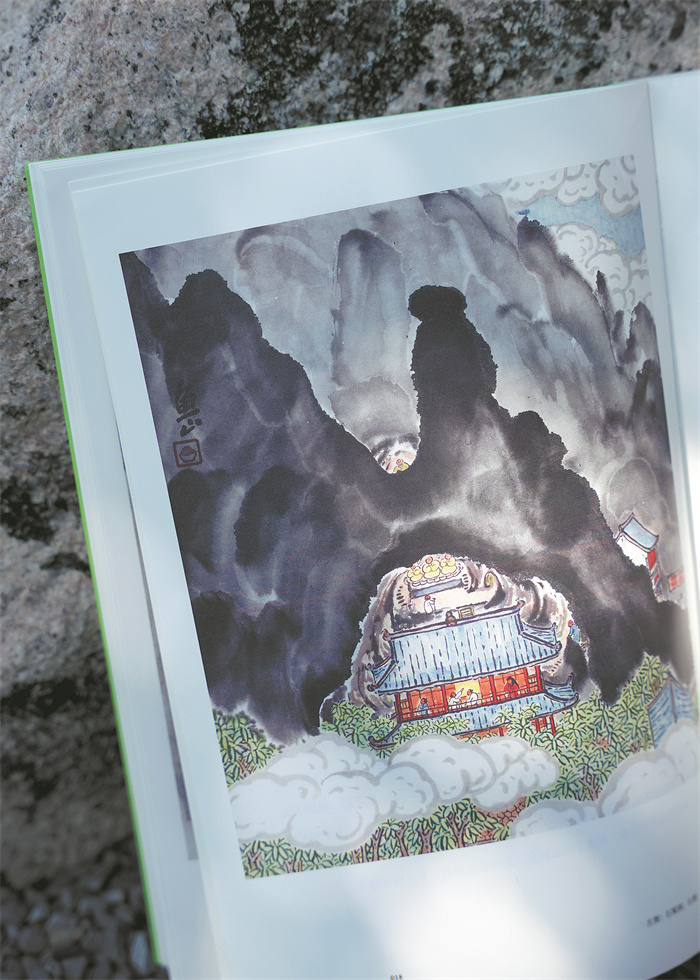
The book's illustrator, Yushan, retraced Xu's footsteps to various famous mountains in order to illustrate the landscapes. With a decade of cultural exploration as a foundation, Yushan used contemporary Eastern aesthetics to re-create over 60 landscapes and scenes described by Xu.
Painting the landscapes Xu traveled through is also to depict his life within them — the journey's hardships, the uncertainty of finding a path, the relaxing moments, and the exhilaration of reaching the summit, he says.
"Xu leisurely traveled through the vast world and joyfully walked within his own small world," he adds.
Explaining Xu's approach and spirit in his travel explorations, Chen Qingjiang, vice-director of the Xu Xiake Research Branch of the Geological Society of China, summarizes it into four key phrases: committing wholeheartedly to a chosen pursuit, exploring vast landscapes with freedom and courage, visiting mountains as if meeting old friends, and embarking on distant journeys as acts of personal dedication.
Xu uniquely combined landscape aesthetics with scientific exploration, a rare achievement among travelers throughout history, with few able to rival him in this regard, Chen says.
