

Ancient past, present converge in panoramic glory as ensemble of historical buildings celebrates two years on UNESCO list
Want to stand where Beijing's ancient past converges with the present in one breathtaking panorama? Zhengyangmen Gate is the perfect option.
From its heights, you get a sweeping bird's-eye view of the bustling and tourist-filled historical lanes of Qianmen Street to the south, while Tian'anmen Square, the National Museum of China and the Great Hall of the People unfold majestically to the north.
With the gate tower in the north and the archery tower in the south, Zhengyangmen Gate stood as the largest gate of the inner and outer cities of Beijing during the Ming (1368-1644) and Qing (1644-1911) dynasties.
READ MORE: Exploring tales from Central Axis
On Monday, to celebrate the second anniversary of the Beijing Central Axis being inscribed on the UNESCO World Heritage List, it was announced that the Zhengyangmen Gate tower, a pivotal landmark along the 7.8-kilometer-long Central Axis, has reopened to the public.
Tickets can be booked in advance online. They cost 20 yuan ($2.95) for adults. Children under 18 and seniors 60 and older are admitted for free.
Restoration of the gate tower, which had been closed for renovations since 2020, was completed at the end of 2025.
Heritage sites along the Beijing Central Axis, including the Palace Museum, the National Museum of China and the Temple of Heaven, were open to the public on Monday, though they are normally closed on Mondays.
In addition, a series of events, themed on the Beijing Central Axis and UNESCO's listing of "Beijing Central Axis: A Building Ensemble Exhibiting the Ideal Order of the Chinese Capital", will be held throughout the year.
"Zhengyangmen Gate offers a stunning panoramic view along the Central Axis. You can take many beautiful photos," said Yang Jun, 58, a Beijing-based photographer.
Wei Yong, a tour guide from Beijing with 12 years' experience, often leads tour groups up the Zhengyangmen archery tower, which was already open to the public, to share the history and restorations of Zhengyangmen Gate. He said he's confident that the newly reopened gate tower will draw many visitors.
"Tourists are interested in the culture and history of the Beijing Central Axis, struck by the charm of Beijing's hutong and the grandeur of the city's skyline," he said.
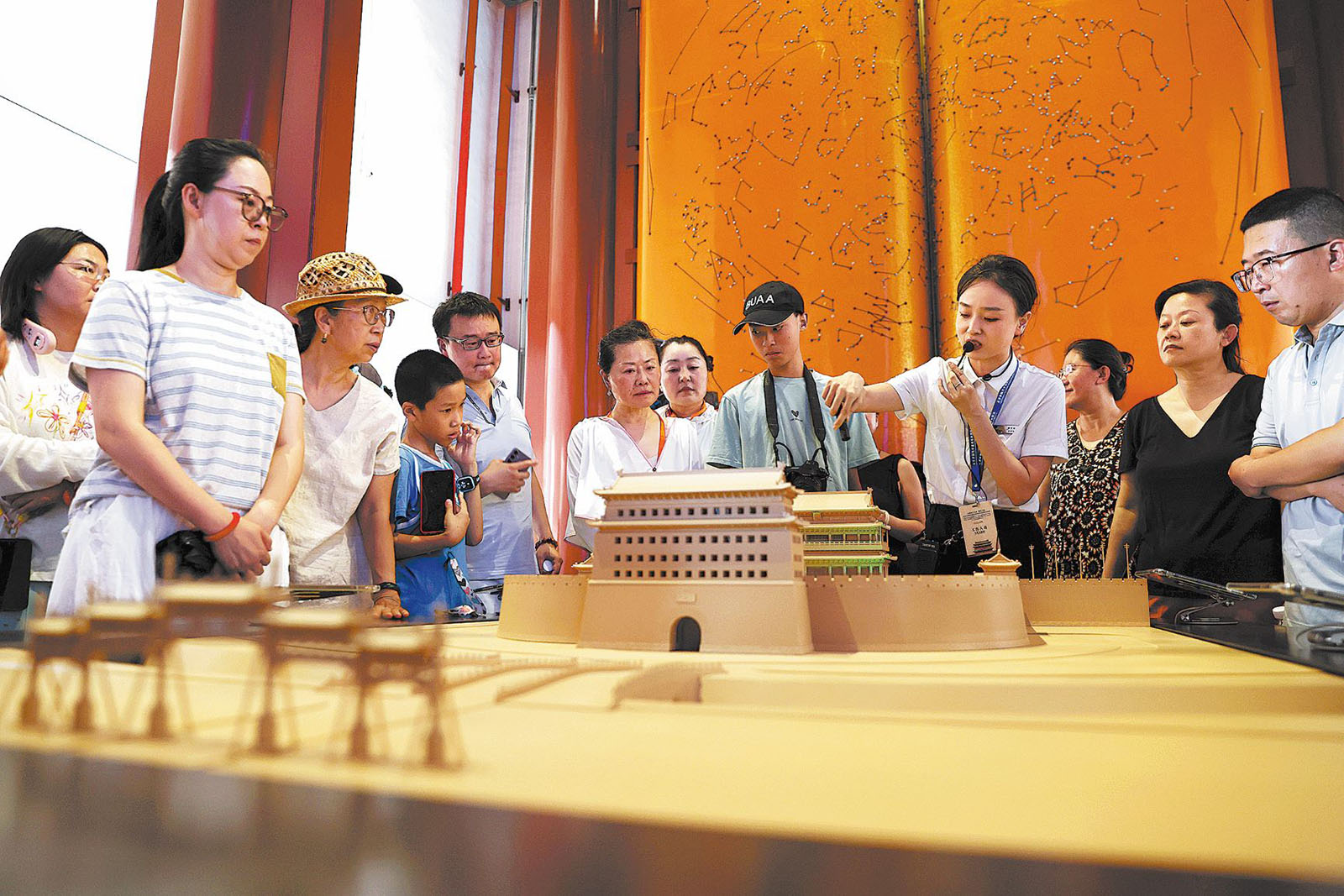
The gate tower now hosts a permanent exhibition showcasing more than 600 years of architectural heritage and the outstanding universal value of the Beijing Central Axis.
Exhibits include an original glazed, animal-shaped ornament from the gate tower's roof ridge, removed during its recent renovation, and a complete architectural model of Zhengyangmen Gate.
The model presents the full original layout and structural design of the gate tower, the archery tower and the barbican, an outer defense structure that no longer exists.
The two towers were originally connected by the barbican's walls. While the gate tower featured a central archway for people to pass through and also served as a command post, the archery tower was built for shooting arrows at attackers.
After suffering repeated damage throughout history, only the pavilion-style gate tower and the brick, fortress-like archery tower remain today. Both were reconstructed and finally completed in 1906.
The exhibition integrates various digital displays and a documentary on Zhengyangmen Gate's history, urban planning and preservation and restoration work.
Historical integrity
"The project has restored the tower's original interior spatial layout," said Chen Liang, director of the heritage conservation department at the Beijing Central Axis Heritage Protection Center. "Now visitors can experience the authenticity and historical integrity of the ancient architecture. It's the most compelling reason to visit the site."
Historically, bricks produced in Linqing, Shandong province, were shipped to Beijing via the Grand Canal to construct major buildings in the capital. For the renovations, Chen and his colleagues visited Linqing's traditional brickmaking sites to source custom-made bricks, in order to ensure that bricks used in the project met the original standards.
ALSO READ: Beijing Central Axis listed as World Heritage Site
The Zhengyangmen Gate tower has also undergone comprehensive, three-dimensional digital scanning. "It's a great transformation, as we used to rely on historical paper drawings in renovation work," he said.
Chen added that all key construction steps, techniques, procedures and expert guidance throughout the process were digitally documented, to serve as references for future restoration work.
During the renovation, roof work was carefully scheduled to avoid disturbing Beijing swifts during the birds' peak hatching and brooding period. From April to July each year, the migratory birds return to Beijing to breed and roost, and the tower is one of their major habitats.
Contact the writers at xulin@chinadaily.com.cn
