

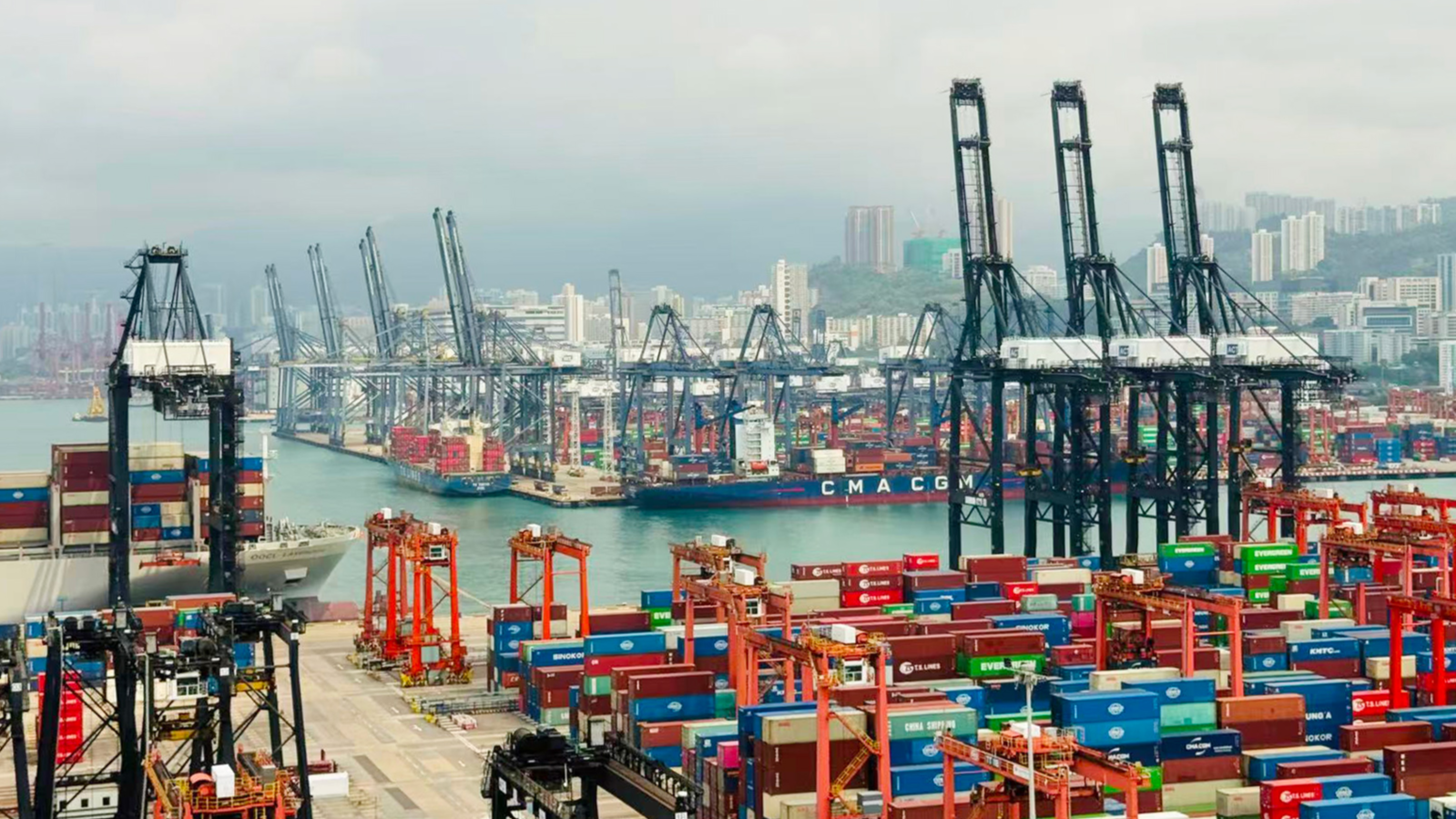
The Hong Kong Special Administrative Region’s total exports surged 53.4 percent year-on-year in June, supported by robust global demand for electronic products related to artificial intelligence, according to official data released on Monday.
This increase marked the city’s largest monthly year-on-year export growth in more than 42 years and extended its streak of positive year-on-year growth to 28 months, dating back to March 2024.
The value of the city’s total exports rose to HK$641.1 billion ($81.75 billion) in June, following a 40.8 percent increase in May. Meanwhile, total imports increased 45.4 percent year-on-year to HK$693 billion, the city’s Census and Statistics Department said.
A visible trade deficit of HK$52 billion, equivalent to 7.5 percent of the value of goods imports, was recorded last month. Both figures grew from May’s HK$44.2 billion and 6.7 percent of imports.
For the first half of 2026, the value of total goods exports surged 39.1 percent over the same period last year, while the value of imports increased 40.6 percent.
ALSO READ: HK’s economy tipped to climb 4.3% this year
Total exports to Asia as a whole rose by 54.4 percent in June. Notable increases were recorded in the values of total exports to most major destinations, including Singapore (83 percent), China’s Taiwan region (79.9 percent), the Chinese mainland (59.2 percent), Vietnam (55.9 percent) and Thailand (52.3 percent).
Exports to other regions also grew significantly; in particular, the United States (114.3 percent) and Mexico (94.2 percent).
A spokesperson for the Hong Kong SAR government said the robust demand for AI-related electronic products globally should continue to bolster the city’s merchandise trade performance.
However, the spokesperson said the recent escalation of geopolitical tensions in the Middle East warrants attention, and the SAR government will continue to closely monitor the situation.
READ MORE: Hong Kong sees 25.8% jump in May exports
Tommy Chung Ki-fung, a Hong Kong lawmaker representing the import-and-export sector, said that the city’s strong external trade figures showed that international buyers are leveraging the city’s flexible and efficient logistics network to restructure global supply chains and replenish inventories in advance.
Sharp fluctuations in import and export data across multiple countries and regions reflect how international firms are accelerating adjustments to their procurement routes amid frequent changes in global trade terms, Chung said. He added that Hong Kong’s status as an international free port is being used as a buffer and reallocation hub to hedge against potential cross-border trade barriers.
Chung advised global trade partners and local small and medium-sized enterprises to closely monitor contract renewals and price adjustment periods in the third quarter, make effective use of Hong Kong’s financial and derivative instruments to hedge risks, and maintain strong adaptability amid the ongoing reshaping of global supply chains.
Wang Zhen contributed to this story.
