

Suzhou looks to build on its aesthetic traditions as more people choose the Chinese blooms over roses and lilies
The lotus pond behind Liu Qinghua's childhood home in northern Jiangsu province was a place of labor, not leisure.
Every summer, as the flowers bloomed and wilted unseen, she was busy digging roots from the mud, loading iron baskets onto her bicycle, and pedaling from village to village to sell them.
She had no time to admire the blooms. But now, as a 34-year-old resident of Suzhou, Jiangsu, the same flower has become part of her weekend ritual.
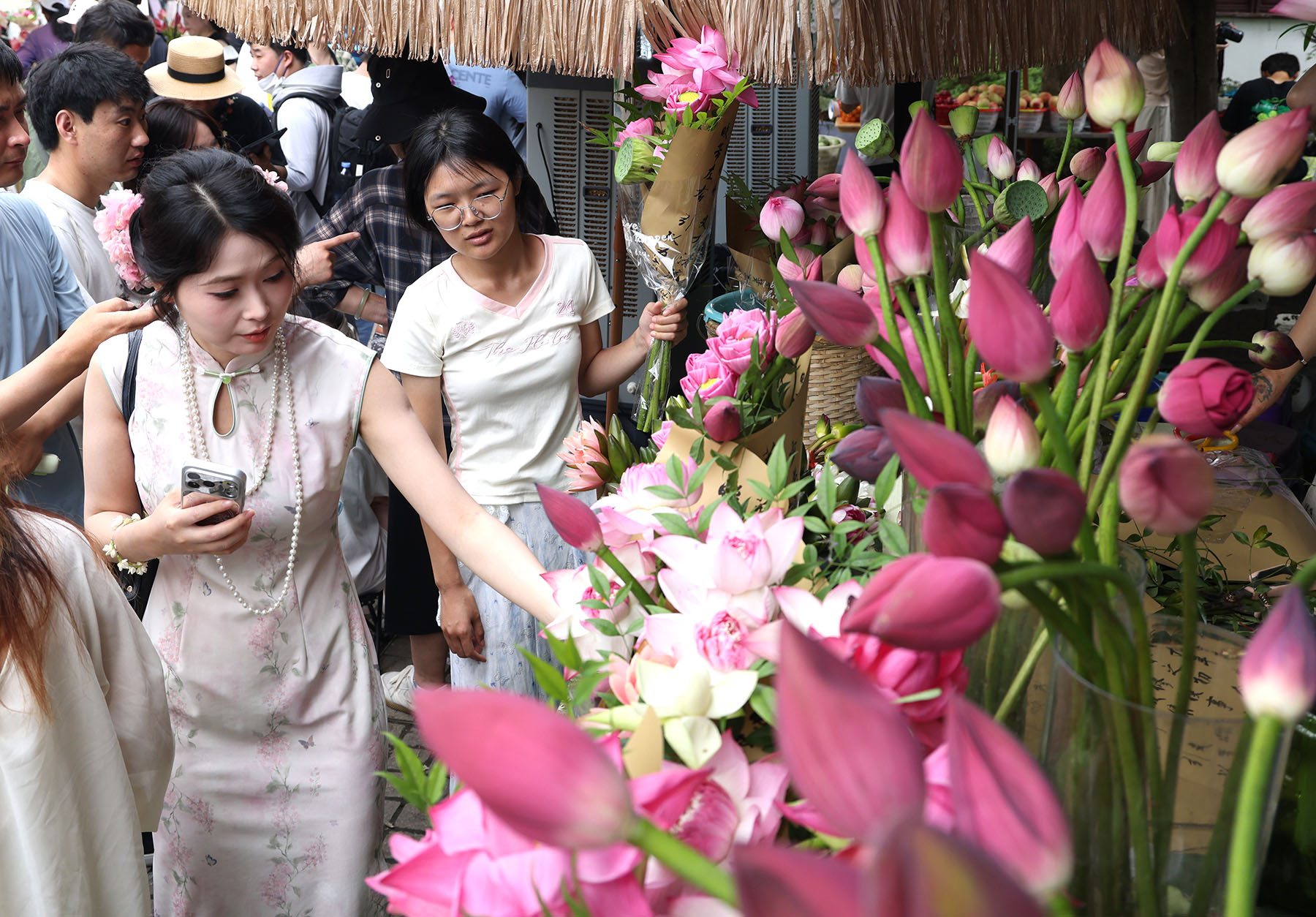
These days, Liu spends many summer weekends with friends or family at the city's lotus markets, which have emerged as a popular seasonal attraction in recent years.
The market on Baita West Road draws the largest crowds.
There, local growers harvest their flowers at night, board free buses before sunrise, and set up stalls by 7 am, offering blooms still wet with morning dew.
In fact, this tradition is deeply rooted in Suzhou's local culture. Wujunzhi, a regional chronicle compiled during the Song Dynasty (960-1279), documents the summer custom of lotus flower fairs.
After several visits to the markets, Liu has watched the vendors' offerings grow increasingly polished — from calligraphy-adorned wrapping paper to vibrant multicolored designs. Outdoor stalls now also feature mist-spraying devices to keep the flowers cool and fresh.
"Suzhou has long been a prosperous region where people have the leisure to discover the subtleties of everyday beauty," she said.
"Whether in garden ponds or in the water vats outside narrow alleyway homes, you see lotus flowers everywhere. This beauty is woven into daily life," Liu said.
Huang Xiayang, a creative planner based in Shanghai, is deeply fascinated by the aesthetic traditions of the Jiangnan region — the area south of the lower Yangtze River — and frequently travels to Suzhou and neighboring Hangzhou, the capital of East China's Zhejiang province.
She considers the lotus market a standout example of cultural tourism done right — rooted in local folk tradition and natural resources, born from farmers' spontaneous gatherings, and quickly boosted by government support.
She has also observed a broader shift: Many people now buy lotus flowers for home decoration over roses or lilies.
Once a niche choice, the lotus has entered everyday life — a sign, she notes, that "the public is more open to traditional culture and Eastern aesthetics than before".
Staying true to principles
In the essay Ode to the Lotus Flower by Song Dynasty philosopher Zhou Dunyi (1017–1073), the bloom symbolizes a person who maintains integrity and purity while navigating a corrupt world — one who stays true to one's principles without currying favor with the powerful.
For Zhang Mengyao, a middle-school encounter with the essay sparked her lasting affection for the flower.
Recently, she drove from Hangzhou to Suzhou to browse a lotus market near the former residence of Tang Yin — better known as Tang Bohu, the famed Ming Dynasty (1368-1644) poet-painter — in search of a parting gift for a friend.
She began the day with a traditional Suzhou breakfast of tea, crab and pork soup dumplings, wontons and steamed rice pastry at a restaurant near the market.
Then she and her friend strolled down a bluestone alley, passed through a creative fair and arrived at the market, where streetlamps were shaped like lotus flowers and lotus motifs adorned the walls.
"Though the market was crowded, it wasn't noisy. People were quietly admiring the flowers and taking photos," Zhang recalled.
"Elderly women by the roadside were selling Yulan magnolia bracelets, whose fragrance mingled beautifully with the subtle scent of lotus."
As rain started falling, she bought a bouquet and asked the vendor for some large lotus leaves, which she and her friend held over their heads as makeshift umbrellas.
"We walked over to Tang Yin's former residence, where there happened to be a small lotus pond. We took some lovely photos there, with the rain and the pond as our backdrop. It felt perfectly fitting."
Later, she found her ideal lotus-themed gift at a Suzhou-style embroidery studio.
"My friend's name contains the characters for 'rain' and 'lotus,'" Zhang explained. "Choosing this gift for her on a rainy day felt so serendipitous."
Contact the writers at xingwen@chinadaily.com.cn
