

Ancient craft passes down generations, avoiding industrial manufacturing thanks to the protectors who continue teaching it, Yang Feiyue reports.
The air in the west wing gallery of Beijing's Prince Kung's Palace Museum carries a scent mixed with aged pear wood, nutty vegetable oil and earthy ink.
Under the soft museum lights, Tai Liping, in his 70s, from the dusty plains of Northwest China, guides a chisel along woodgrain. Curls of lumber fine as ribbon spiral from his blade.
A few meters away, Sun Yibo, 46, from the water-laced city of Suzhou, Jiangsu province, gently lays a sheet of absorbent xuan paper (rice paper from Anhui province) onto a carved plank brushed with vermillion paste.
READ MORE: Woodblock prints add to holiday's traditional flavor
With a seasoned hand, he presses a round palm brush over the surface. Slowly, the fierce visage of a door god — a mythical guardian — emerges onto the page.
Both artists are featured in the ongoing Blessings: Exhibition of Traditional Chinese New Year Paintings Collected by Prince Kung's Palace Museum, which conveys blessings for Spring Festival, running until April 12.
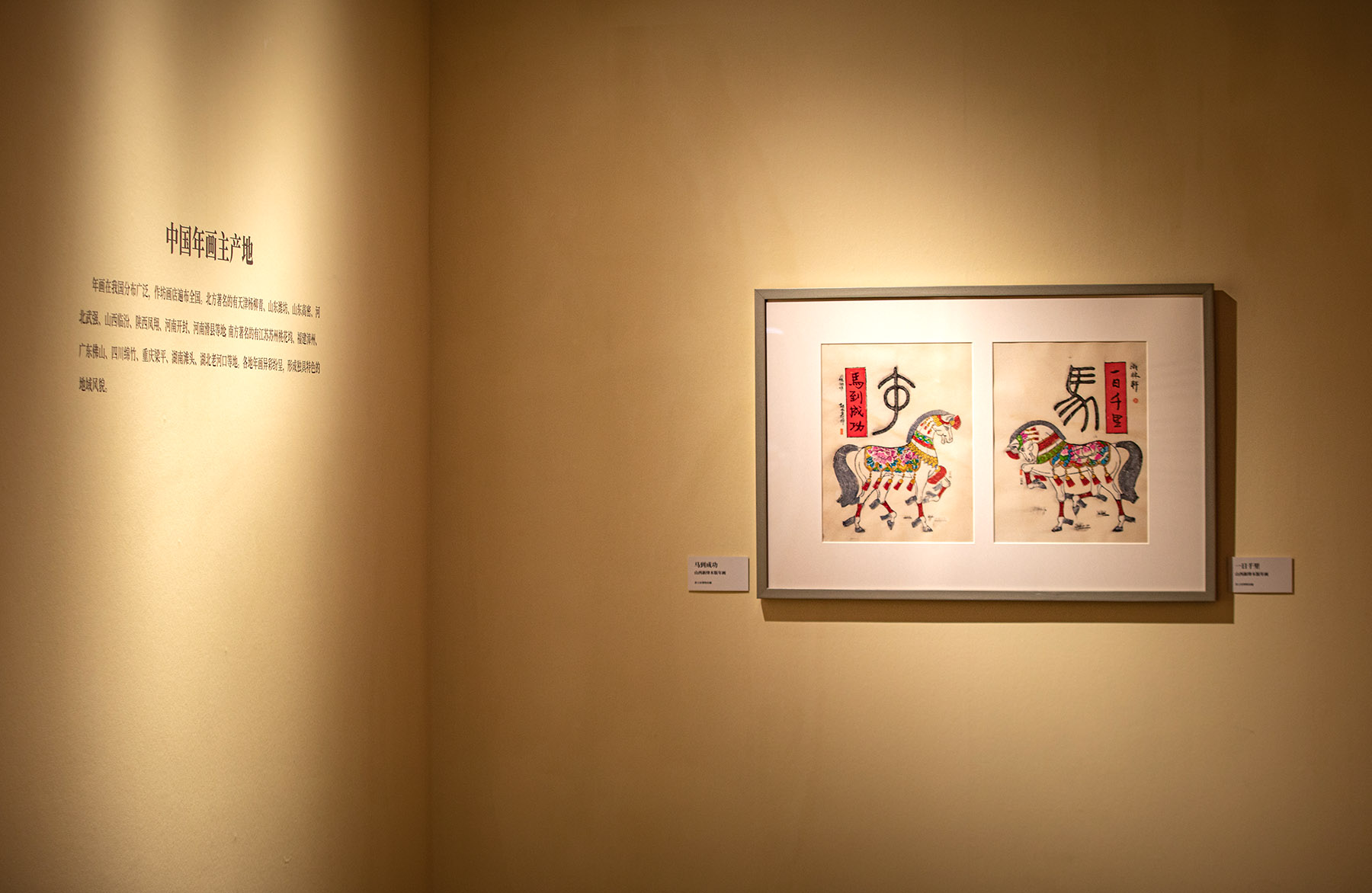
While over 100 framed prints line the walls, vibrant with gods, plump babies and galloping horses, the true protagonists are the worn wooden blocks themselves and the living masters who give them a voice.
Woodblock New Year paintings, known as (muban) nianhua, are more than decoration. For centuries, they have been essential ritual objects for Chinese families during Spring Festival, acting as talismans, storytellers, and embodiments of hope for the coming year.
The technology behind ancient woodblock printing is one of China's seminal inventions. Before its advent, such images had to be painted individually, making them costly. The wooden block was a revolutionary force in mass communication and folk art.
A master carver transfers a drawn design onto a smooth, seasoned plank, traditionally pear wood for its fine, durable grain. Then, using chisels and knives, they meticulously carve away the negative space, leaving the design's lines raised. This becomes the "line block".
For multicolored prints, a separate block is carved for each color. Once complete, a single block can yield thousands of identical impressions, carrying blessings from artisan workshops into millions of humble homes.
The ancient art, with its unique charm, has survived the test of time and avoided modern technological development.
"A machine-cut line is dead. A hand-carved line has qi, or vital energy and spirit," Sun explains.
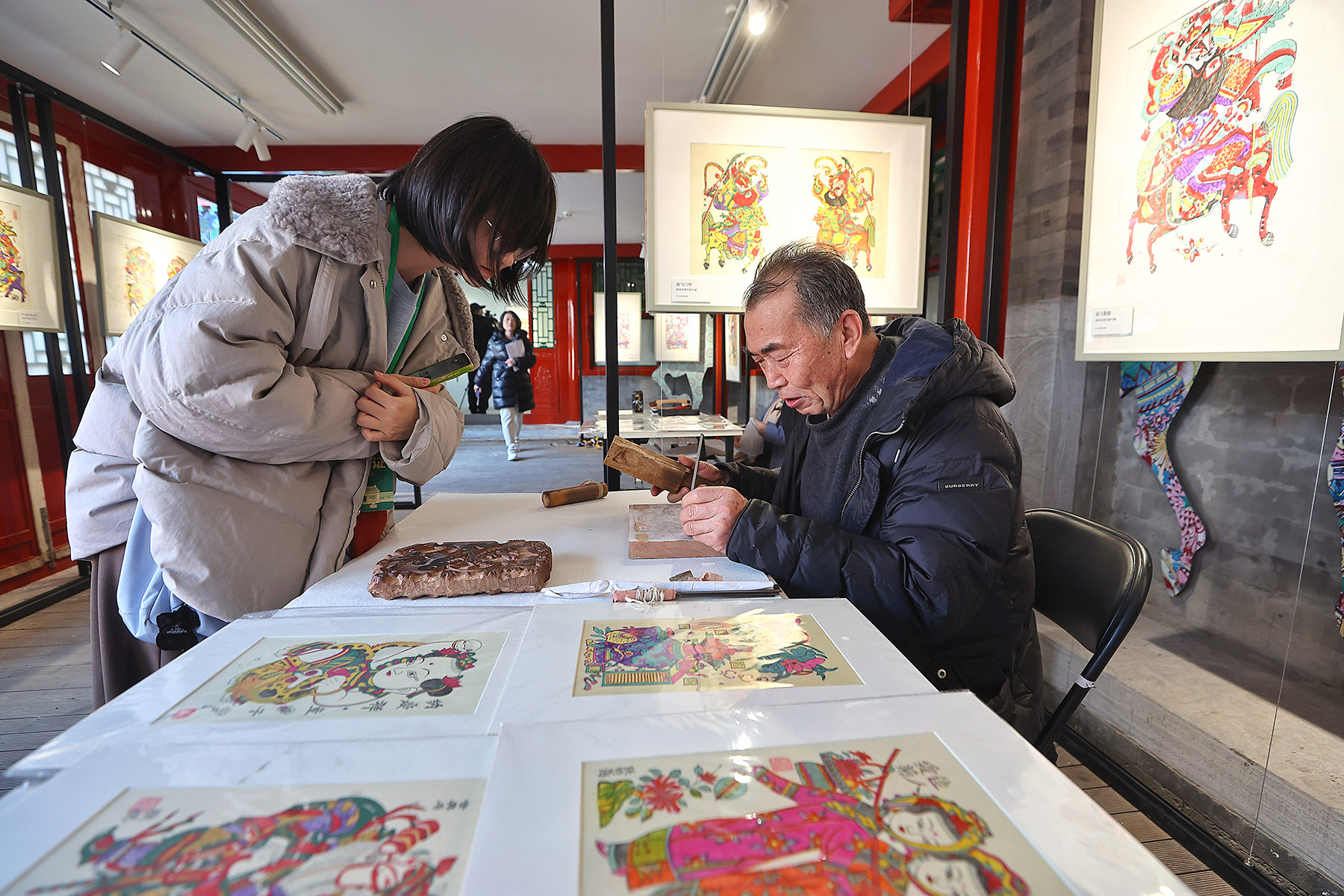
The resistance of the wood, the artisan's breath and pressure, and the slight variations in each cut — all these imperfections imbue the final print with a life that industrial perfection cannot replicate, Sun points out.
In the gallery, Tai works on a block destined to become part of a Six Household Deities series. His style is bold, rustic, and explosively colorful, unmistakably Fengxiang style, from Shaanxi province.
"In the old days, a complete household needed six guardians," Tai says.
He lists them like old friends: the Door God for the gate; Earth God inside the courtyard; Kitchen God above the stove; Granary God for the harvest; Horse God for the stable; and Dragon King for the well.
"To have all six posted was essential, even for the poorest family," he notes.
His connection to this craft is ancestral. The Tai family genealogy records woodblock printing since the Tang Dynasty (618-907).
By his grandfather's time, their workshop housed over 690 sets of woodblocks and produced a staggering 6 million prints a year, shipped by merchant networks across Northwest China.
"My mission is to recover what was lost," Tai says.
He estimates that over a thousand traditional Fengxiang designs existed before the social upheavals of the mid-20th century, and only a fraction survived. For 40 years, his life's work has been to restore these lost templates through research, interviews with elders, and painstaking recarving.
The pear wood must be air-dried for three years. Before carving, the block is soaked in rapeseed oil to soften the fibers, Tai says.
The carving sequence is rigidly prescribed — the head before the body; the inner lines then the outer lines; and horizontal cuts first to break the grain, then vertical cuts.
Printing is another marathon: the line is block-printed first, then each color block aligned and applied separately.
"Each layer must dry to precisely 80 percent before the next is added. A complex piece can take weeks," Tai explains.
If Tai's Fengxiang style is a robust folk ballad, then Sun's Taohuawu prints from Suzhou are a refined classical sonnet.
Historically, Taohuawu and northern Tianjin's Yangliuqing were known as two dominant, commercially prolific centers. Suzhou, a canal-laced city long famed for birthing scholars, painters, and silk, lent its unique aesthetic to its New Year paintings featuring elegant lines, nuanced colors, and literate themes.
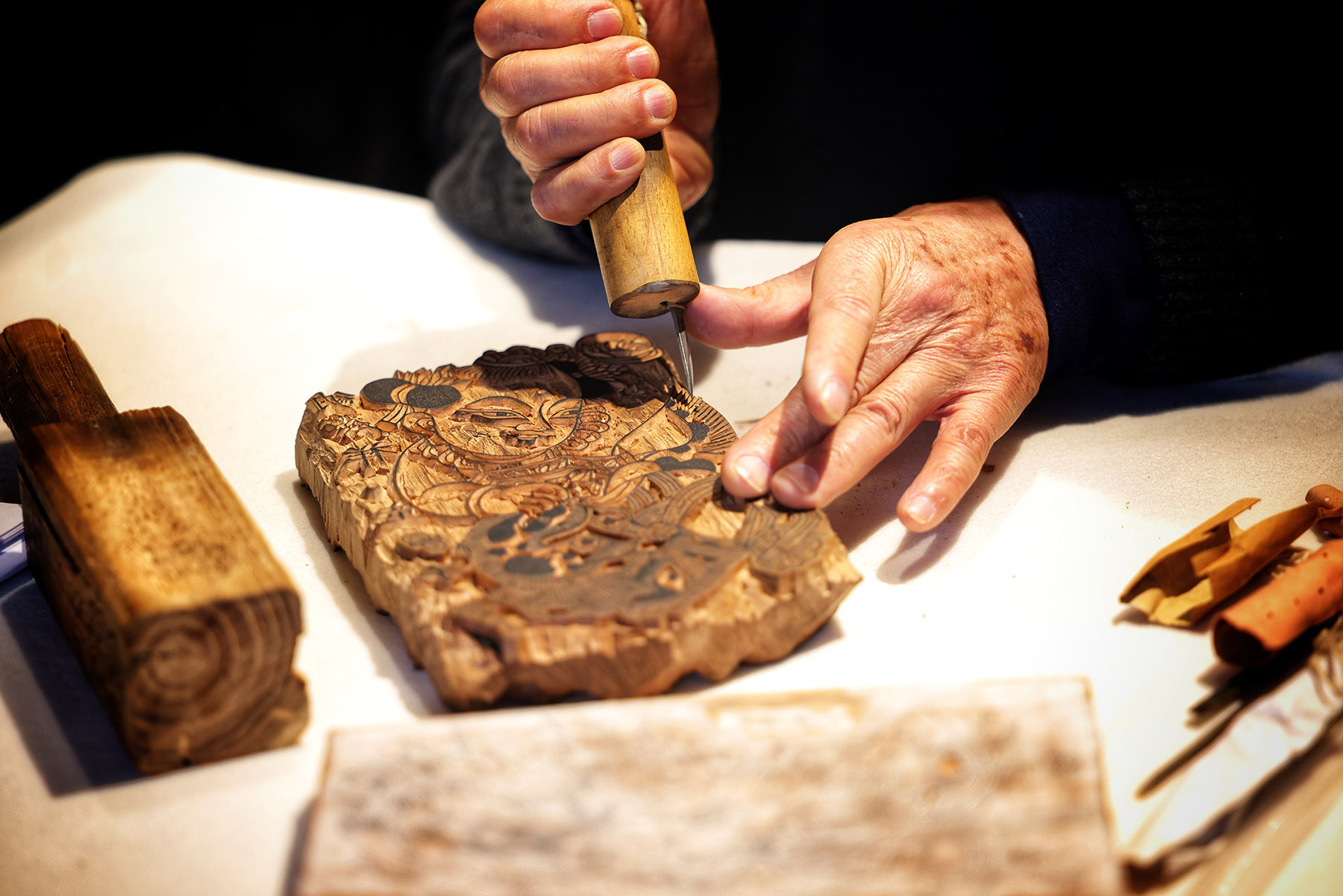
A defining technique of Suzhou carving lies in a web of hair-thin intersecting lines.
"Where lines cross, the knife doesn't stop or turn. It must pass through the intersection in one fluid motion," he explains. The result is flawless continuity and, crucially, a microscopic gap at the crossing.
"This gap allows ink to flow during printing, preventing ugly blotches. A machine laser's cut follows the vector path, and can't replicate this human intuition," he adds.
To date, Sun has maintained classic symbolic elements in his works, such as peonies for wealth, bats for good fortune, and pomegranates for many children.
Yet he actively pursues innovation and has collaborated with video game giants such as Tencent, creating woodblock art for games. These designs are digitalized, becoming part of game worlds where players might quiz non-player characters about the lore behind the paintings.
"I tell my students first to use this ancient skill to carve what you love, be it anime characters or game heroes," Sun says. "Master the technique through passion. Then you'll understand its power and can circle back to the tradition."
This philosophy ensures that the craft's survival becomes a living, evolving conversation.
The exhibition's curator, Xu Chen, has orchestrated this dialogue between past and present, and north and south in the displays, aiming to introduce audiences to an ecosystem where the art is made, not just shown.
Visitors to the exhibition first step into the world of Auspicious Arrivals at the Door, which chronicles the evolution of door gods. From the ancient mythical guardians to the vastly popular Tang Dynasty generals, these protectors transformed over centuries from fierce exorcists into benevolent bringers of blessings.
A standout piece is a rare single-door guardian in the form of a majestic equestrian figure of Lord Guan (a deified general and god of wealth), which was reproduced from a lost Qing Dynasty (1644-1911) woodblock.
"It's perfectly suited for modern apartment doors," Xu notes.
Moving into the Welcoming Fortune and Happiness section, visitors are surrounded by visual puns. A chubby baby holds a carp (yu), a homophone for "abundance". A child rides a tiger (hu), echoing the sound for "blessing" (fu).
"This was how folk wisdom and wishes were encoded and passed down through generations," Xu explains.
The Operas Transformed into Painting section reveals nianhua's role as pre-modern home entertainment. These prints captured climactic scenes from popular operas, often arranged in a series like a storyboard and pasted around the family kang (heated brick bed) to narrate tales of loyalty, love and adventure.
Finally, the Seasonal Scenes and Objects area grounds the art in the rhythms of agrarian life. The Spring Ox print marked the solar term Start of Spring (li chun), urging farmers to till the land. The Nine-Nine Cold Dispelling Chart served as a ritualized countdown to spring. These prints functioned as a household's almanac, aligning daily life with the cycles of nature.
ALSO READ: Auspicious prints to greet our future
The exhibition coincides with 2026, the Year of the Horse, and features equestrian elements, notes Chen Xiaowen, deputy director of museum.
The horse's symbolic charge through Chinese culture has enamored the Chinese people as "it stands for vigor, perseverance, and success", Chen says.
The exhibition harnesses this energy by curating a galloping array of "equestrian" nianhua, tying the ancient art to the perennial zodiac cycle and making historical blessings feel immediately personal, he adds.
In a world of fleeting digital pixels, the physicality of nianhua is its power. It is art people can smell, feel, and watch as it is born from material and muscle memory. It reminds people that some of humanity's most profound hopes are still entrusted to seasoned wood and patient, skilled hands.
Contact the writer at yangfeiyue@chinadaily.com.cn]
