

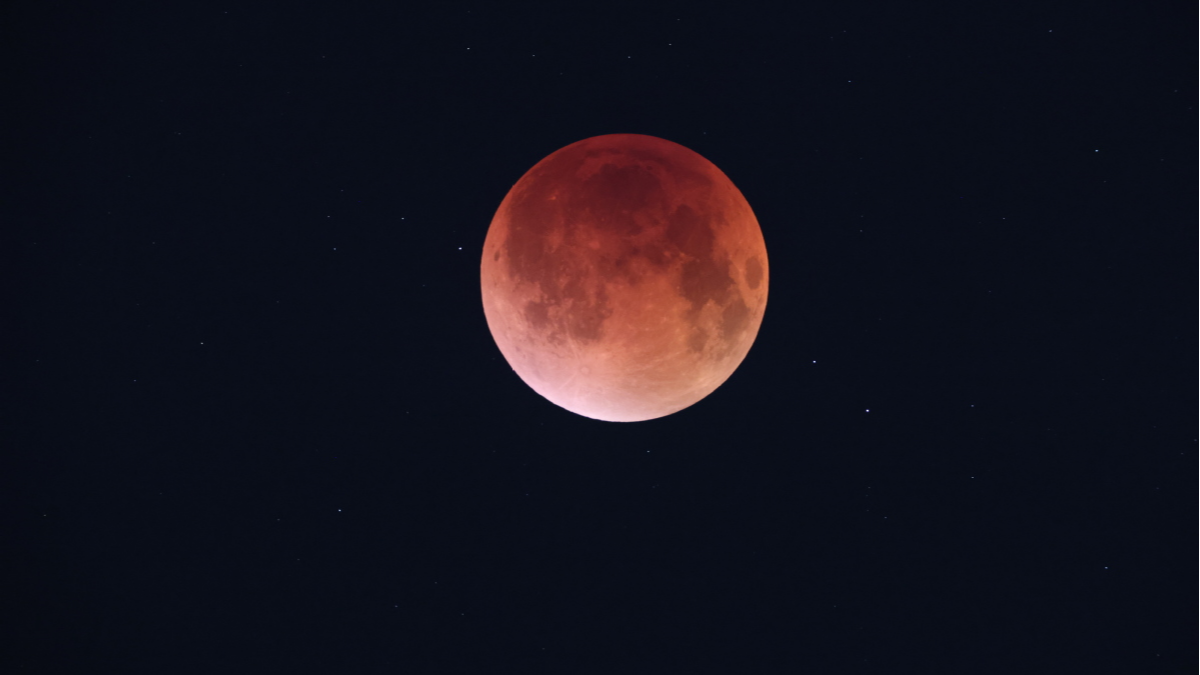
Some parts of China are expected to see this year's first "blood moon" around 7 pm on Tuesday, coinciding with this year's traditional Lantern Festival.
A lunar eclipse occurs when the Earth positions itself between the sun and the moon, causing the moon to move into Earth's shadow. As the moon gradually enters Earth's umbra, it darkens and may take on a reddish or orangish hue, known as a "blood moon", due to Earth's atmosphere refracting longer-wavelength red light onto its surface, said Tang Haiming, secretary-general of the Shanghai Astronomical Society.
"Because Earth's umbra is much larger than the moon's shadow, this total lunar eclipse — unlike total solar eclipses which last only a few minutes — will last nearly an hour from 7:04 pm to 8:03 pm on Tuesday," said Tang, noting that it is a rare coincidence for a total lunar eclipse to coincide with traditional festivals like the Lantern Festival.
READ MORE: It's lantern festival — time to have a ball
"The observable area for this lunar eclipse is quite extensive. The entire East Asian region, including China, Japan, as well as other parts of the globe like Australia, New Zealand, and New Guinea, will be able to witness the full event," he said, adding that the timing is advantageous, as the moon enters Earth's shadow at moonrise, favorable for photography enthusiasts to capture stunning images with terrestrial landscapes.
Tang mentioned that the best observation spots in China include Taiwan, Heilongjiang, Liaoning, Jilin, Shandong, Jiangsu, and Shanghai. People in Central China might also be able to see the "blood moon". However, cloudy and rainy weather could affect visibility.
READ MORE: Modern lights for cherished tradition
The next lunar eclipse is expected in August this year, observable in South and North America. However, people in China will have to wait until Jan 1, 2029, to see another "blood moon", he said.
