

Exhibition reveals a fusion saga in white porcelain, where nomadic and agrarian cultures shaped each other across dynasties, report Yang Feiyue and Zhu Xingxin in Taiyuan.
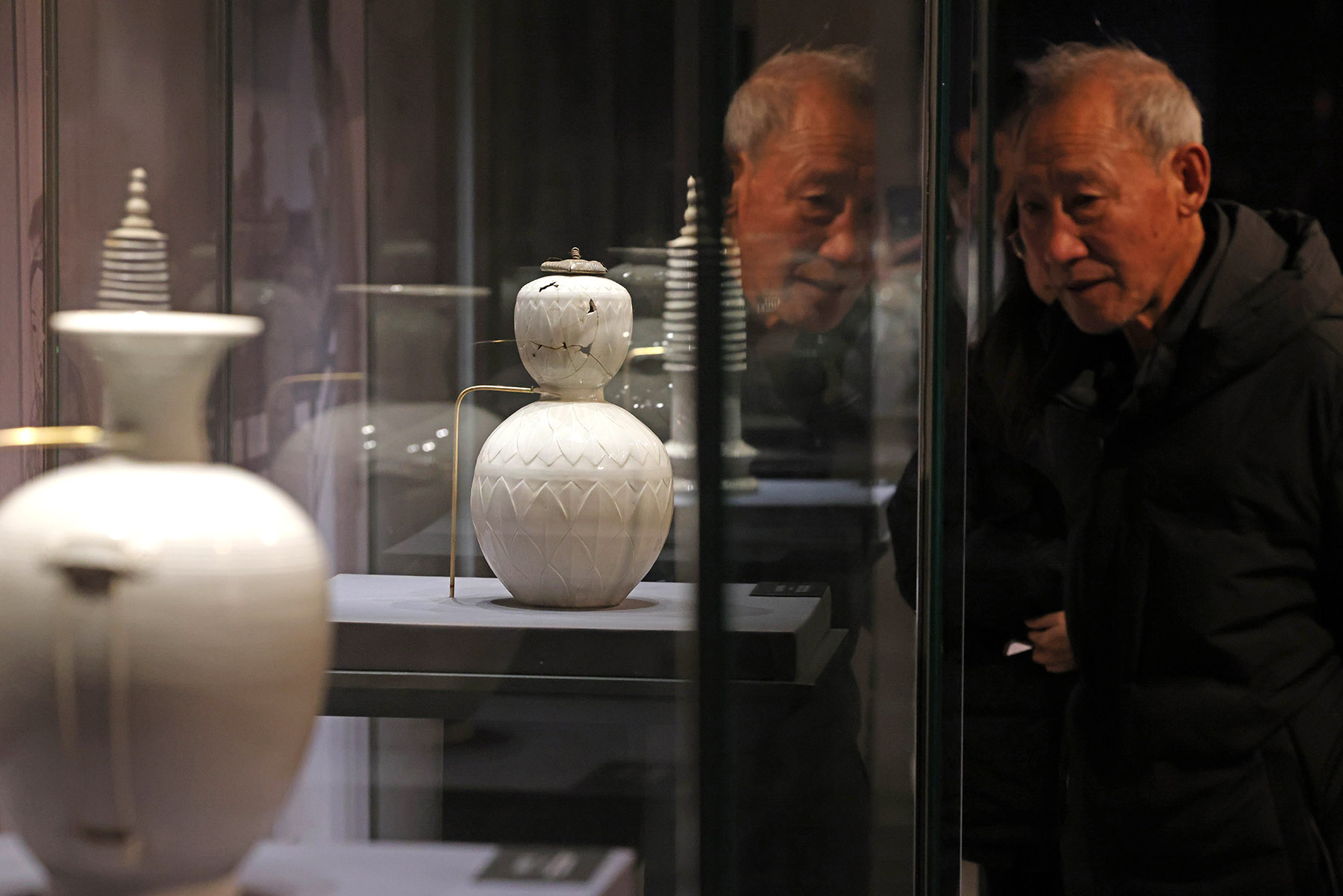
In the hushed light of the Shanxi Museum's special exhibition hall, a single artifact from the Liao Dynasty (916–1125) poses a silent, profound riddle.
It is a pi'nang hu (leather-bag-shaped pot) — a white porcelain vessel of flawless craftsmanship, its surface smooth as polished jade, its silhouette an unmistakable replica of a nomadic leather flask.
Every functional and decorative detail is meticulously rendered in clay: the raised ridges imitating stitched seams, loops suggesting carrying a cord, even the supple, bulging curvature of a hide bag designed to hold liquid.
Yet, beneath this visual mimicry lies a material truth that confounds the eye: to the touch, it is uncompromisingly ceramic — cool, hard, and resonant with the fired permanence of the Central Plains kiln.
READ MORE: Delicate wares exhibit county's resilience
This object is a paradox in porcelain. Is it a Khitan nomadic tribe leather flask frozen in time, or a Central Plains potter's ingenious tribute? This captivating dissonance lies at the heart of the ongoing exhibition, Northern White Porcelain: White Porcelain and Ethnic Fusion, in Taiyuan, Shanxi province.
By bringing together over 200 objects from 14 institutions across China, the exhibition, on display until May 5, uses these silent witnesses not merely to chart stylistic change, but to investigate a central, dynamic engine of Chinese history: How did this most demanding type of art become one of its most potent mediums for continuous ethnic and cultural synthesis?
"The birth of white porcelain itself is a result of ethnic fusion and technological innovation," says Zhao Fanqi, the exhibition's curator.
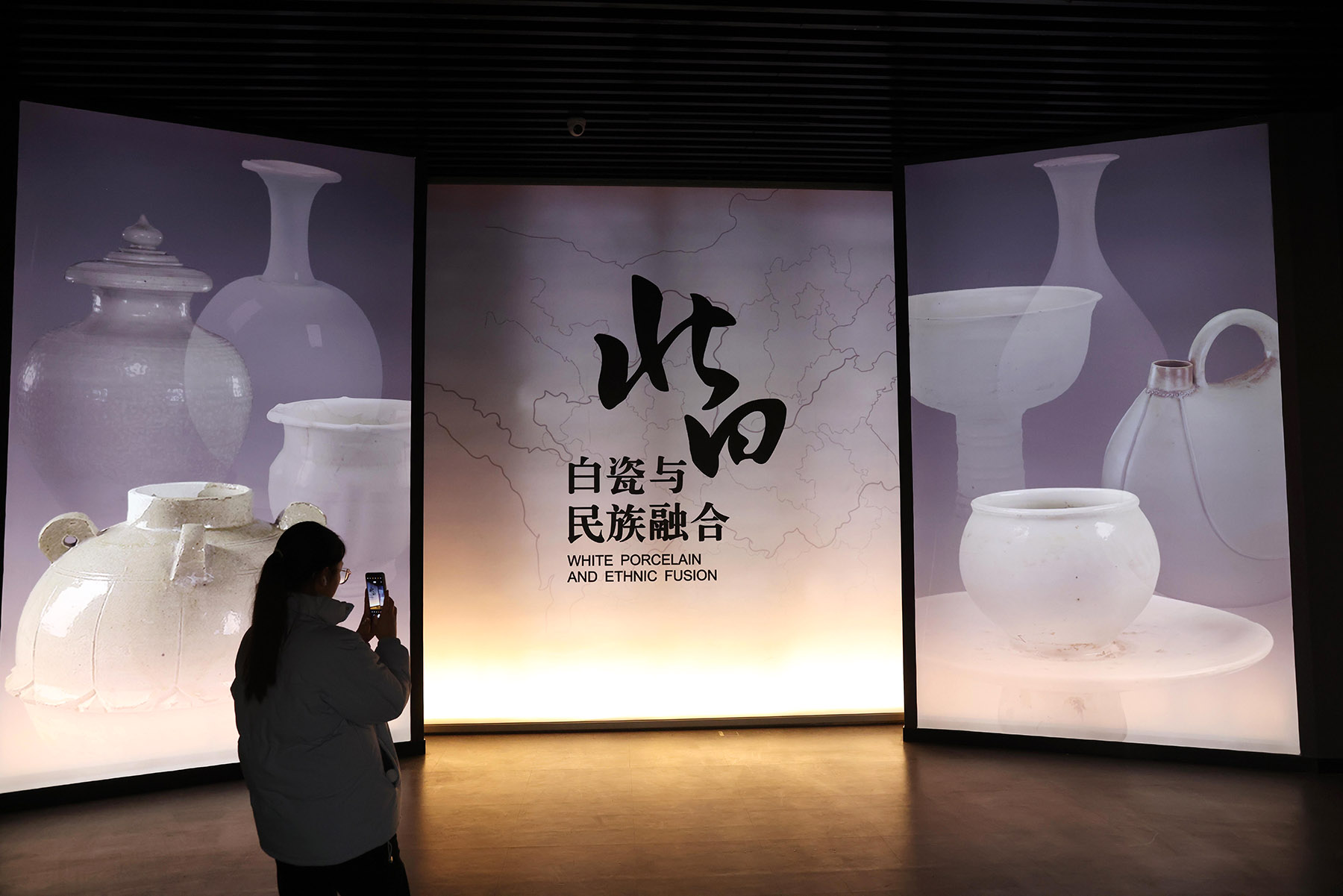
To understand white porcelain's role as a fusion medium, one must first recognize its own hybrid genesis. Its emergence was not an isolated northern breakthrough but a direct product of the great upheavals and population movements over the long course of history.
"White porcelain germinated under the macro-background of the great ethnic fusion," Zhao explains.
"It amalgamated the porcelain-making techniques of the south, the clay resources and the social aesthetics of the north, while absorbing some foreign cultural elements along the way," he adds.
Before this synthesis, northern ceramic production, exemplified by early celadon, largely followed southern blueprints.
"The north initially produced celadon, which largely represented a continuation of southern traditions," Zhao notes.
The quest for white required a radical technological departure: a relentless campaign to purify the local clay and glaze, meticulously controlling the iron content to below 1 percent through a painstaking process of trial and error in northern kilns like those in Hebei and Henan provinces.
The triumph of this struggle is showcased in a humble yet breathtaking exhibit: a shard of Sui Dynasty's (581-618) translucent white porcelain.
The porcelain body is so exquisitely thin it appears semi-translucent, the glaze luminous and creamy, almost ethereal.
"The emergence of white porcelain was epoch-making in the history of Chinese ceramics," states Zhao Zhiming, deputy director of the Shanxi Museum.
"It immensely enriched Chinese porcelain varieties, ended celadon's dominance, and initiated the new kiln pattern of 'southern celadon, northern white porcelain'."
The exhibition's true power lies in moving beyond a simple chronology to reveal the distinct patterns of fusion that played out across different political and cultural landscapes.
A Tang Dynasty (618-907) white porcelain molded-flattened flask perfectly illustrates the confident, synthetic spirit of the Tang Dynasty, when white porcelain ascended to luxury status, becoming a "lingua franca" among elites across Eurasia.
Its flattened body and rounded contours borrow directly from the leather flasks used by nomadic people for transport on horseback.
The piece was likely custom-made for high-ranking nobility within the Central Plains, Zhao Fanqi points out.
It absorbed the vessel forms of nomadic people and the decorative elements of foreign cultures, such as the honeysuckle (rendong) pattern on its belly, he adds.
During the era of concurrent dynasties, such as Song (960-1279),Liao, and Xixia (1038-1227), political borders hardened, but cultural currents grew more intricate.
Rival courts shared an unexpected reverence for white.
"Various dynasties at that time held a kind of reverence for the color white… They aesthetically accepted it, and therefore, continuously developed resources," Zhao Fanqi notes.
Within this shared idiom, different peoples performed distinct acts of cultural translation.
The Liao Dynasty white porcelain leather-bag-shaped vessel from the opening is the quintessential example. The Khitan nomadic ethnic tribe nobility deliberately chose the most iconic vessel of their nomadic lifestyle but recreated it in the most prestigious medium available: high-fired white porcelain.
"The pi'nang hu… closely resembles the traditional leather containers of the Khitan people… and later evolved into the common chicken-crested pot (jiguan hu) of the Khitan people," Zhao Fanqi interprets.
"This reflects how the Khitan people absorbed Central Plains culture and carried it forward."
Simultaneously, the Xixia Dynasty pursued fusion at a more fundamental, industrial level.
A Xixia Dynasty white porcelain dish-mouthed vase from the Suyukou kiln site in northwestern Ningxia Hui autonomous region exhibits a serene, even glaze. Excavations there revealed a startling technological transfer.
"Some saggers unearthed at the kiln site were sealed with porcelain glaze, a technique found only at Shanglin Lake (a southern celadon center) in Zhejiang province," Zhao Fanqi reveals.
"It suggests southern technology, and even southern craftsmen, directly coming to Suyukou for kiln production."
The Yuan Dynasty (1271-1368) created a contiguous time of unprecedented scale, forcibly mingling peoples, goods, and ideas.
This catalyzed the final, mature phase of fusion, where synthesis became systemic.
The Huozhou kiln in Shanxi province, operating under the Yuan artisan household system, achieved a technical pinnacle with its "fine spur-mark" firing, producing porcelain of impeccable, uniform whiteness.
This technical mastery served a newly unified market. The Huozhou kiln used the same sublime clay and glaze to produce two seemingly opposite vessel types side-by-side: the scholarly, elegant Yuan Dynasty yuhuchun vase (a slender vessel for display and poetic inspiration), beloved by Han literati, and the pragmatic pan'er bei (cup with a loop handle) rooted in nomadic utility.
The latter is a hybrid in form.
"Its cup body is a multiethnic traditional form… but at the rim, a crescent-moon-shaped handle was added," describes Zhao Fanqi.
"This vessel type is essentially the traditional Central Plains form, augmented with the nomadic loop handle, creating a new form. It reflects the Huozhou kiln's absorption of grassland culture."
Walking through the exhibition, one gradually discerns a grand pattern emerging from the individual cases.
"The greatest distinction between white porcelain and other vessel types is precisely its connection to ethnic fusion," Zhao Fanqi reflects.
ALSO READ: The deceptive beauty of ceramic artistry
The exhibition aims to offer a narrative that reveals a grand, coherent pattern rather than a series of isolated incidents.
"If we regard each piece of porcelain with fused elements as a material 'fossil' of a 'fusion event', then this exhibition strings together countless such events," Zhao Fanqi explains.
White porcelain of the Sui and Tang dynasties provided the model for the Liao, Xixia and Jin (1115-1234) dynasties, while their innovations, in turn, prepared the essential elements for the extensive fusion seen in the Yuan, he adds.
Experts agree that white porcelain is the fruit of technological exchange, a vessel for aesthetic dialogue, a medium for negotiating identity, and an embodiment of political wisdom.
It demonstrates that the grand construction of the Chinese national community is not an abstract concept, but a civilizational marvel — layer upon layer, built over long centuries through countless concrete, solid, and luminous "fusion events", much like the porcelain itself.
Contact the writers at yangfeiyue@chinadaily.com.cn
