

Returning to my father's home province, I discover a Shanxi shaped by both ancient traditions and modern innovation.
Long before I knew Shanxi for its ancient temples, grottoes or walled cities, I knew it as the place my father came from.
My Chinese father was born there and spent his childhood in Jincheng, a prefecture-level city in southeastern Shanxi. When I was in elementary school, I occasionally visited my dad's hometown village, though my memories of those trips are now fuzzy.
Years had passed since my last visit, and beyond those childhood trips, I knew surprisingly little about the province. Returning to Shanxi this time, I was not simply going back to a familiar place. I was seeing it with new eyes.
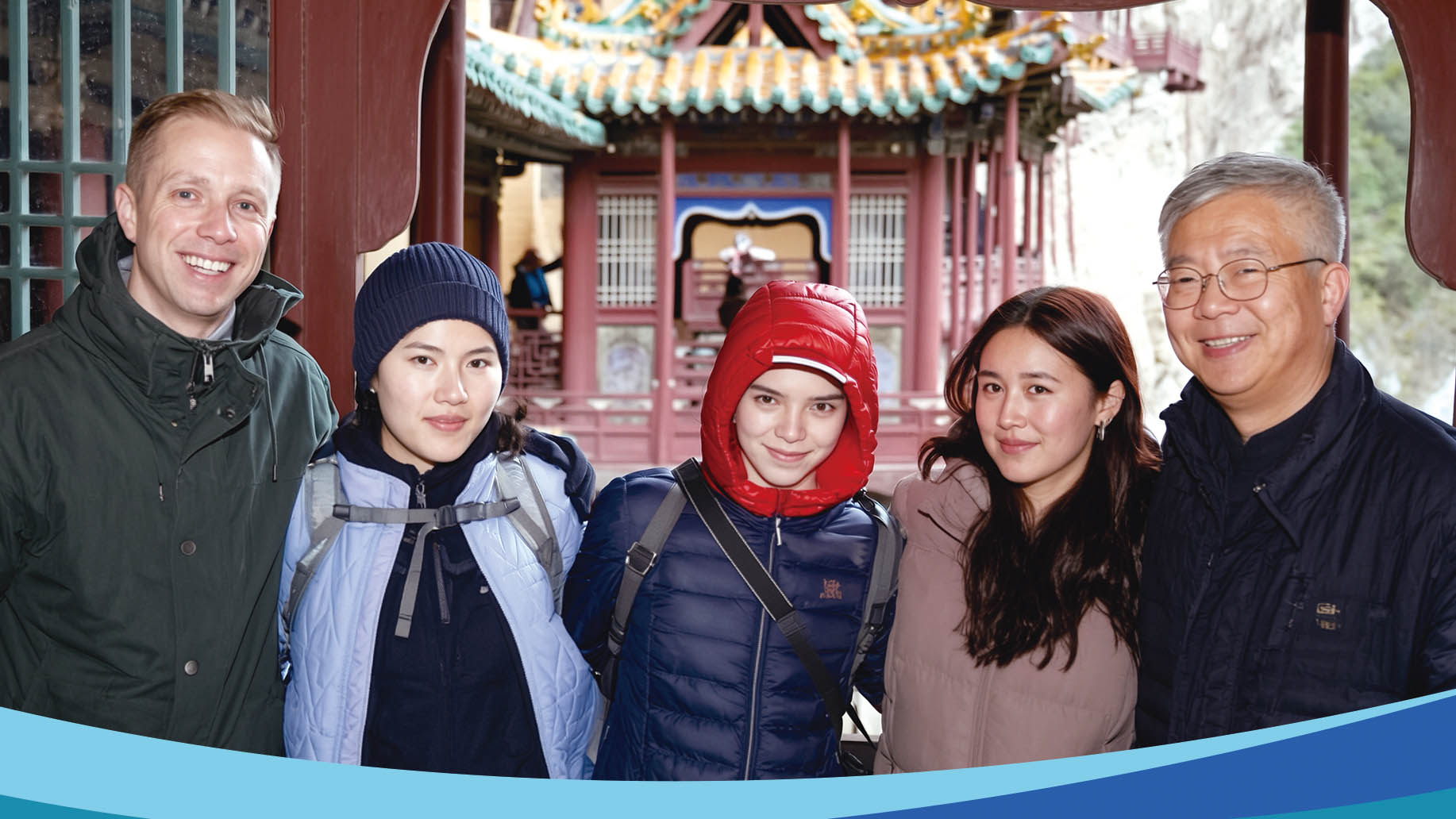
I was traveling with a group of students taking Chinese, history and music classes at George School in Pennsylvania, the United States, as part of a three-week trip through China. The five days in Shanxi focused on language immersion, intangible cultural heritage preservation, and the province's history and culture.
That new perspective began almost immediately. Just hours after our three-hour flight from Shanghai landed in Datong, our group was on the way to our first stop: the Hanging Temple. Stepping out of the airport, I felt the cold air of northern China, a sharp contrast to Shanghai's sticky humidity. Soon, as we drove toward the temple, the city gave way to mountains.
When we arrived, we saw the peaks of Hengshan Mountain stretching around us and rising into the sky. Further ahead, the Hanging Temple came into view: a complex of buildings constructed on a cliff tens of meters above the ground, topped with colorful, ornate tiles and traditional Chinese design elements. The buildings were propped up by thin wooden beams, giving them that iconic "hanging" look.
Walking along the elevated structure, sensing the mountain wind in my hair, and taking in the breathtaking scenery left me in awe. As I leaned on the railing and looked out, I noticed a mountain adjacent to the cliff. In red strokes, three massive Chinese characters were inscribed on it — fo, he and chan — Buddha, harmony and Zen.
The moment shifted my attention from the temple's architecture and scenery to its cultural and religious significance.
Our tour guide explained that the temple has stood for more than 1,500 years and is China's only existing temple that integrates three major Chinese philosophical and religious traditions: Buddhism, Taoism, and Confucianism. Throughout the temple, we saw statues of Buddhist, Taoist, and Confucian figures housed side by side.
Together, these elements gave me a way to think about spiritual coexistence that I had not considered before.

In a world where different religions can often seem isolated or divided from one another, this temple recognized the individual values of each belief, yet brought them together in harmony, ultimately representing a beautiful balance within China's spiritual landscape.
Over the next several days, our itinerary took us from the Yungang Grottoes to Pingyao Ancient City and Liujiabao village. Exchanges in Datong and Taiyuan also gave us opportunities to spend time with local university students.
Compared with the brief hometown visits of my childhood, I was beginning to see Shanxi not as a single place connected to my family, but as a province with layers of history and contemporary life.
In Taiyuan, we visited the Chunyang Palace for a showcase on the role of technology and 3D scanning and printing in preserving historical buildings.
A historical preservation expert presented a scanning device positioned in front of a wooden replica of an ancient building, explaining that it could create a digital model of the building.
He clicked a button on its screen, and the device began rotating and scanning the building. A few moments later, he transferred the data to his computer. When he revealed the finished 3D model on the screen, we were amazed by the result.
The machine recorded remarkably fine details of the environment and building, down to each tile, brick, and ornate design element. Because the model was 3D, the expert could rotate it and examine the structure from every angle.
The precision and comprehensiveness of the scan surprised me, especially since all it took was the press of a button and a few moments.
The expert also explained some practical applications of this technology. For instance, digital models of historical structures can help specialists reproduce specific parts through 3D printing to replace or restore damaged areas.
Once scanned, historical sites can also be recreated digitally for media, including video games.
One example he discussed was Black Myth: Wukong, a Chinese role-playing game that incorporates ancient Chinese architecture into its digital world. Of 36 identified real-world locations used as references for the game, 27 are in Shanxi, making the province a major source of its architectural imagery.
By highlighting history in popular culture and media, its relevance can be maintained even across generations.
The integration of ancient architecture and modern approaches challenged an assumption I had about the relationship between history and modernization. Rather than seeing new technology as something separate from the preservation of old buildings, I watched it being used to record and help restore them. I began to see that technological change and historical preservation do not necessarily have to work against each other. New tools can also provide ways of carrying the past into the future.
For years, Shanxi was little more than a collection of childhood memories. This trip allowed me to discover a fuller picture of Shanxi. What once felt like a distant part of my identity now feels more tangible, grounded in places I have seen, histories I have learned, and perspectives I had not considered before.
I arrived in Shanxi knowing it as my father's home. I left beginning to understand how it could be part of my own story, too.
Written by Emma Wey, 16, an 11th-grade student at George School in Pennsylvania, the United States, and Yang Yicheng, a teacher at George School.
