

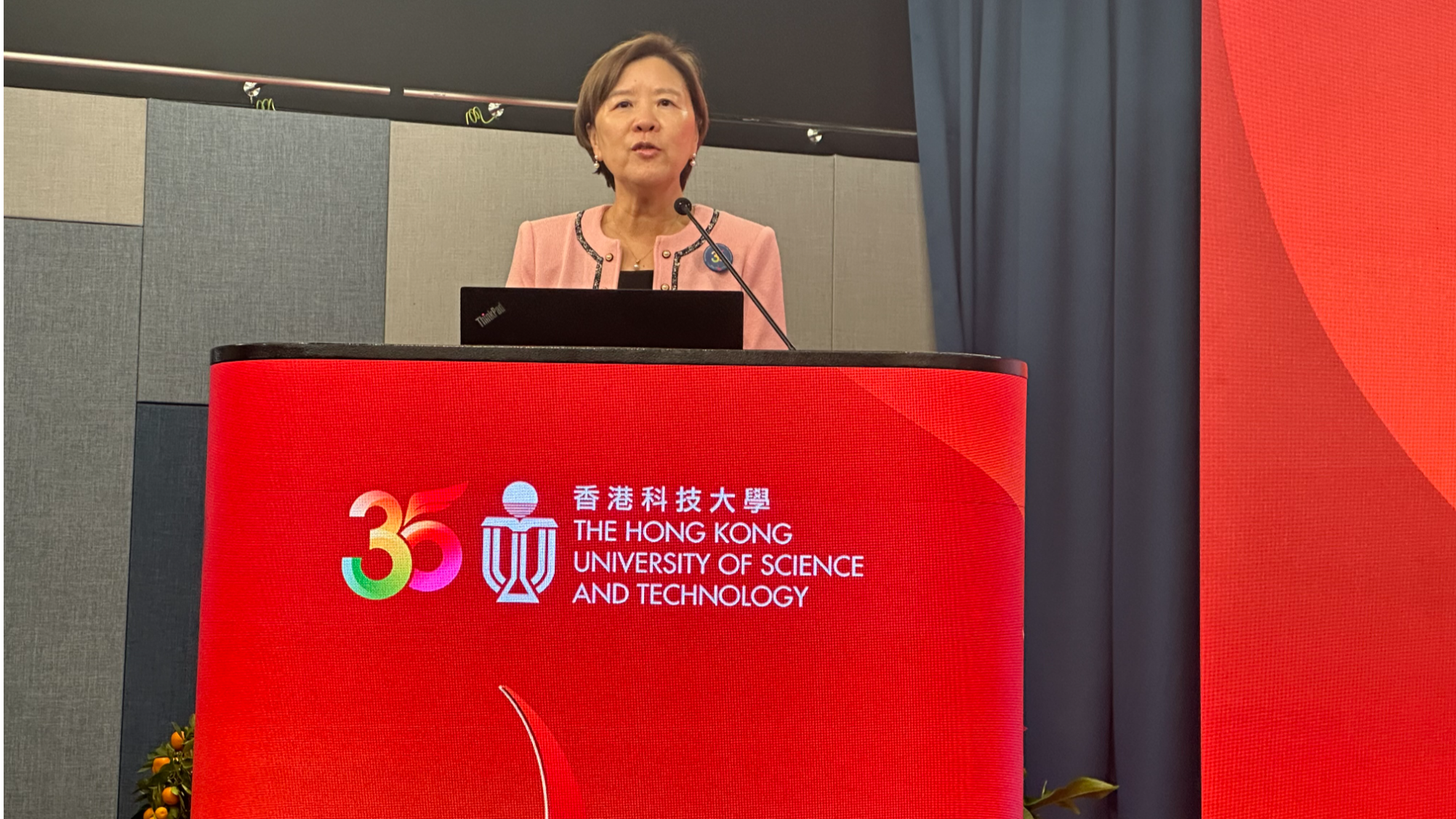
The primary facility for the city’s third medical school was topped out last week, and the school is making “good progress” in terms of infrastructure planning, curriculum development, faculty recruitment and partnerships, President of the Hong Kong University of Science and Technology Nancy Ip Yuk-yu said on Wednesday.
The Medical Education and Research Complex, on a 6,000-square-meter site in the southern part of HKUST’s Clear Water Bay campus, is scheduled to be completed in mid-2028 and will be the institution’s largest single building once operational, Founding Dean of the School of Medicine Li King-chuen said.
The special administrative region government gave HKUST approval last November to set up Hong Kong’s third medical school, joining the University of Hong Kong’s Li Ka Shing Faculty of Medicine and the Chinese University of Hong Kong’s Faculty of Medicine.
The school plans to take in its first batch of 50 medical students in the 2028-29 academic year. Applications are expected to open next year.
Ip said the university had entered “a new phase” in developing its medical school.
RELATED ARTICLES:
- HKUST unveils world’s first zero-degradation cooling device
- HKUST’s medical school dean vows to contribute to GBA and nation
- Chan: HKUST medical school to put city at forefront of innovation
- Lee: HK’s third medical school to nurture new generation of doctors
- How will HK benefit from the third medical school?
- HKUST sets to fast-track establishment of third medical school
Infrastructure work progressed with the topping-out of the Medical Education and Research Complex on Oct 20, less than six months after its April 28 groundbreaking ceremony.
“Progress has been very fast,” said Li. The building will house a clinical skills and simulation training center, research laboratories, a medical library, small-group seminar rooms and teaching laboratories, and will have a rooftop drone landing pad to improve transport connections, he added.
Ip said efforts to recruit faculty are progressing “very smoothly”.
“This not only reflects the medical school’s global appeal but also shows that the international academic and medical communities are very confident about Hong Kong’s prospects for medical innovation,” she said.
She added that the medical school would continue looking for top-caliber talent around the world and that recruitment was open and rigorous.
At least 19 people had been confirmed on the school’s staff list as of Wednesday afternoon. They included Ip, who specializes in molecular neuroscience; Anskar Leung Yu-hung, former vice-dean for human capital at HKU’s medical faculty and a chair professor of hematology; and globally leading scholars Jeremy Kirk Nicholson and Elaine Holmes.
Nicholson, whose research includes metabolic phenotyping, has been cited more than 101,000 times and has an h-index of 151, according to HKUST’s website and the Scopus database. The index measures research productivity and citation impact. Holmes, who focuses on medical biochemistry, metabolomics and analytical chemistry, has 77,000 citations and an h-index of 134.
“Building HKUST’s medical school from scratch is a once-in-a-lifetime opportunity,” Leung told reporters. “I share its vision and want to contribute my experience, above all to help train the next generation of healthcare professionals.”
Contact the writers at wanqing@chinadailyhk.com
