

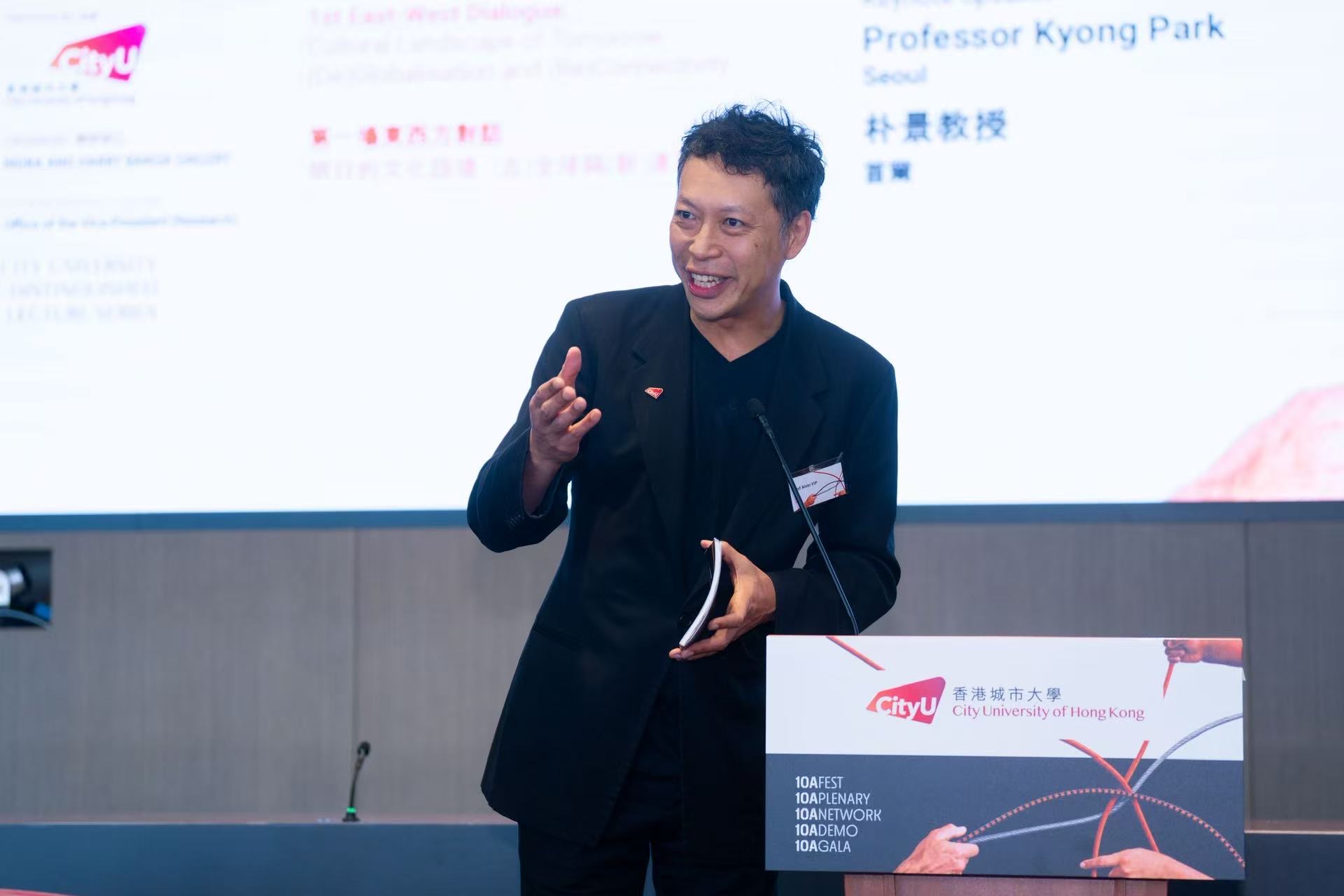
A City University of Hong Kong (CityUHK) gallery, celebrating its 10th anniversary this year, continues to explore unconventional ways to blend the university’s technical prowess with creative practices.
Alvin Yip, director of the Indra and Harry Banga Gallery, said that in today’s hyper-competitive global higher education landscape, CityUHK — and especially the gallery — stands out among institutions seeking to break down the rigid walls between scientific discovery and cultural expression.
Founded in 2016, the Indra and Harry Banga Gallery sets itself apart from traditional university museums, which have historically relied on private donations of classical artifacts. Yip emphasized the gallery’s ambitious curatorial philosophy, positioning it not only as a repository for beautiful objects, but also as a dynamic engine for interdisciplinary collaboration and a showcase for technological innovation.
“Our mission is defined by being interdisciplinary, intercultural, international, and interperiod,” Yip told China Daily in a recent interview.
Yip said the gallery deploys three distinct art-tech methodologies to translate complex academic data and scientific research into engaging public experiences.
The first methodology is digital museology, which uses advanced technologies to reconstruct lost or fragmented historical contexts. The gallery has previously used these tools to digitally animate the original, intricate architectural designs of the Yuanmingyuan (the Old Summer Palace) and create interactive digital models of Leonardo da Vinci’s visionary flying machines.
In another exhibition of traditional African art, curators developed an interactive game to help digital-native visitors understand the complex cultural contexts behind ritual masks and costumes.
The second methodology, “prototyping”, uses artistic media to make technological innovations emotionally resonant. For instance, a recent landmark exhibition featured 23 original scientific research outputs from Hong Kong, using filmmaking and narrative arts to transform abstract data into compelling human stories.
The third approach focuses on integrating art-tech practices, in which digital and physical elements are inseparable. One striking example involves close collaboration with professors from CityUHK’s School of Creative Media, through which the gallery regularly transforms rigorous academic theories into playable, immersive video game experiences.
The gallery’s agility comes from operating across disciplines within the university. This allows the space to act as a neutral, cross-disciplinary bridge, bringing together researchers from fields as varied as architecture, computer science, and creative media.
Looking to the future, Yip is eager to incorporate the next wave of technological developments, viewing generative artificial intelligence, virtual reality, augmented reality, and extended reality as vital extensions of the physical space rather than replacements for it.
He playfully referred to these tools as “new toys” that lower the technical barriers to creative expression. For instance, AI is significantly reducing the cost and complexity of controlling industrial hardware, such as robotic arms used in interactive artistic performances.
Ultimately, the gallery’s most profound mission is regional: to bring together museum directors and cultural practitioners from the Chinese mainland, the Hong Kong Special Administrative Region and Southeast Asia, to pioneer a distinctively Asian museological language, he said. For instance, by intentionally bringing future technologies and historical objects into the same physical space, the gallery seeks to move beyond the chronological or siloed categorization that has defined Western museology for centuries.
By moving away from post-colonial Western storytelling frameworks, the initiative aims to reclaim cultural sovereignty in how Asian history and local innovations are interpreted, he said.
Contact the writer at vivienxu@chinadailyapac.com
