

Editor’s note: What draws the world’s leading scientific minds to Hong Kong? In this series, China Daily speaks with locally based researchers ranked among the global top 2 percent of scientists, exploring the frontiers of their current research and uncovering why they chose to make Hong Kong their home.
Hong Kong’s relentless scientific research efforts aren’t merely dictated by rules. They aim to break discipline barriers as the world, more than ever, needs cross-disciplinary answers to pressing problems.
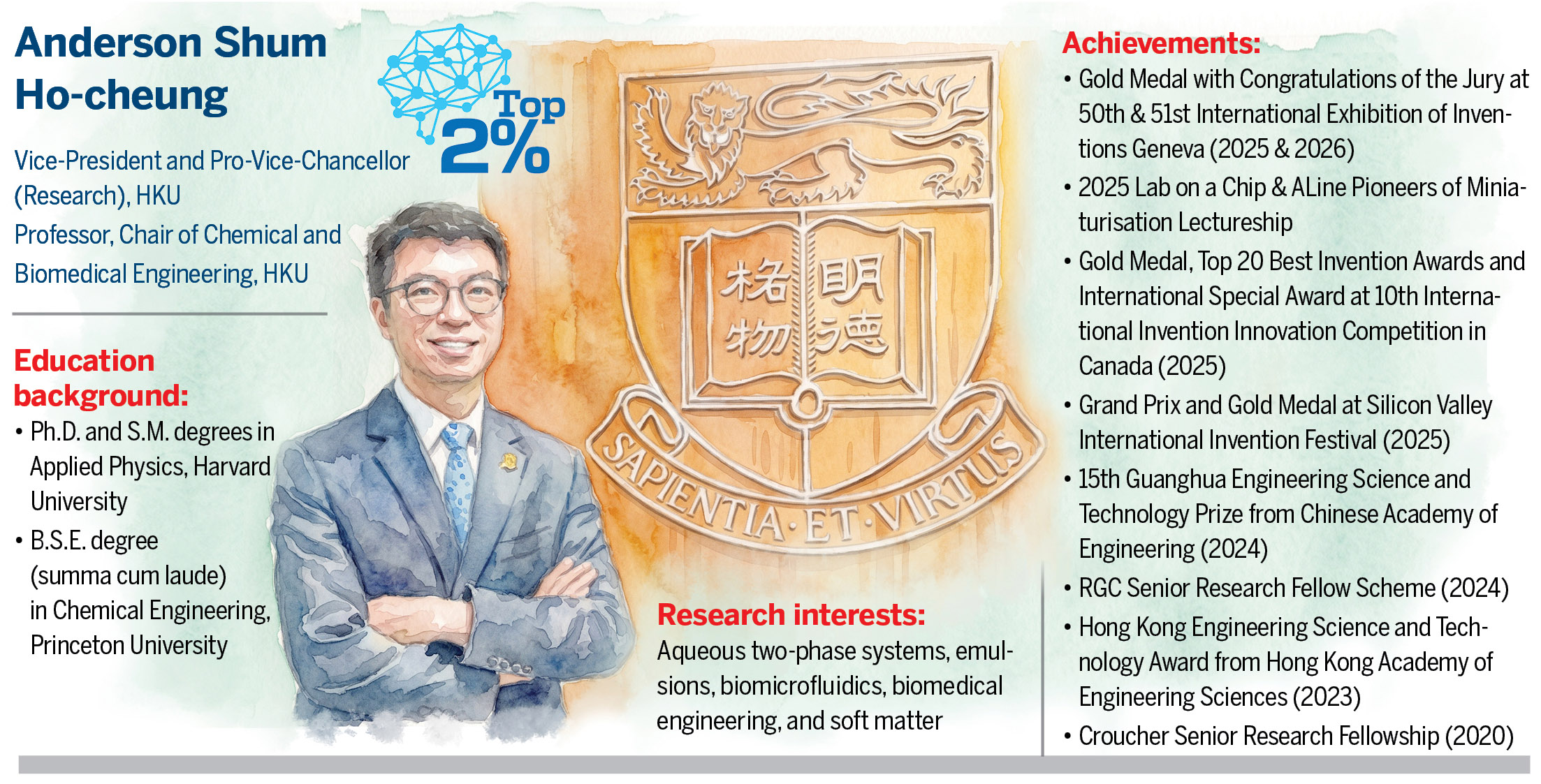
Anderson Shum Ho-cheung — vice-president and pro-vice-chancellor (research) at The University of Hong Kong — has taken such a path after earning his doctorate in applied physics at one of the world’s most prestigious seats of higher learning, Harvard University, having earlier majored in chemical engineering at Princeton University.
Returning to Hong Kong, he joined HKU’s Department of Mechanical Engineering and ventured into bio-engineering and chemistry, and materials engineering, and has extended his research to microfluidics and soft matter, which also covers physics, chemistry, biology and engineering.
“I think nowadays research is really interdisciplinary because we try to focus on the problems that the world needs solutions to. And when we look at solutions, the solutions will not necessarily be in the form of just one discipline,” he tells China Daily.
He says he believes that, with a blurring line among traditional disciplines, all of the globe’s pressing issues are, basically, cross-disciplinary and multi-faceted, particularly with the proliferation of artificial intelligence that has lowered the threshold of traditional sectors, enabling nonprofessionals to participate in meaningful cross-disciplinary collaboration.
READ MORE: Top bio-engineer: world needs interdisciplinary solutions
A doctor, for instance, can leverage AI to effectively develop innovative medical technologies.
Shum’s career may offer a glimpse of the paradigm shift in the ecosystem of research and development.
Helming HKU’s RISE system — a platform geared to weaving together research, innovation, strategic partnerships and entrepreneurship — Shum says the model is dedicated to translating discoveries into practical solutions that foster positive social impact.
The university launched another new platform — the Strategic Partnership Alliance for Research and Commercialisation — at the institution’s annual flagship event, HKU Innovation Week 2026 in October. The event gathered more than 1,000 representatives of governments, industry, academia, research and the investment community to promote cross-disciplinary and cross-sector collaboration, and propel the special administrative region’s research breakthroughs onto the world stage.
SPARC, designed to directly connect global organizations with HKU’s faculties, world-class research capabilities, and vibrant entrepreneurial ecosystem, strives to strengthen the bonds among stakeholders in government, industry, academia, research, and investment at an early stage, says Shum.
Early-stage alignment streamlines the entire translation process and avoids costly detours, such as selecting materials unsuitable for mass production. At the university level, it helps professors create a channel to make the translation of their cutting-edge research more focused and efficient.
To the scholar, the research process isn’t always smooth. In his third year at Princeton, Shum was asked to investigate, under the guidance of world-class professors, how small molecules called surfactants align on metal surfaces and whether they can slow down corrosion.
His task was to visualize the molecules’ alignment patterns — an almost impossible challenge at the time as nobody had ever succeeded before. For nine consecutive months, he worked from morning till the next day’s wee hours without a breakthrough, but eventually captured an image no one had seen before. It made him realize that no career could offer him the same sense of fulfillment, and that experience ultimately inspired him to pursue scientific research.
Beyond the lab
However, translating scientific research into industry goes far beyond scientific challenges. It involves raising capital, creating market-driven models, drafting business plans, managing manufacturing, and navigating clinical approvals. Every single step is a hurdle.
“Therefore, society needs to pay more attention and offer greater support to allow us to jointly build a more efficient ecosystem — one that can translate high-quality research into valuable contributions to society,” says Shum, stressing the importance of engaging with different stakeholders early to make the translation process more efficient.
Although plenty of efforts are needed to actively promote research, scientific probes and translation, these can’t be easily achieved. Shum says he believes seats of higher learning have a unique role to play in Hong Kong’s mission to make itself a world-class innovation and technology hub.
Local universities must actively leverage their academic strengths to conduct solid basic research and achieve scientific breakthroughs, while boosting connections with stakeholders to make commercialization more effective, he says. “If universities and top researchers can’t play such a role, no other institution or stakeholder can.”
Citing the Guangdong-Hong Kong-Macao Greater Bay Area for deepening collaboration, Shum says the region offers an ideal ecosystem for Hong Kong researchers to identify suitable manufacturing sites and scale up production.
HKU’s Techno-Entrepreneurship Academy, set up in Shenzhen’s Qianhai zone two years ago, has attracted more than 100 startups with total valuation exceeding 7 billion yuan ($1.04 billion).
Regardless of how meticulously a plan is crafted, delivering world-leading outcomes remains out of reach without the right talent to execute it, says Shum. But he’s confident that the city’s strategic initiatives and policies do appeal to world-class talent.
He says infrastructure too must keep pace with researchers’ technical demands, highlighting the Northern Metropolis as a crucial enabler. As Hong Kong expands its research laboratory spaces, equipment and large-scale scientific infrastructure, bolstered by universities’ rising global prestige and talent circulation, the city will gain greater visibility among top researchers. When all these factors reinforce one another, the SAR will enjoy a compelling edge in attracting world-class talent.
HKU has five State Key Laboratories. With Hong Kong being attractive to world-class talent, the labs can have a more international environment, Shum says.
The community and residents need to see for themselves how technology can improve their quality of life. By bringing in talent and by training and cultivating talent through research and through partnerships with the Chinese mainland and overseas, “we can give our students real training and real experience for generations to come”, he says.
Shum, who also heads the Hong Kong Young Academy of Sciences, is a fine example of how young researchers can excel in research. “Rather than just acquiring knowledge or technical skills, the key is learning how to learn. Being a fast learner allows researchers to adapt quickly,” he says. “Otherwise, even if one can excel in a certain field, the knowledge gained would gradually become obsolete once that field loses its relevance, or superior solutions emerge.”
Contact the writers at atlasshao@chinadailyhk.com
