

Three youth-led projects show how accessible design can move beyond basic needs to support independence, personal choice and equal participation.
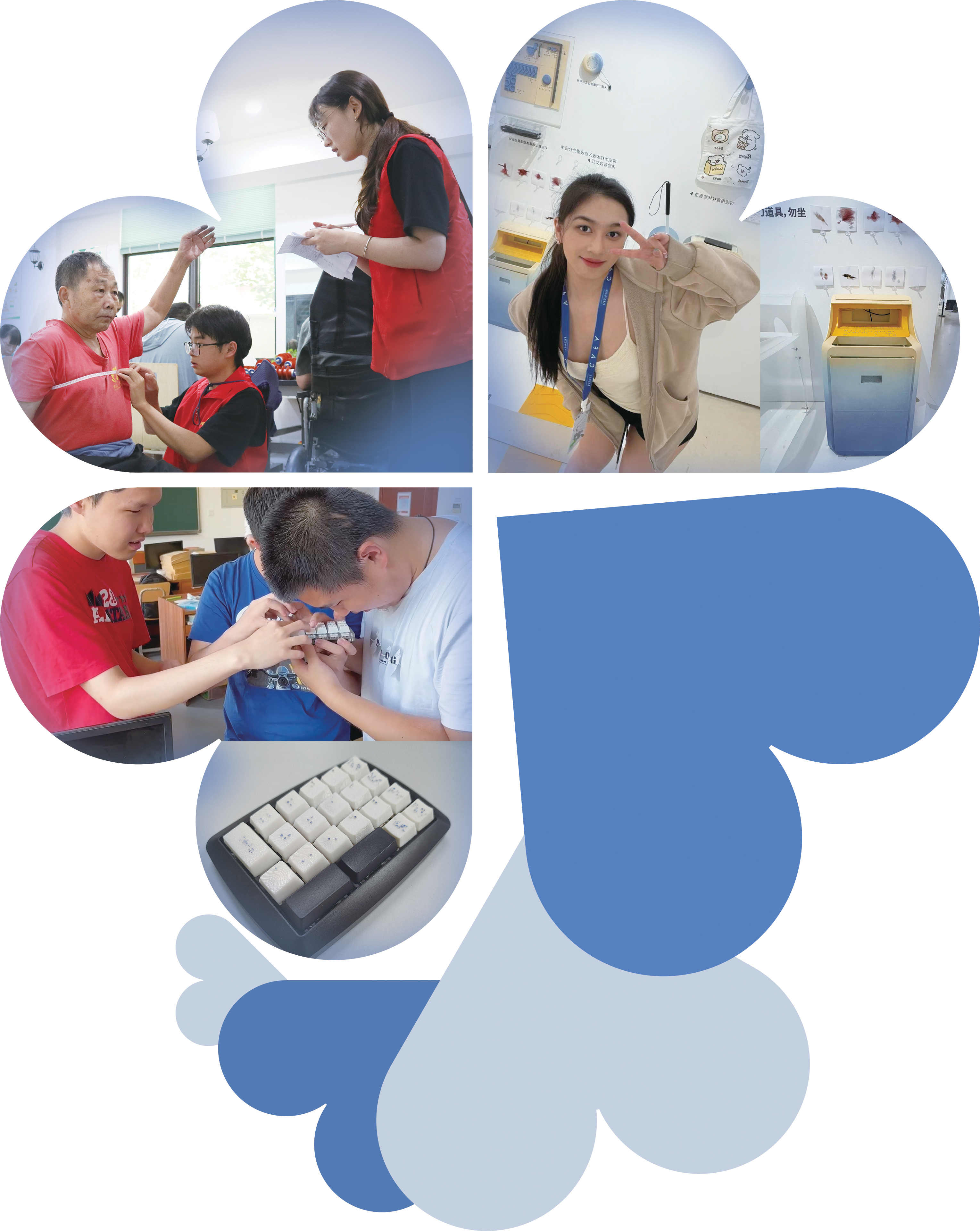
Among the many art and design works on display at the 2026 Central Academy of Fine Arts Graduation Season in May, a bathroom design by 21-year-old student Li Shurong drew visitors' attention and went viral on Chinese social media platforms Weibo and Xiaohongshu.
Its most distinctive feature is an AI-powered waste bin designed to help visually impaired women monitor their periods with greater ease and dignity.
Equipped with a built-in camera and an AI model, the waste bin can detect blood on toilet paper. Once blood is detected, it sends a voice notification to the user.
The idea grew from Li's observation that many visually impaired women avoided talking about menstruation because of its private nature, even though they often need additional support.
READ MORE: Raising a glass to accessibility
Because they cannot visually check for menstrual blood, some can only rely on pelvic pain or smell to monitor their periods.
"It seemed there had been no solution to this awkward situation. Since I come from a design background, I thought I should try to do something," Li said.
To turn the idea into reality, Li carefully collected photographs from volunteers showing bloodstains in different forms to train the AI model. The smart bin still needs refinement — for example, it sometimes has difficulty detecting blood on wrinkled paper — but Li says it could eventually be produced affordably.
"If mass-produced, the waste bin's outer casing would cost just a few dozen yuan. Once trained, the core AI model can be updated and reused," Li said.
Li's project reflects a growing emphasis not simply on meeting the basic needs of people with disabilities, but on making everyday life more comfortable, dignified and inclusive.
Though small in scale, her design mirrors a broader shift in disability services toward greater attention to quality of life.
In July 2026, China's State Council Working Committee on Disability released the plan for the protection and development of persons with disabilities during the 15th Five-Year Plan period (2026-30). Improving the spiritual and cultural lives of people with disabilities and enhancing their quality of life are among the priorities.
Young designers are putting that shift into practice in other areas of daily life. For another group of students, greater independence begins with something even more ordinary: getting dressed.
Making life easier
For Sun Yue, now 21 and studying at Nantong University in Jiangsu province, the first time she felt betrayed by her disability came when she was about 10.
Living in a village in Suqian, Jiangsu province, Sun, whose disability affects her lower limbs, had been invited to interview at the best middle school in town. The test seemed simple: put on a T-shirt and skirt without help to prove she could care for herself. But Sun could not pull up the skirt, no matter how hard she tried.
"My guilt, panic and anger were all directed at myself at that moment," she said.
She failed the test and lost the opportunity to attend the school. For Sun, dressing independently was challenging enough; the idea of clothes designed to make it easier had barely crossed her mind.
Years later, Sun encountered young designers looking at the same problem from the opposite direction. Instead of asking people with disabilities to adapt to conventional clothing, they were redesigning clothing to better meet their needs.
Launched in 2022, Nantong University's accessible clothing project now has around 15 core members, including Sun and Zhang Xiaotong, 22, one of its founders.
Zhang majors in textiles and fashion, while Sun — once rejected by a school because she could not dress independently — is now an applied psychology major.
"When I first heard about the project, I didn't even know 'special' clothing for people like us was a thing," Sun said. "But I realized my own situation might help them, so I signed up."
While Sun was learning about accessible clothing for the first time, Zhang had already noticed a gap in the market. The few accessible garments available on e-commerce platforms were often labeled as "hospital" or "nursing" wear. Most followed the same template — buttons running down the sleeves and pant legs to make dressing easier.
Zhang and her team wanted a more individualized approach. They put that principle into practice with a pair of custom-designed pants for Sun. Full-length zippers run down both sides, enabling her to dress and undress independently.
The team also added padded lining around the hips and lower back to ease discomfort related to wheelchair use, along with two hidden pockets at the knees for self-heating patches to help improve circulation.
Besides Sun's pants, the team has designed and delivered 385 accessible garments to date. They include a garment for an older person with a 90-degree spinal curvature and a wedding dress for a woman who has undergone an amputation. Every piece is tailored to the user's individual dressing needs.
For the team, however, meeting practical needs is only part of the goal. Through small innovations, the students also seek to help users feel more confident and express their personal style through clothing.
They created an "aromatic fabric" using microcapsule textile technology to ease concerns about body odor. Fragrance compounds are sealed in tiny capsules within the yarn, gradually releasing scents including lavender and mint.
Zhang said she would never forget what a user with a spinal-cord injury once told her: "Perfume means beauty to you, but to me, it means dignity."
"They, just like you and me, have sophisticated aesthetic tastes and high expectations for their quality of life," she noted.
Guo Ying, a professor at Nantong University who has advised many disability-related projects, said young Chinese designers are using "smart, low-cost innovation" to change conventional approaches to supporting people with disabilities.
That approach is also taking shape in assistive technology.
Smart solutions
At the College of Special Education at Beijing Union University, a student team created China's first accessible Braille keyboard using materials costing around 300 yuan ($44).
The first version was completed in 2024. Based on Chinese Common Braille, it was designed to help blind students work more efficiently and accurately during exams.
By 2026, it had gone through three upgrades, becoming more like a regular keyboard in appearance while its internal technology also became more advanced. Among the team members is Wang Yueran, 23, who also has a disability.
Wang said the team used 3D printing to improve the tactile precision of the Braille keys.
Java-based technologies were used to develop parts of the supporting software, which works with screen-reading tools to provide real-time audio feedback and help blind users check their input and navigate exam content more easily.
ALSO READ: A home without barriers
Qu Xin, vice-dean of the College of Special Education at Beijing Union University, notes that the university's inclusive education and access to new technologies play an important role in helping students with disabilities participate more fully in society.
"Just as any child without a disability can find their place in society, we want children with disabilities to know they can do the same," Qu said.
Wang's own experience bears out that hope. The keyboard helped him take school exams, while participating in the project strengthened his resume and later his application for a government-related job.
His experience, according to Wang, shows how accessible design can ensure that people with disabilities are not placed at a disadvantage in education, employment and wider society.
Similar to Li and Sun, whether the challenge involves menstruation, getting dressed or taking an exam, thoughtful design can shift some of the burden of adaptation away from people with disabilities and toward the products and environments around them — giving them greater independence and a more equal chance to participate in society.
Contact the writers at liyuche@i21st.cn
