

Facsimile project boosts public appreciation of artistic exchanges and cultural responsibility, Lin Qi reports.
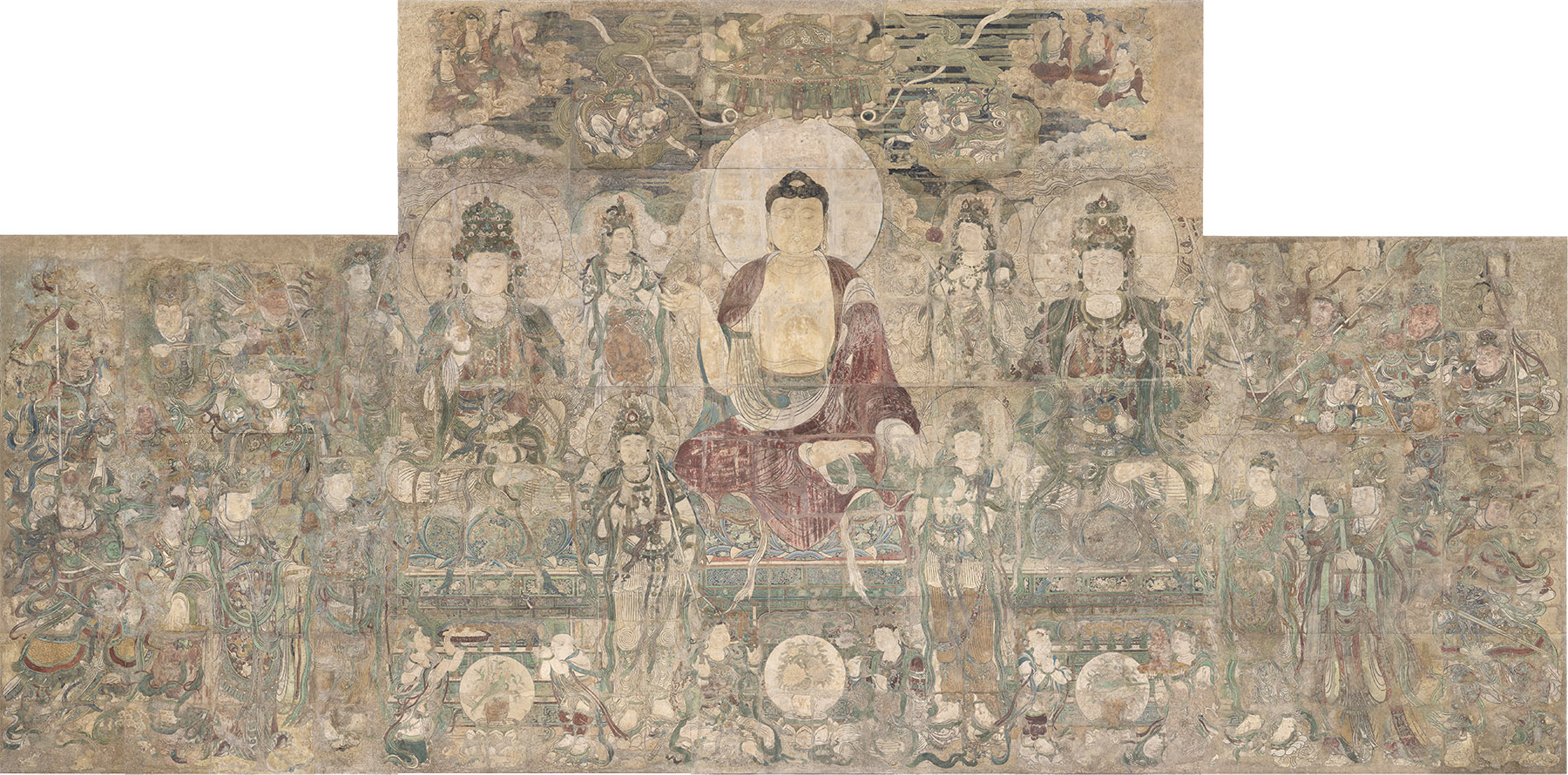
On view at the Metropolitan Museum of Art's Fifth Avenue venue in New York City, a 700-year-old Chinese Buddhist mural exudes a magnificent nobility that captivates eyes and hearts worldwide, including those from its birthplace across the Pacific Ocean.
This 14th-century mural, known as Buddha of Medicine Bhaishajyaguru (Yaoshi Fo), depicts a celestial scene in which the central figure, the Buddha of Medicine, sits on a lotus throne surrounded by deities.
It is monumental in size — 7.5 meters tall and over 15 meters at its widest part — and resplendent with details so rich that one can't help but imagine the endeavoring efforts and physical challenges of its creators. It is regarded as a paragon of Yuan Dynasty (1271-1368) mural art.
In March 2024, a special group of painters and conservators joined its audience. These members of the Chinese National Academy of Arts traveled from Beijing to appreciate its one-of-a-kind beauty with an ambitious mission — to make a life-size facsimile.
They returned to New York City several times in the following two years, working closely with their counterparts at The Met and ensuring the reproduction's accuracy.
The Chinese National Academy of Arts recently launched a website featuring documentaries of this mission, with collaborations between professionals in China and the United States. A virtual reality experience also allows viewers to examine the facsimile.
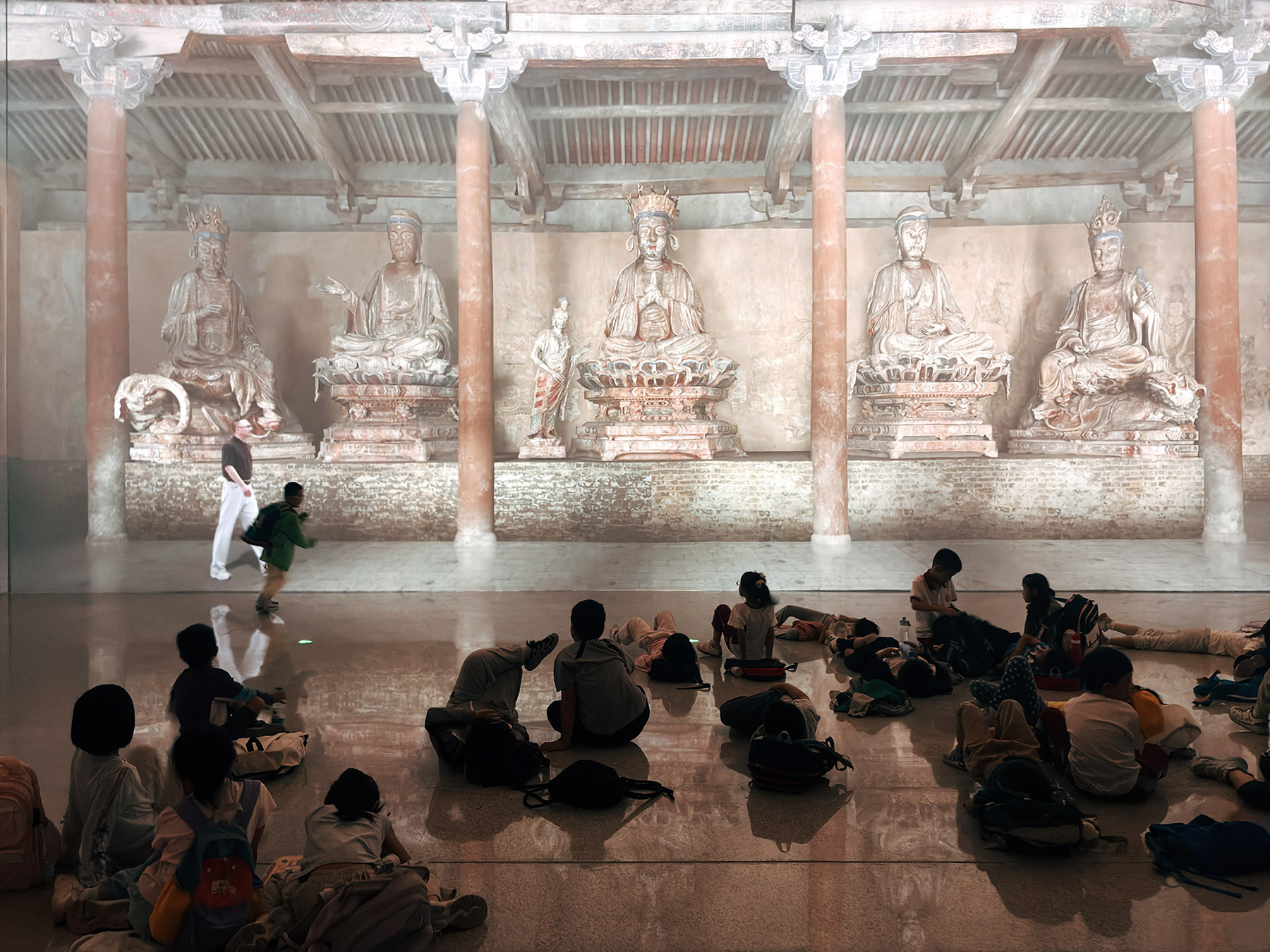
In Beijing, visitors can see the work themselves at the Chinese Traditional Culture Museum, where the copied mural is the centerpiece at Tracing Antiquity, Pursuing Legacy: Replication and Revival of Ancient Chinese Murals, an exhibition ending on Nov 15.
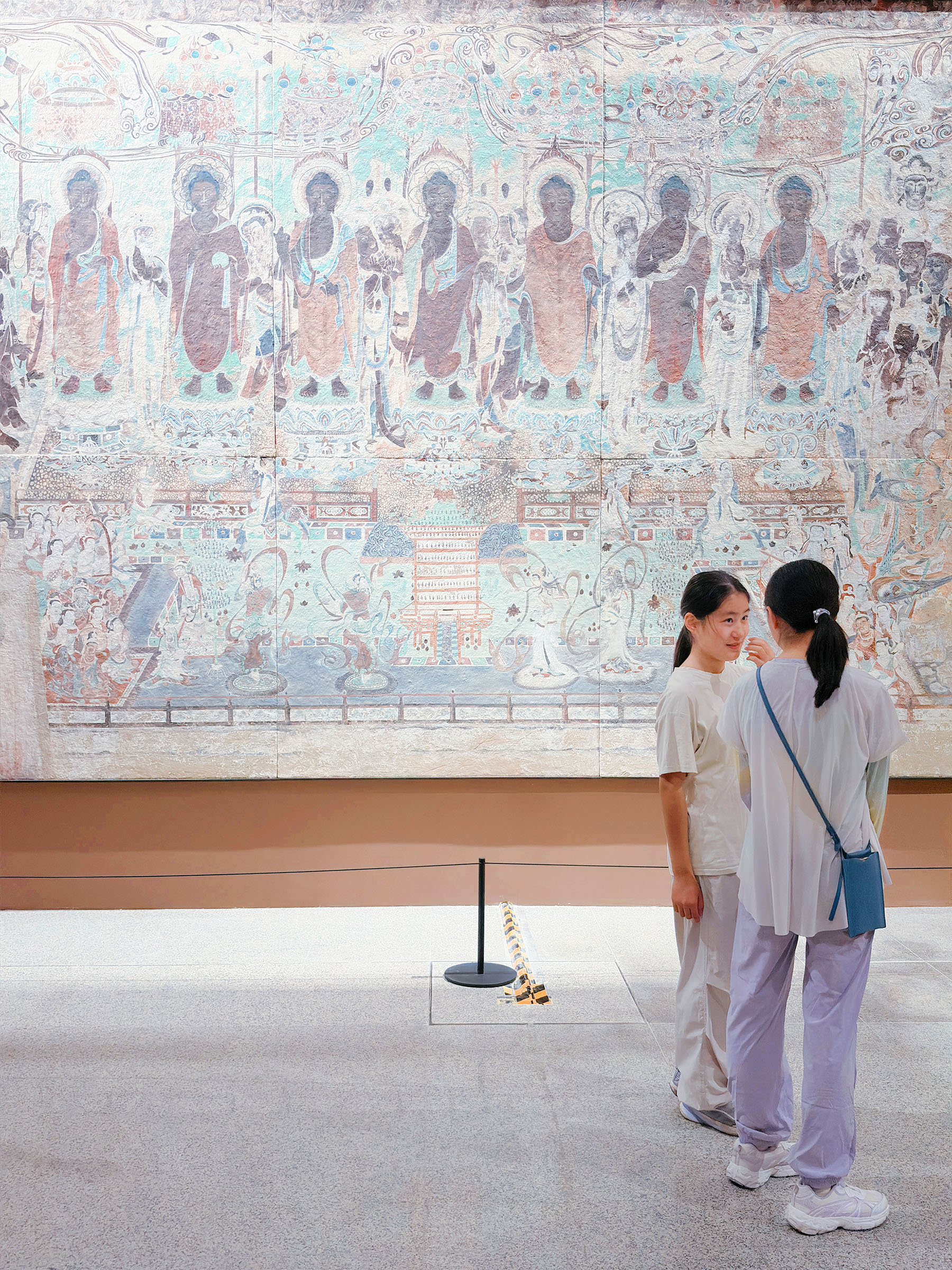
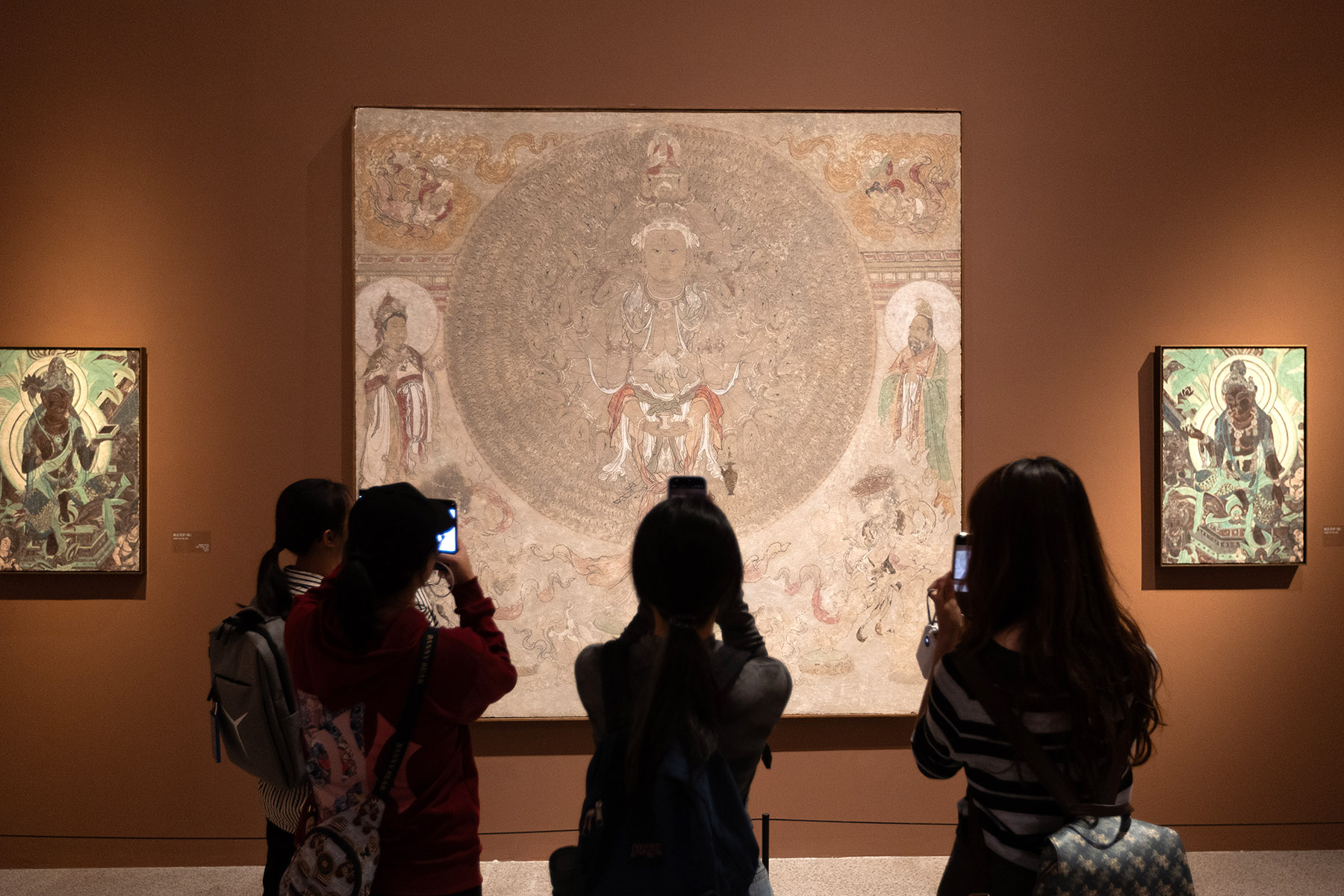
Also on show are reproductions of murals at important relic sites in northern and western China, including Shanxi and Gansu provinces, and the Xinjiang Uygur and Xizang autonomous regions, reflecting cultural and artistic exchanges along the Silk Road. They are also available on the website.
The Chinese National Academy of Arts launched this research and copy project in 2016 to preserve these extant murals that dotted the ancient trade network.
The institution's head Zhou Qingfu says, "The fieldwork and systematic copying and interpretation have allowed artists a better understanding of the Chinese cultural profundity embodied in the murals." Presenting their work to the public will help people "strengthen cultural confidence and promote Chinese culture to a wider international audience", he adds.
The idea of copying the Yaoshi Fo mural began years ago, when artists traveled to the Guangsheng Temple in Hongdong county, Shanxi, where the mural adorned one of its halls.
Historical documents say the temple was first built in the Eastern Han Dynasty (25-220). It suffered natural disasters and social upheavals and was reconstructed several times. In 1303, a devastating earthquake struck, and the Yaoshi Fo mural was believed to have been created as a decoration during its reconstruction.
The deity figure is believed to bring healing power. In reality, it was drawn to a fateful crossroads amid early 20th-century social turmoil. Temple monks and county administrators agreed to trade several murals at Guangsheng, including the Yaoshi Fo one, to antiquity dealers for money to refurbish the long-neglected temple.
The Yaoshi Fo mural was cut into 274 pieces, transported overseas, and realigned. It was donated to The Met in the 1960s.
Today, Guangsheng Temple is protected as a heritage site. It draws visitors as one of the historic buildings reenacted in the phenomenal action RPG (role-playing game) Black Myth: Wukong.
The Yaoshi Fo facsimile draws attention to a fragment lost in the monastery's trajectory.
Zhang Jian, who oversaw the reproduction, says the workload was enormous and far more challenging than painting a new one. "It is both an academic challenge and a cultural responsibility."
The undertaking of the painters at the Gongbi Academy of the Chinese National Academy of Arts, which Zhang directs, was to re-create the mural and to "fake" its aging — water stains, weathering, and mottling, among others — grounded in experience, knowledge accumulation, and deduction, rather than baseless imagination.
To achieve the effect, Zhang's team overcame many difficulties. Han Maoyuan, a participating artist, says he found the data acquisition and color management in the preliminary stage incredibly challenging. The Met gallery's lighting is relatively dim, and the colors would change depending on the lighting.
"We must first establish a stable, reliable color conversion standard," Han says. "That is to say, when making the copy back in Beijing, we needed to ensure the colors appear as closely as possible to the original we saw at The Met."
At The Met, the team used a lift to examine the mural closely. They repainted selected parts on clay panels and revised the details to achieve a satisfying similarity. These samples would later form the basis of the reproduction in Beijing.
Painters then worked on an earthen ground layer made with soil sourced from Guangsheng. Zhang says that while painting the original lines and colors, they also tried to capture the cracks, peeling and patinas.
The team corrected misalignments from previous conservation efforts. For example, previous restorers mismatched a five-centimeter gap between the Buddha of Medicine's head and body, causing the deity's head to shift outward toward his right shoulder. The facsimile corrected this misplacement.
Han says damage and loss are part of the work's history, and so are the restoration traces in transmission. "We do not need to make a complete, perfect piece, but we must present the mural as truthfully and accurately as possible."
Contact the writer at linqi@chinadaily.com.cn
