

Innovative Xinjiang projects transform barren land into productive seafood waters

The Xinjiang Uygur autonomous region is arid and far from any ocean — yet aquatic life is starting to thrive there.
Saline-alkali land has been converted into aquaculture ponds, turning barren ground into productive waters and putting seafood on plates thousands of kilometers from the coast.
What was once unusable land now yields aquatic products, sustains livelihoods, and points to a new direction for the region's development.
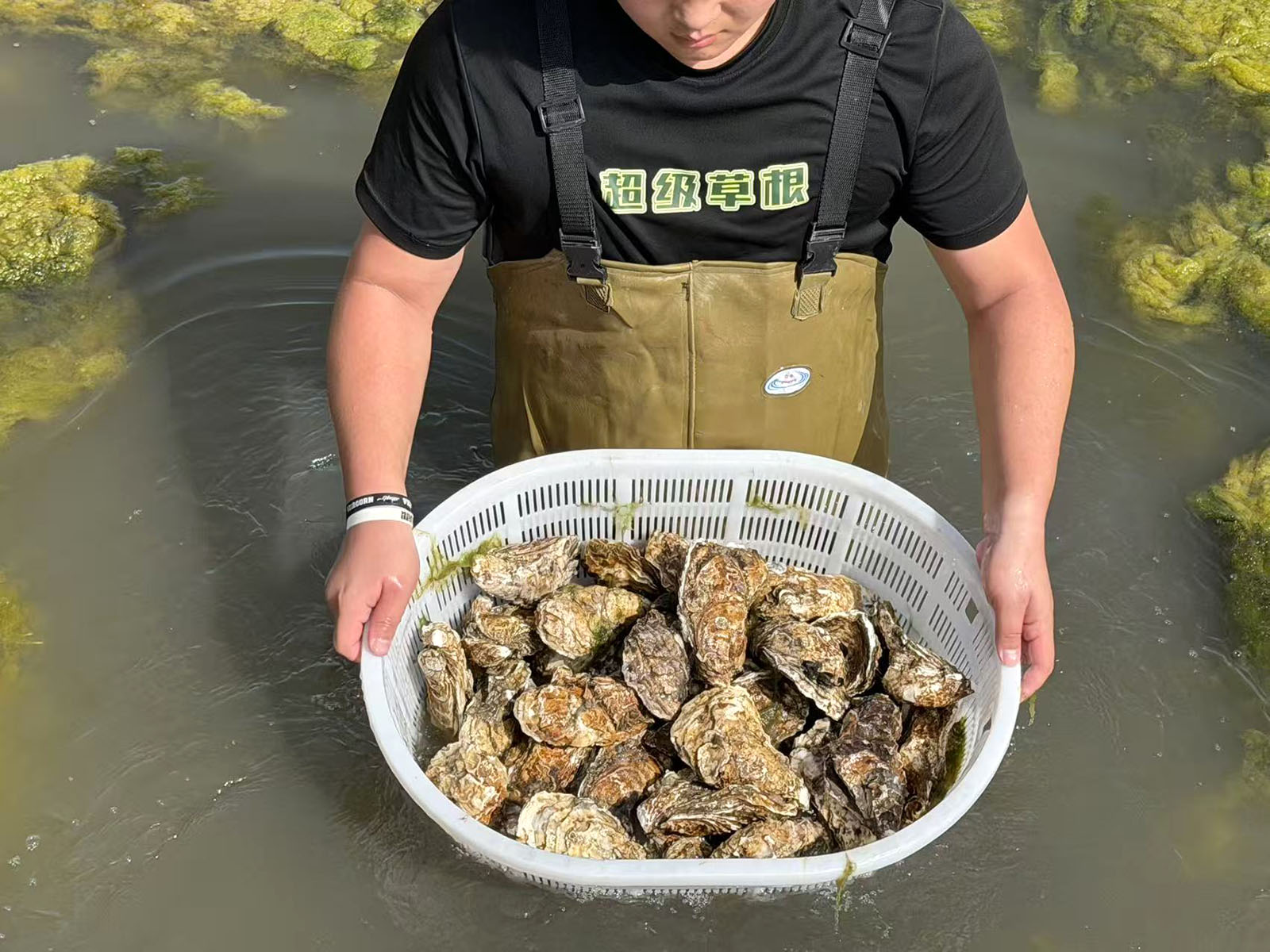
An oyster trial launched in late May in Xinkailing township, Aral, covers about 3.3 hectares, with total output expected to reach about 3 metric tons. All the oysters are sold fresh in local markets at affordable prices and have been well received by customers.
READ MORE: China expands marine ranching to boost food security
"The oysters in Xinjiang grow faster than those in our coastal hometown over the same period, and they taste even better," said Chen Wuqun, general manager of the aquaculture company behind the oyster project.
The project grew out of an investment promotion under Zhejiang province's paired assistance to Xinjiang, which aims to put the region's unused brackish waters and saline-alkali land to productive use.
Chen has more than 20 years' experience in aquaculture. In 2024, he set up a 6.7-hectare pilot pond, which showed that seafood species could survive local conditions. By the end of that year, the operation had expanded to 26.7 hectares. It now covers 93.3 hectares and farms multiple varieties of seafood, including oysters, Sanmen green crabs, green clams, mullet and shrimp.
Chen said all the ponds rely exclusively on treated local groundwater. The water is first left to settle so that rust can be removed, and then exposed to sunlight for more than seven days before being channeled into the ponds.
"Water quality is monitored every three days after seedlings are stocked, with calcium, magnesium, potassium, and other basic minerals replenished as needed. Lactic acid bacteria, photosynthetic bacteria, and suitable beneficial algae are also regularly introduced to support the growth of the aquatic organisms," Chen said.
Crab seedlings, fish fry, and oyster seedlings are all sourced from Zhejiang, airfreighted in, and stocked in batches. Oysters feed mainly on cultivated algae. The crabs and fish are fed mainly chilled fresh small fish and shrimp, trucked from Zhejiang in refrigerated vehicles.
Local demand has underpinned the project's growth. "We don't worry about sales. Local fresh seafood markets remain largely untapped, leaving ample room for domestically farmed products with little risk of oversupply. Local consumers now buy live seafood right here," Chen said.
He plans to expand the oyster farming area to 10 hectares next year.
Exotic crustaceans
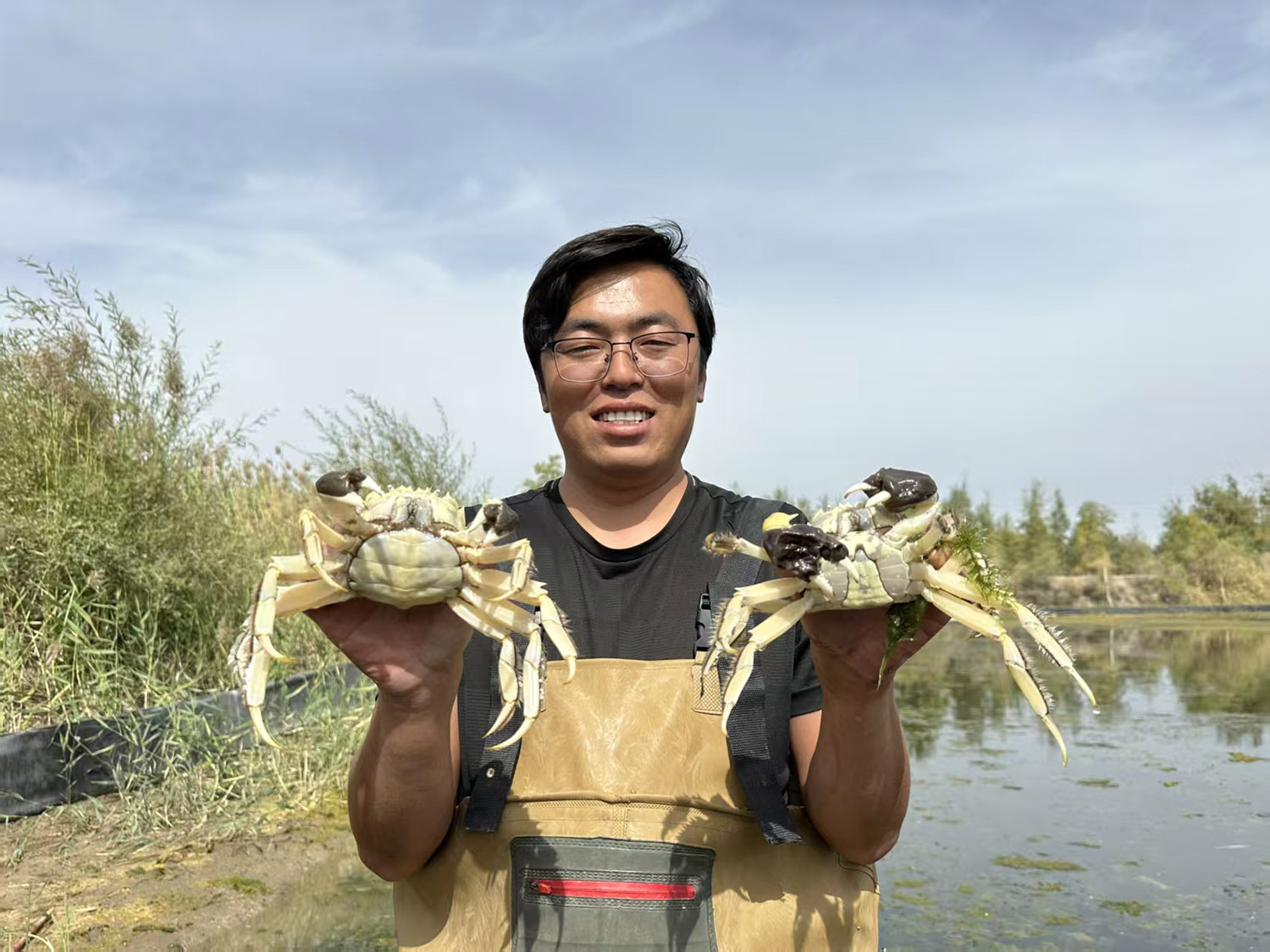
Oysters are not the only surprise in Xinjiang's aquaculture industry this year. In Ganquan township, white jade crabs have entered their harvest season under the guidance of Shu Qifu, a technician from a crab-breeding company in Huzhou, a city in Zhejiang.
Shu said he developed the variety jointly with Shanghai Ocean University. After trials in 2024 and 2025, he has worked full-time in Xinjiang this year on large-scale breeding.
About 150,000 juvenile crabs have been stocked so far this year across 10 hectares. The crabs are sold mainly in Jiangsu and Zhejiang provinces, and Shanghai, and also in Central Asian countries.
"Local conditions suit the species well," Shu said. He explained that snowmelt from the Tianshan Mountains is free of industrial pollution and rich in calcium, magnesium, phosphorus and zinc — minerals suited to crustacean growth. Abundant sunshine and the absence of a plum rain season help keep pond water at around 28 C, which he said is optimal for the crabs.
The snowmelt is first diverted to a reservoir and left to settle for two to three days before being pumped into the ponds. Because the native water is highly alkaline, with a pH of 10 to 11, lactic acid bacteria and organic carbon sources are added. These bring it into the 7.5–8.5 range crabs prefer and also cultivate beneficial microbes.
Water grass collected from local rivers gives the crabs shelter, provides a natural source of vitamins, and helps keep the water clean.
Shu also carries out regular pond-bottom maintenance and adds trace elements and beneficial bacteria. He uses bacteria cultured on site and fermented manure with small amounts of fertilizer.
The crabs are fed high-protein feed transported from Huzhou, supplemented with corn, wheat, and pond grass. "High protein in the feed improves the crabs' condition, which lowers disease rates and raises survival rates," Shu said.
Word of Xinjiang's seafood is spreading well beyond the farms, reaching consumers far and wide.
Pan Ziheng, a lawyer from Shanghai, began a yearlong work assignment in Kashgar, Xinjiang, in September. A month of steady beef and mutton left her craving seafood, so she set out to track down a local source.
She came across a rural courtyard pond on the social media platform Xiaohongshu, and a friend later spotted it in person while passing by. They went to eat there and found the prices reasonable.
"The crab price was roughly what I would pay in Shanghai, at just over 100 yuan ($15) per kilogram. The taste and texture were excellent."
According to Pan, notices on both sides of the pond invited diners to catch seafood themselves as a hands-on experience. Eager to eat, however, they let the pond owner do the work.
Back in Shanghai, crabs were Pan's favorite. Before she left for Xinjiang, her friends worried she would miss out on seafood so they treated her to crab meals for a whole week.
But Xinjiang gave her a pleasant surprise. She never expected to find such good-quality and affordable crabs there.
"I believe there will be more and more seafood in Xinjiang in the future," she said.
Snow-water salmon
The development of seafood farming in Xinjiang is providing new food choices and generating employment opportunities for local residents.
"The initiative has enriched Aral's lineup of specialty agricultural products and added new dimensions to Zhejiang-Xinjiang industrial collaboration and consumption-based assistance," said Zhu Jie, head of the project fund industry group of the Zhejiang Taizhou aid-Xinjiang command.
The benefits of aquaculture extend beyond Aral.
"Being able to eat fresh salmon in this edge-of-the-desert area truly enriches our taste buds and adds a special ingredient to our dining tables," said Zhang Hu, a resident of Nantun township in Tiemenguan.
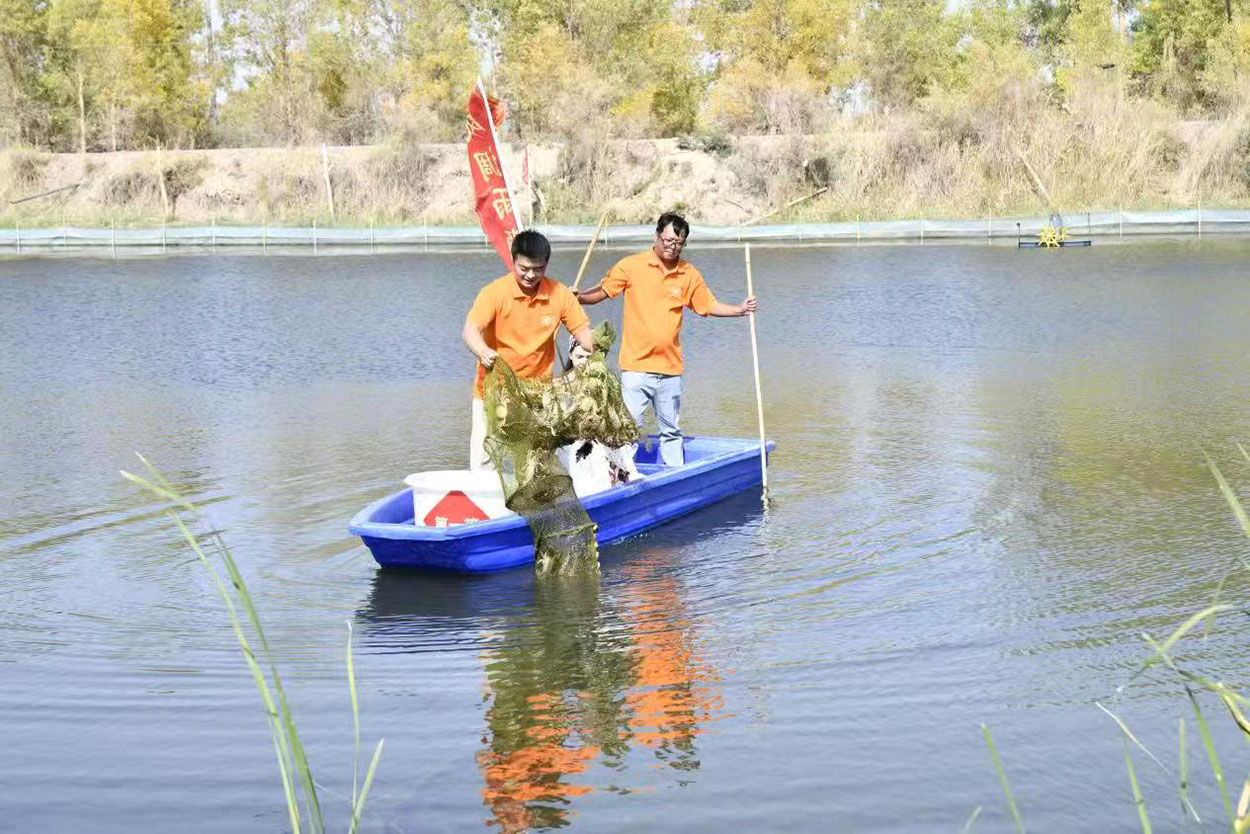
What makes fresh salmon possible in a desert region is a natural resource. Hu Jianli, who is in charge of an aquaculture company in Tiemenguan, explained the water comes from the snowmelt of the Kunlun Mountains and is clean enough for human consumption.
"Testing has shown it meets direct-drinking standards. It is precisely this unique cold water resource that has allowed a seemingly impossible industry — salmon farming — to take root at the edge of the desert."
Hu added the answer to keeping the water clean lies in a waste-collection system at the bottom of the net cages.
Waste such as fish feces and leftover feed produced during salmon farming is collected through waste-collection devices, piped to onshore treatment facilities, processed into organic fertilizer and ultimately returned to the fields.
"The whole system forms a closed loop, with aquaculture waste kept out of the reservoir water, achieving cyclic utilization of aquaculture waste," said Hu.
Beyond new food options on local tables, the industry is also creating jobs.
Farmers have joined the initiative and added nearly 70 hectares of their own aqua farms, Chen said.
His company employs over 500 workers at its breeding bases, paying around 5,000 yuan a month plus free meals and accommodation.
One of them is Subinur Aimaier, a 25-year-old Uygur graduate of Xinjiang Vocational University, where she studied to become a primary schoolteacher.
After graduating in 2025, she returned to her hometown and spent over six months leading a team of tutors at a local cram school. Looking for a career change, she came across a recruitment notice from Chen's company.
Subinur is now attending a company training program on livestreaming in Urumqi, running from Oct 20 to 30. It covers script writing, on-camera presentation, techniques for promoting local specialties, and prepares her to promote the company's aquatic products via livestreams.
She said the job has also introduced her to breeding technologies that were previously unavailable in Xinjiang. She is satisfied with the salary of 4000 to 5000 yuan a month, and her workplace is close to home.
"I've gained independence and confidence," Subinur said.
She said given the opportunity, she would like to start a business with Chen.
Salt to gold
In September this year, the Ministry of Agriculture and Rural Affairs issued the national fisheries development plan for the 15th Five-Year Plan period (2026-30).
Under the plan, efforts will be made to strengthen work on saline-alkali-tolerant germplasm and the breeding of new varieties, intensify research on key technologies across the entire chain — including precise regulation of saline-alkali water quality and reducing salinity and treating alkalinity through aquaculture — and develop and promote differentiated technical models tailored to different regions and types of saline-alkali water and soil resources.
These measures are designed to improve saline-alkali water and soil resources, create new space for aquaculture, and promote a virtuous cycle between ecological restoration and industrial development.
This national direction is being put into practice at the local level. By 2025, the output of saline-alkali water products by the Xinjiang Production and Construction Corps exceeded 10,000 metric tons, achieving a production value of 200 million yuan, XPCC Daily reported.
ALSO READ: Crayfish drive rural vitalization
Zhu said the seafood farming initiative in Xinjiang focuses on revitalizing underused resources across Aral, including idle saline-alkali land and saline drainage water from farmland.
"It turns the salinity and alkalinity that once constrained agricultural development into an advantage for aquaculture. It's a worthwhile exploration aimed at generating economic returns from salinealkali land and building a desert blue granary," said Zhu.
Empowered by scientific special commissioners, Aral has overcome geographical constraints.
"Drawing on inland aquatic research expertise and mature aquaculture technologies, and through 'aqua-mimicry' water conditioning and seedling desalination and acclimation, we have made seafood farming a reality in the vast desert and Gobi areas far from the sea, extending science and technology aid to Xinjiang from traditional crop farming to specialty aquaculture and promoting technology exchange between China's eastern and western regions," Zhu added.
Fang Aiqing and Qian Suling contributed to this story.
Contact the writers at wangsongsong@chinadaily.com.cn
