

Tour guide's family loss brings story of great journey to life
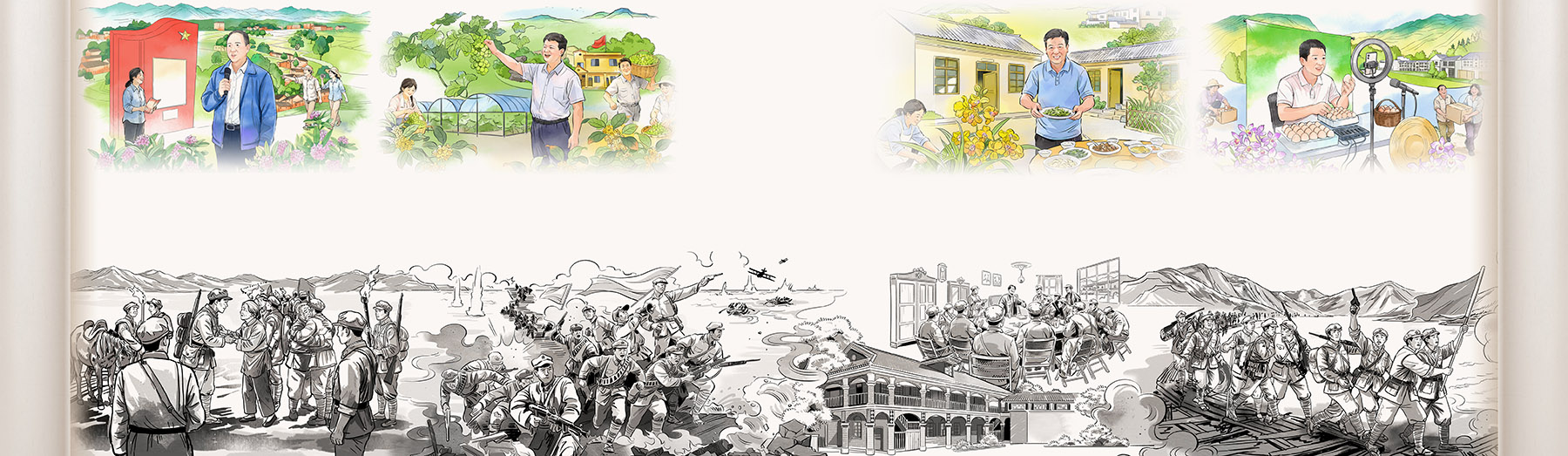
Editor's note: This year marks the 90th anniversary of the victory of the Long March — a monumental feat in human history. China Daily is publishing a series of reports reflecting on this historic journey and exploring how the spirit of the Long March continues to inspire the Chinese people on their new path toward national rejuvenation.
In the cradle of China's revolutionary history in the small city of Ruijin, Jiangxi province, volunteer guide Liu Yang is transforming how visitors experience the legacy of the Long March by weaving his family's personal tragedy into the narrative.
In 1934, Ruijin served as the starting point for the Red Army's arduous 12,500-kilometer overland maneuver that saw nearly 200,000 troops set out from various revolutionary bases on a mammoth trek to evade military encirclement. Only one in four would survive the ordeal and make it to northern Shaanxi, as most of them perished from combat, exhaustion and starvation.
For 48-year-old Liu, who also works in the local nursing home, the epic Long March journey runs deep in his family history.
Eleven relatives from his grandfather's generation joined the Red Army, with only one returning home. Liu Degui, a relative who died at the age of 27 during the Long March, is the only one officially listed as a martyr; the others disappeared, as did many other Red Army recruits.
With no known descendants of his own, Liu Degui was posthumously given an heir under a regional custom intended to carry on a martyr's lineage: Liu Yang's father. This gave Liu Yang an ancestor he would never meet. Every Qingming Festival, China's traditional tomb-sweeping holiday, he carefully restores the inscriptions on Liu Degui's tombstone.
This intergenerational grief and pride shaped Liu Yang's life choices. He served in the military from 1997 to 2002, handling internal publicity duties. In 2007, he returned to Ruijin and began volunteering as a docent specializing in revolutionary history.
"I am a descendant of Red Army martyrs," Liu Yang said. "I hope that through my work, I can pass on the Long March spirit to more people, inspiring them to strive in our new era."
The Long March spirit embodies a devotion to the public good, perseverance through hardship, self-sacrifice and solidarity with ordinary people.
Over 19 years, he has led more than 1,000 guided presentations. His audiences range from school-age study-tour groups to domestic scholars and overseas guests.
One encounter with a visitor remains etched in his memory. An elderly tourist from Shanghai broke down in tears during a segment describing Red Army soldiers trapped in deadly grassland bogs. The man's father, a Long March veteran, had been pulled from the marsh by a fellow soldier.
Rejecting rigid, script-heavy lectures, Liu Yang leads tour groups through mountain villages dotted with revolutionary landmarks. He combines on-site storytelling, folk songs and short walking segments inspired by the original Long March journey, bringing history to life for visitors.
The family's tradition of public service is continuing into the next generation. His college-age son, Liu Zhenhao, enlisted in the military this year, while his young daughter takes part in volunteer docent shifts to learn about revolutionary history.
Liu Yang has witnessed Ruijin's Red tourism sector undergo dramatic changes. Visitor numbers have surged, public infrastructure has improved, and parking areas now accommodate hundreds of private vehicles and large tour buses. Despite the city's transformation, Liu Yang believes the core message endures.
"The Red Army fought for ordinary people's well-being and bore the burden of rescuing the nation," Liu Yang said. "Each generation has its own Long March. Today, we must carry forward that same spirit of devotion."
After nearly two decades of guiding visitors, Liu Yang sees evidence of that mission in the reactions of those who travel to Ruijin to engage with this chapter of history. Visitors say that walking on the actual ground where revolutionary history unfolded deepens lessons that books and classroom materials cannot fully convey.
Lai Xiaorui, a 24-year-old from the neighboring city of Ganzhou who was visiting to reflect on the Red Army's trials, said being on-site anchors abstract history in real-world sacrifice. "We come to places like this so we do not forget the past. We draw strength from this history," he said.
Xia Zichen, a middle school student who serves as his history class representative and designed his own multi-city revolutionary-history itinerary during the summer vacation, visited to fill gaps in his school education. "Textbooks only give fragments. Visiting the actual sites fills in so many missing pieces," he said.
Remote Guizhou village evolves into tourist haven
When Wang Zhiqiang left his village in Guizhou province as a teenager, the pathway in front of his family home was barely wide enough for a person to walk along.
"If you weren't careful, you would fall straight into the crop field," he said. Today, the village attracts so many visitors that, during peak periods, traffic police are needed to manage congestion on the surrounding roads.
Wang, founder of the Red Home Farmhouse Restaurant in Huamao village in Bozhou district, Zunyi, has witnessed and benefited from the transformation.
"My hometown was very poor back then. There wasn't even a highway near my house," he said.
Like many rural residents seeking a better life, Wang left his village — initially in the 1980s by himself and later with his wife and children — to find work in Zunyi city. He found a job in construction, starting as an unskilled laborer earning just 2 yuan (29 cents) a day. Work, however, was often irregular.
"Sometimes, before I found the next job, I had already eaten through my savings," he said.
Over time, Wang acquired new skills and became a contractor by the 1990s. By 2010, he was considering returning to his hometown. His children were growing up, and he felt they lacked a sense of belonging to their ancestral home.
In 2013, he returned to the village, completely renovated the family homes and invested more than 300,000 yuan — almost all of his savings.
Meanwhile, the village was undergoing a transformation of its own. Roads were built, eventually reaching individual households.
"Every family can drive their car right into their own yard," Wang said.
As visitor numbers grew, Wang spotted a business opportunity. Tourists were coming to see the village, but there were few places to eat. He decided to open a restaurant.
His family was unconvinced.
"They said, 'Who is going to come to this remote corner to eat? Don't invest in that, or you'll lose everything'," Wang said.
Undeterred, he placed his faith in the village's growing appeal and, in particular, his wife's cooking skills. The restaurant soon took off. On weekends, customers from Zunyi had to book three days in advance.
One encounter illustrates the restaurant's appeal. A woman in her 80s from Guiyang, the provincial capital, arrived with her son, daughter-in-law and grandson. With the restaurant packed, the family had to wait until evening to eat, when Wang's wife prepared a special meal for them.
"She said the food reminded her of her mother's cooking when she was a girl in the countryside," Wang said.
The restaurant's success translated into tangible gains. At its peak in 2019, it served nearly 50,000 customers, generating gross revenue of 1 million yuan. It also provided jobs for more than 10 local residents, including returning migrant workers and students working during their summer holidays.
The restaurant's fortunes reflect the broader transformation of Huamao village. A decade ago, about 3,000 villagers worked away from home. Today, the number has fallen to around 460.
Per capita disposable income in the village rose from about 12,600 yuan to 29,650 yuan last year. In 2025, the village received 710,000 tourist visits, generating more than 24 million yuan in revenue.
Liu Shenghong, a 26-year-old tourist who learned about the village on Douyin, a popular short-video platform, visited to try his hand at pottery making.
"Tourism seems really developed here. I think the scenery here is truly beautiful. The roads were especially well built," he said.
For Wang, the village's transformation reflects the spirit of the Long March. In January 1935, during the Long March, the Zunyi Meeting was held in the city. The meeting marked a critical turning point in the history of the Communist Party of China and helped chart the way forward for the Red Army.
"If the people of our hometown did not have this Long March spirit, this spirit of hard work, how could there be such beautiful houses, such a beautiful village? This was all done through hard work," he said.
Wang pointed to a quiet sense of competition among villagers. When one family built a house, others would work for years to build one of their own.
"It's a form of emotional support. The spirit is remarkable. Everyone has done well and worked hard," he said.
Struggling hamlet pulls itself up by the grapevine
Maozhushan, a small settlement within Nanyi village in Quanzhou, Guangxi Zhuang autonomous region, was once synonymous with extreme poverty. A traditional local rhyme summed up the harsh conditions: "Mud-brick houses, a life so bare. Pumpkin soup, the only fare. No one would give a daughter's hand to a man from Maozhushan land."
Today, the village has undergone a dramatic turnaround. Well-paved roads now wind past sprawling vineyards that line both sides of the settlement.
Wang Junrong, 45, Party secretary of Nanyi village, attributes this success to the area's distinct geography.
"Surrounded by mountains, the village has a large temperature difference between day and night, creating a microclimate especially favorable for growing grapes," Wang said. "We tried other crops in the past but failed. Citrus, for instance, was vulnerable to citrus greening disease. Then we tried grapes, and they thrived."
Building a thriving fruit industry required immense perseverance. For Wang, the effort reflects the historical spirit of the 1934 Xiangjiang River Battle — a key moment in the Red Army's Long March fought right in Quanzhou county.
"Why do we learn from the Red Army and the spirit of the Xiangjiang River Battle? It is the spirit of daring to overcome all difficulties and never being overwhelmed. We apply exactly that spirit to rural vitalization," Wang said.
Wang grew up hearing the local saying about Maozhushan's poverty. As a young man, he left home to study performing arts at Guangxi Arts University. After graduating, he worked as a wedding host and traveling entertainer. In 2015, however, he decided to return home.
"I could see that national policies were increasingly favoring agriculture, rural areas and farmers. I realized that conditions back home were becoming better than those where I was working," he said.
By the time Wang became Party secretary in 2021, villagers had already established grape cultivation as a viable industry. However, he was told that getting the business off the ground had been difficult. Although villagers knew grapes tasted good, many were reluctant to plant them because of the high initial investment.
Party members and a few other villagers took the lead, persuading others to join them in planting grapes. After the first growers succeeded, they encouraged more villagers to follow suit.
After taking office, Wang turned to livestreaming to market the village's grapes. Today, the village sells boxes of purple grapes to urban consumers while also attracting tourists who come to pick the fruit straight from the vines.
"Tourists arrive in big busloads, empty-handed, and all leave with their arms full," Wang said.
To keep the industry competitive, the village has also focused on improving grape varieties and extending the harvest season.
"Older varieties no longer meet changing consumer tastes, so we have focused on improving varieties, mainly to extend the picking season. That way, whenever visitors come to Maozhushan, they can enjoy fresh grapes," Wang said.
"In the past, the picking season lasted only about a month, and we had just two varieties. Now we have more than a dozen, with grapes available from June through the end of December."
The efforts have helped raise local incomes. Last year, Maozhushan's per capita disposable income reached 38,000 yuan ($5,655), an increase of 8,000 yuan compared with 2021.
For Wang, however, the village's development has come at a personal cost. "Before I became a village cadre, my hair was black. Over these five years, I have often lain awake at night thinking about problems and how to solve them. There have been many days and nights when I could not sleep. Now most of my hair has turned white," he said. "But I have done something to make people's lives happier, and I have no regrets.
"Now the villagers have a strong sense of happiness and fulfillment. Their hearts are full of joy, and their faces beam with happiness. I will continue to apply the spirit of the Xiangjiang River Battle to my work, stand together with the people, and build the village into an even better place," Wang said.
Small favor leads to big changes for ordinary villagers
In 2013, Dai Xiaoyong was working at a hospital when officials from his hometown of Xinghong in Chishui, Guizhou province, asked for help with basic administrative paperwork because they were unfamiliar with computers.
With the hospital just a few minutes away by car, Dai agreed to lend a hand. What began as a brief favor soon grew into a decadelong commitment that transformed both his life and the community around him.
As his responsibilities in the village mounted, balancing two roles became impossible. Dai made the tough choice to leave his higher-paying hospital job and dedicate himself to public service full time. He was appointed deputy Party secretary in 2017 and stepped into the role of village Party secretary the following year.
"I felt there was a lot I could do in the village," he said. "When it comes to personal fulfillment, I knew I could achieve something meaningful here. I was born and raised in Xinghong, and I feel a deep attachment to this land and our village."
When he first returned, the village had only a few kilometers of cement roads and no money in its collective coffers. Today, more than 40 km of paved roads connect all the village settlements, running water reaches every household, and an online business helps residents with limited mobility earn money by selling eggs.
In 2022, Dai began making short videos to explain policies to rural residents. As his audience grew, he started livestreaming to promote local agricultural products, including eggs from black-bone chickens.
"Elderly people and those with limited mobility can raise chickens in the bamboo forests around their homes. They collect about a dozen eggs a day, and we help sell them," the 41-year-old said.
Dai estimates villagers can earn between 3,000 yuan ($446) and 8,000 yuan a year from egg sales.
Li Caiming, 55, has raised chickens for years, but he used to keep only a small number. Since the village established a reliable sales network, he has expanded his flock.
"We raise more now because we don't have to worry about finding buyers or selling at a low price. We don't have to take the eggs to market ourselves," Li said.
For Dai, helping villagers increase their incomes is part of a broader effort to build a sustainable economic foundation for Xinghong.
"When I first arrived, the village had no money," he said. "I realized that a village needs its own source of income. With money, we could do much more to help villagers solve their problems."
Under his leadership, the village committee developed a cured meat processing plant, built an e-commerce livestreaming hub, introduced rice-fish farming, and put idle collective assets and other resources to productive use.
These initiatives have accompanied improvements in basic infrastructure and public services.
"Over all these years of hard work, our village has undergone huge changes ... No villager has been left unable to afford food, medical care or schooling," Dai said.
Xinghong's transformation has also shaped Dai's understanding of his responsibilities as a village official. The area carries a significant place in revolutionary history. In early 1935, the Central Red Army crossed the Chishui River four times, breaking through the encirclement of Kuomintang forces. The campaign was a pivotal episode in the Long March, helping the Red Army overcome a numerically superior enemy and regain the strategic initiative.
For Dai, the historical episode offers a lesson in serving the people.
"What stands out most from the Red Army's four crossings of the Chishui River is their wholehearted commitment to the people. When it comes to people, nothing is too small to matter. Every little concern they bring to us is a big deal. Get these small things right, one by one, and together they add up to something truly significant," he said.
More than a decade after returning to Xinghong, Dai remains committed to the village and its residents.
"I have given everything to the people of Xinghong. I want villagers to feel that we officials are on their side. Each generation has its own responsibility and mission. As a Party member, I have a duty to lead the people here to prosperity," he said.
