

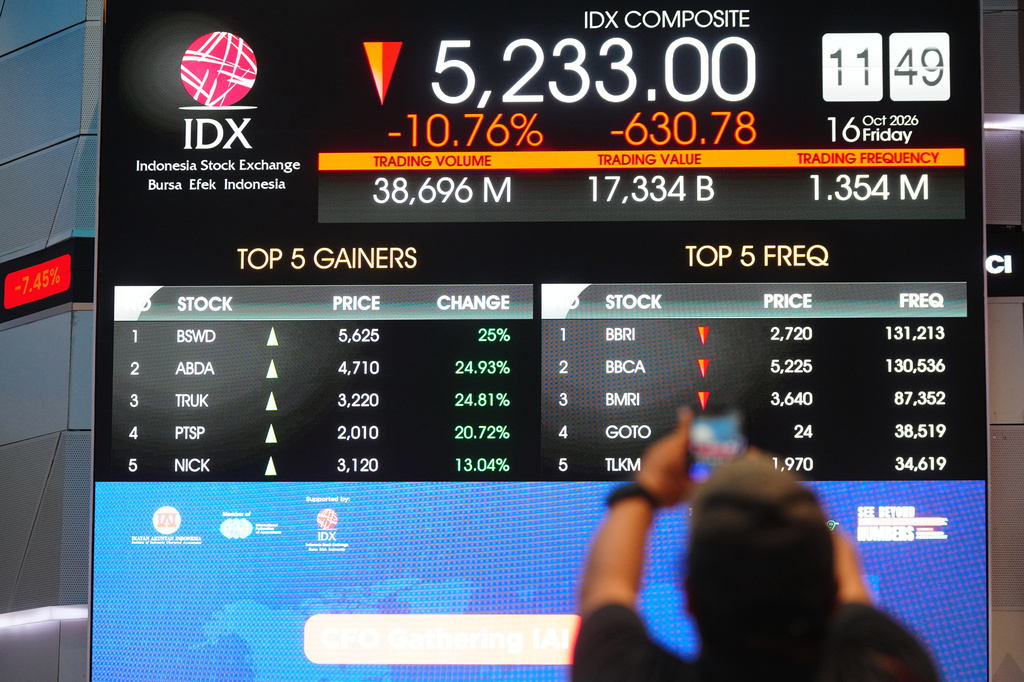
Indonesian stocks suffered their worst rout in nearly three decades after MSCI Inc warned the country’s emerging-market status was in jeopardy, raising the prospect of its removal from global indexes and stoking fears of foreign capital flight.
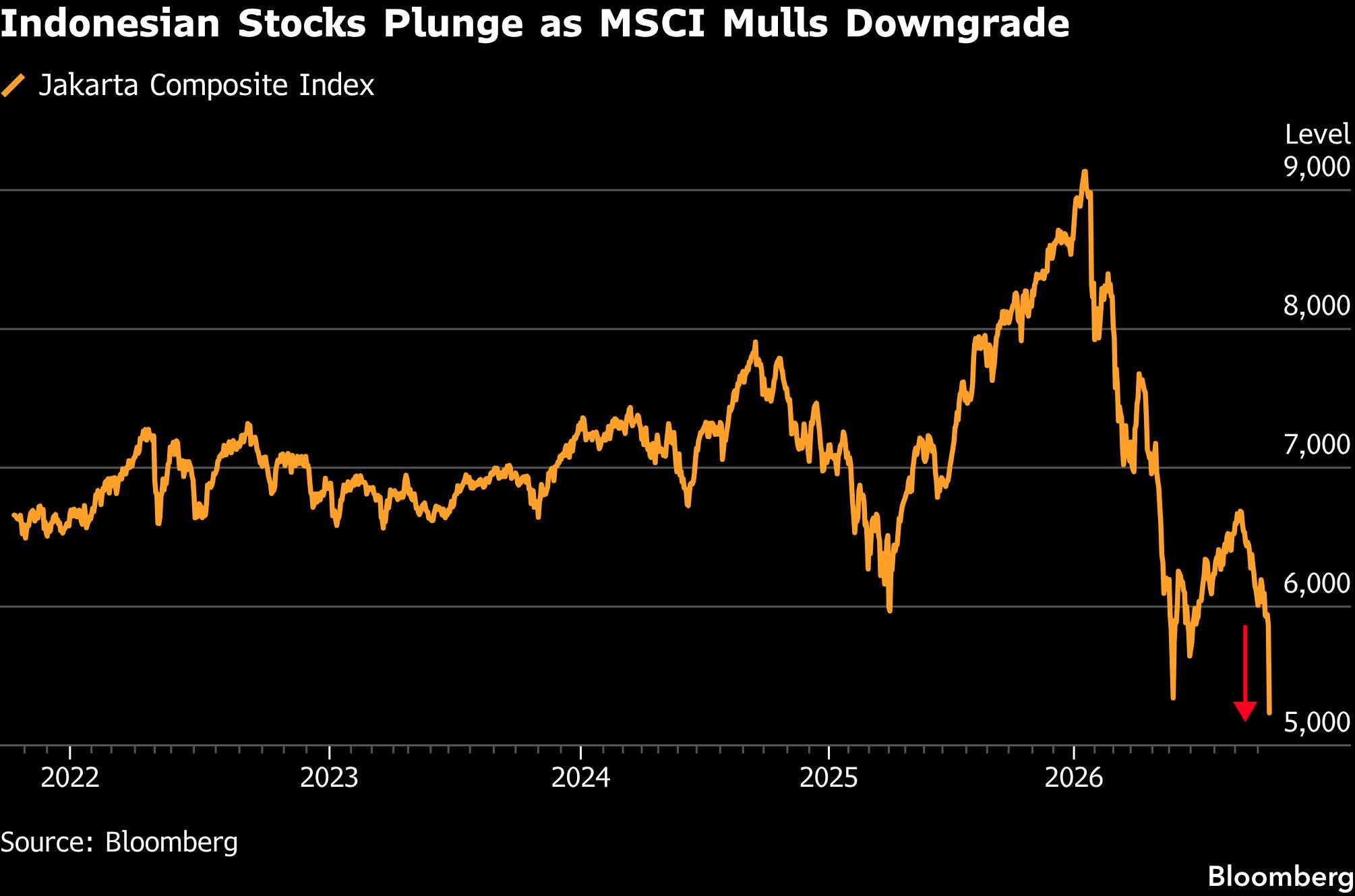
The benchmark Jakarta Composite Index tumbled nearly 12 percent, its biggest one-day decline since January 1998, in a selloff that triggered a 30-minute trading halt. Friday’s selloff added to an already punishing year for local equities, cementing their position as the world’s worst-performing market. The rupiah also neared a record low while bonds declined.
The index provider is launching a consultation and weighing what is effectively a double downgrade for Indonesian equities, bypassing frontier status and relegating the Southeast Asian nation to standalone-market status because of the severity of its investability problems, according to a statement. It expects to go ahead with its final decision in June unless there is clear evidence of material improvements in market governance.
At the heart of MSCI’s concerns are opaque shareholding structures, suspected coordinated trading and weak enforcement, it said. While Indonesia has announced reforms including greater ownership disclosures and higher minimum free-float requirements, the index compiler said that institutional investors want to see consistent implementation and evidence of material impact.
“It’s a massive hit to credibility,” said Felix Darmawan, an analyst at PT BCA Sekuritas. “MSCI is basically calling out the Financial Services Authority on opaque structures and lack of real enforcement. June 2027 gives the securities regulator some time to clean house, but the damage to foreign confidence starts right now.”
If downgraded, Indonesia would fall into the same country classification as Palestine or Lebanon. The review brings renewed scrutiny to governance under President Prabowo Subianto, who has been working to restore confidence and lure investors back to the region’s biggest economy after a bruising year. His government is already contending with criticism over funding for its ambitious lunch program, concerns about central bank independence and unease over growing state control over key industries.
Mirae Asset Sekuritas Indonesia estimates that a reclassification to standalone could trigger around $3 billion in passive outflows based on Indonesia’s remaining weight of some 0.4 percent in the MSCI Emerging Markets Index. Citigroup Inc puts that figure at mid-single-digit billions.
In response, the Indonesia Stock Exchange said it plans to seek clarification from MSCI on the rationale behind the reclassification plan, pointing to what it called “significant progress and reform measures”. The financial services regulator, meanwhile, says it’s reviewing the assessment and is committed to strengthening law enforcement in the market.
The regulator, in a separate briefing, said it has found evidence of stock-trading manipulation in PT Dian Swastatika Sentosa, imposing 1.5 trillion rupiah ($83.2 million) in fines to related participants. Separate probes found manipulation in the allocation of shares during the initial public offering process for PT Barito Renewables Energy and PT Petrindo Jaya Kreasi.
Weak reforms
For years, investors have complained that the inability to trade a large portion of the market because of low float, coupled with questions over who owns what, has undermined the integrity of the stock market. The resulting concerns over price discovery and whether trading reflects true supply and demand were thrust into the global spotlight in January, when MSCI first raised the prospect of a downgrade to frontier status.
Earlier estimates for a potential frontier-market downgrade pointed to about $5 billion in additional passive outflows from MSCI index-tracking funds and a further $3.5 billion if FTSE Russell followed suit, according to Goldman Sachs Group Inc analysts in June.
Still, the latest escalation surprised local officials. On Friday, the stock exchange’s development director told reporters that MSCI had given no indication about a possible downgrade at a recent meeting with other regulators, FTSE Russell, Moody’s and global investors.
The scrutiny comes as foreign investors are already heading for the exits. Global funds have pulled a net $4.9 billion from Indonesian stocks so far in 2026, on track for the worst year ever. The main stock benchmark has fallen 40 percent. The selling has spilled into the currency market, with the rupiah down about 8 percent this year to become Asia’s worst-performing currency. That’s even as Bank Indonesia reiterated its commitment to maintaining rupiah stability.
A shift to standalone only intensifies those pressures. The designation is reserved for markets that fail to meet MSCI’s criteria for either its emerging- or frontier-market indexes, and can weigh on both share prices and liquidity. Currently, no Asian market carries that status.
“Standalone is unambiguously worse than a Frontier downgrade, if implemented, as there is no Frontier-index inflow offset, and every remaining EM-benchmarked passive dollar would have to exit,” Citigroup analysts including Ferry Wong wrote in a note. While valuations are already “crisis-cheap”, they see no catalyst for a re-rating.
In the announcement, MSCI said it will also maintain its freeze on certain index changes involving Indonesian securities until further notice. This year alone, the MSCI Indonesia Index, due to regulatory changes, has already lost half of its membership. Meanwhile, FTSE Russell earlier this month reaffirmed the emerging-market status of Indonesian equities amid efforts taken by local authorities.
For now, some say that it’s better to wait on the sidelines for fear of the situation deteriorating. “This will make Indonesia a ‘pariah’ market as it gets kicked out of EM indices,” said Valverde Investment Partners’ John Foo. “Best case will be further foreign outflows, worst case will be complete exit by foreign funds as too small to bother. We are lucky we have zero exposure to Indonesia for now. Bad gets worse.”
