

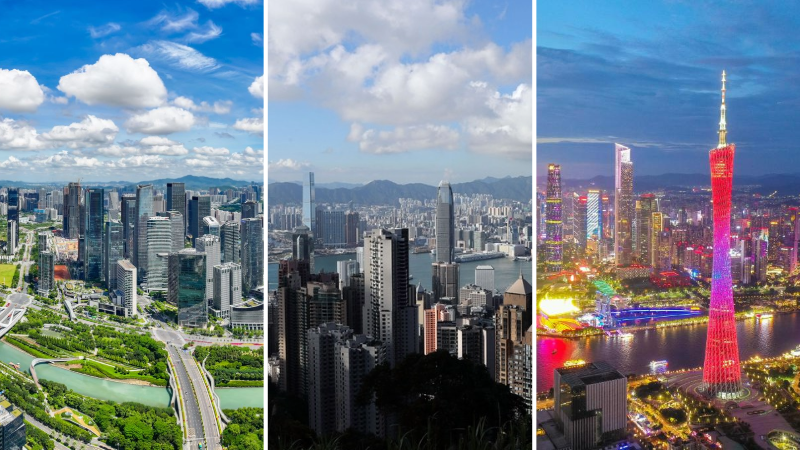
Twenty-one companies in the Guangdong-Hong Kong-Macao Greater Bay Area have made this year’s Fortune Global 500 list, with precision manufacturing and internet services rising strongly, powered by the latest intelligent technologies.
Last year, 23 Greater Bay Area companies were included in the rankings. Property giants Vanke and Country Garden — once frequent entrants from Shenzhen and Foshan respectively — missed out this year amid the deep restructuring in the real estate industry.
Shenzhen, Guangzhou, and Hong Kong have eight, six, and five companies on the list respectively, while Foshan and Dongguan each has one, according to the rankings, released by Fortune on Tuesday.
Shenzhen-based insurer Ping An Insurance continued to lead Greater Bay Area companies, ranking 48th worldwide. Huawei Investment & Holding Co Ltd moved up two places to 81st, while electric vehicle maker BYD remained at 91st. Internet giant Tencent jumped 19 places to 97th, entering the global top 100 for the first time.
Among Guangzhou-based companies, China Southern Power Grid ranked highest at 86th.
ALSO READ: Guangdong, HK, Macao jointly showcase GBA opportunities to SOEs
Hong Kong-based China Resources slipped one place to 68th, while Lenovo Group climbed 43 places to a record-high 153rd.
Foshan-based home-appliance manufacturer Midea Group ranked 231st, and Dongguan’s Luxshare Precision Industry recorded the largest rise, surging 86 places to 337th.
A total of 122 Chinese companies made the list, eight fewer than last year. China remained second globally behind the United States, which had 141 companies. The Chinese companies generated combined revenue of about $10.4 trillion.
READ MORE: Greater Bay Area emerges as launchpad for China's biotech rise
Globally, the top 500 companies generated a record $43.1 trillion in revenue, up 3.2 percent year-on-year. Amazon topped the rankings for the first time, followed by Walmart, while China’s State Grid remained third.
Guo Wanda, executive vice-president of the Shenzhen-based China Development Institute, said the latest rankings reflect a K-shaped pattern of economic development increasingly evident in both China and the United States.
Companies representing the digital and intelligent economies are expanding rapidly and moving up the rankings, while some traditional sectors, including property, conventional manufacturing and services, are under growing pressure.
The advances made by Tencent and Luxshare Precision Industry illustrate the momentum of industries driven by digitalization, artificial intelligence and intelligent manufacturing, Guo said. A city’s economic performance will increasingly depend on whether it can successfully foster new industries and growth drivers as part of its broader economic transformation, he added.
READ MORE: Guangdong, ASEAN to discuss collaboration at supply chain forum
Zhang Guoping, associate researcher at the Shenzhen Academy of Social Sciences, said Shenzhen’s four companies in the global top 100 — Ping An Insurance, Huawei, BYD and Tencent — demonstrate the strength of the city’s emerging productive forces.
Tencent’s 19-place rise into the top 100 is particularly significant, reflecting its transformation from a consumer internet platform into an AI-driven technology company, with cloud services and large language models providing new revenue streams.
Zhang said Shenzhen has developed a diversified group of leading companies spanning advanced technology, new energy vehicles and the digital economy, rather than relying on a single dominant industry.
The absence of Vanke and Country Garden from this year’s list is therefore more than a short-term reflection of the property cycle; it highlights a structural shift from growth driven by land development, urbanization and leverage toward growth based on technological innovation, advanced manufacturing and the digital economy, he said.
Yao Xi contributed to the story.
