

Editor's note: A new wave of entrepreneurship is sweeping across the Chinese mainland, driven by the rapid rise of AI-powered one-person companies. The second article in our series analyses how governments are optimizing policies to avoid homogeneous competition and drive differentiated development of OPCs.
With one-person companies becoming one of the hottest entrepreneurial trends on the Chinese mainland, favorable government policies have been upgrading with the aim of fostering a full-fledged ecosystem for small businesses to grow. Zhou Mo reports from Shenzhen.

When GBAnexus — a government-backed big-data center in technology powerhouse Shenzhen — launched China’s first inclusive online artificial-intelligence platform for one-person companies (OPCs) and other small enterprises last month, it marked more than just a new digital service for solo entrepreneurs.
The platform — offering free cloud resources, low-cost access to AI models, limited free data services, and full-chain entrepreneurial incubation — aims to bring down digital costs for OPCs, making it easier for them to grow.
Procurement costs of computing power, AI models and data are too high for OPCs to afford, leaving them at a disadvantage. Moreover, OPC founders often operate without access to professional entrepreneurial guidance and industry connections to turn ideas into viable businesses, says Li Dongyang, director of operations at GBAnexus.
READ MORE: Keeping heads above the water
“We want to build an inclusive service community where the benefits of AI can be shared by micro firms, and solo entrepreneurs can receive tailored entrepreneurial support,” he says.
Li says the platform’s computing resources are available at 50 to 80 percent of prevailing market prices. OPCs can also gain access to its more than 40 billion data records.
Its launch stands as a vivid example of how Chinese mainland authorities have gone to great lengths to back one-person businesses — a model that’s undergoing a significant upgrade. While cities threw their hats in the ring to attract solo entrepreneurs with financial subsidies and affordable working spaces, they are now creating a sound ecosystem with comprehensive resources, such as computing power, skill trainings and application scenarios, to fuel their growth.
The fever of introducing OPC-related policies and measures among mainland provincial-level areas and cities hasn’t cooled down in the second half of this year. Southwest China’s Yunnan province and the Northwest China city of Xi’an, Shaanxi province, unveiled a series of measures to support OPC development last month.
East China’s Zhejiang province introduced the country’s first specialized terminological standard focusing on OPCs, providing a unified industrial benchmark for the identification, evaluation, operation and services of OPCs across the country. The provincial capital of Hangzhou in June launched an all-in-one service guide that aims to establish a companion-style service mechanism for OPCs.
The initiatives mark a major shift from initial supportive policies rolled out nationwide, largely centering on financial incentives and subsidized office space.
Ye Fei, general manager of the Plug and Play China GBA International Innovation Center, has strong feelings about the frenzy, recalling the time he was approached by the authorities of various districts in Shenzhen and cities across the country that sought his advice on developing OPCs.
“I told them to think twice before jumping on the bandwagon as this model is never a one-size-fits-all solution for every city. Local governments need to clarify their core goals first as different objectives call for different strategies,” he says.
Tailor‑made policy needed
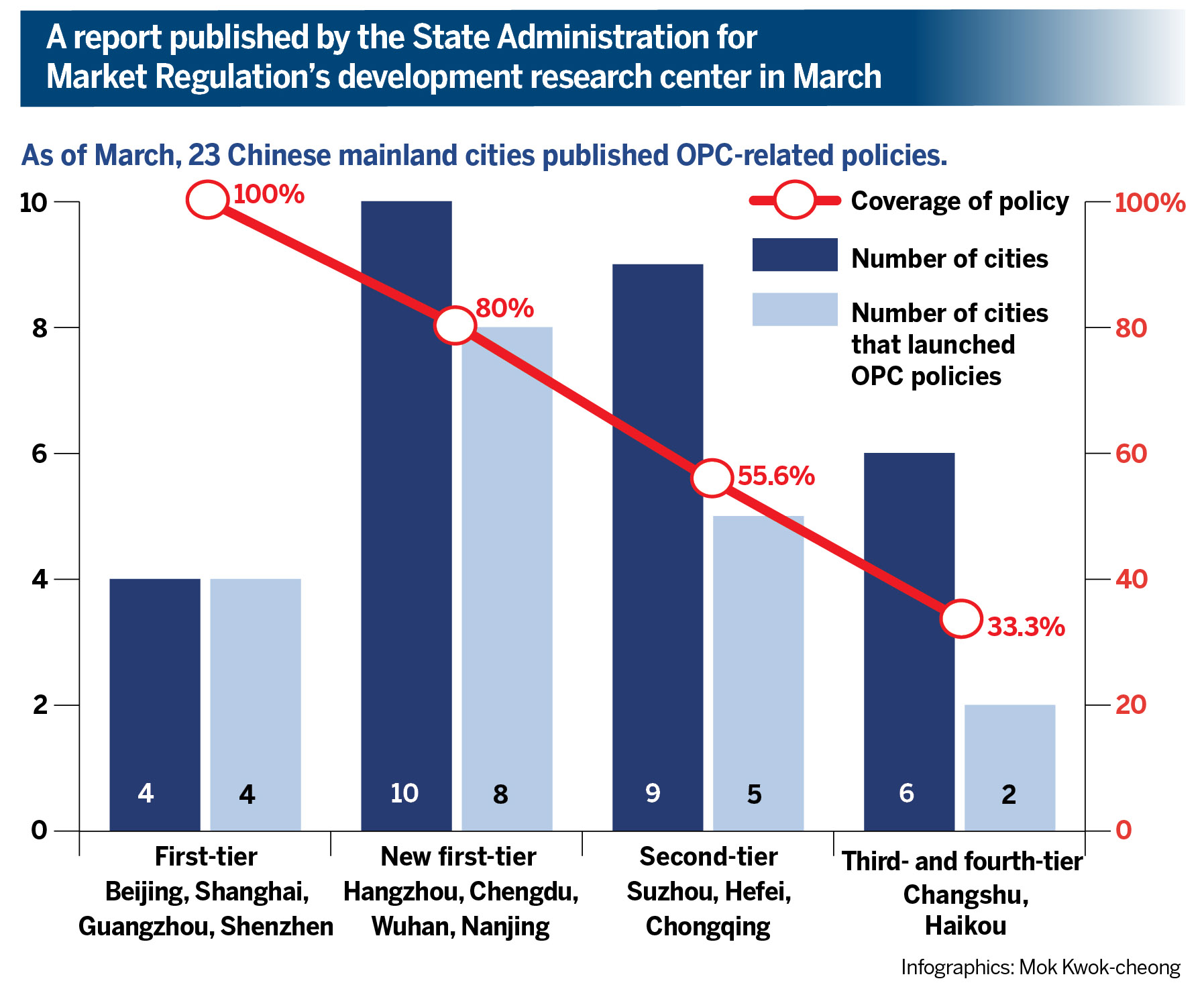
As of March, 23 Chinese mainland cities had launched OPC policies, with over 100 policy measures unveiled, according to a report published by the State Administration for Market Regulation’s development research center.
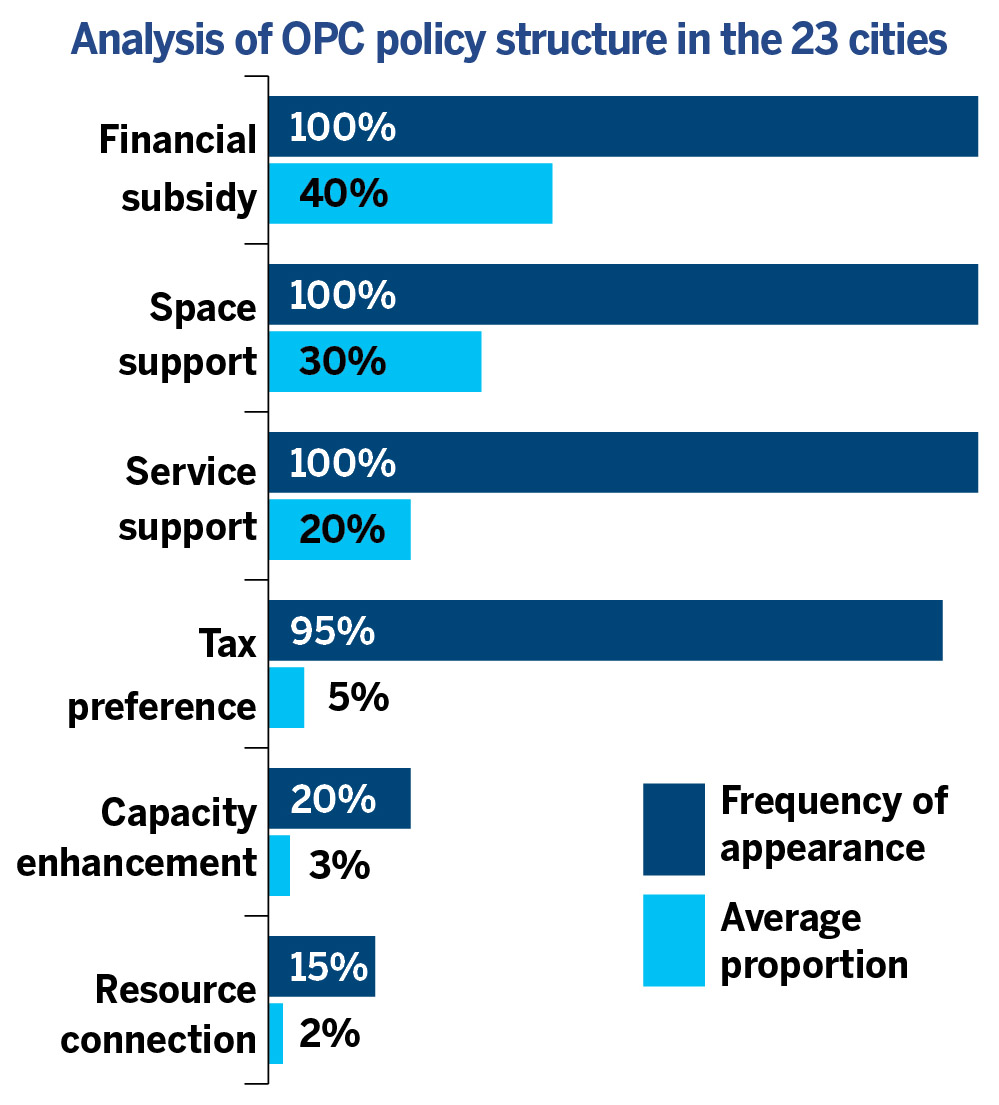
Most of the cities’ policies centered on financial subsidies, working space support and public services provision, with little differentiated designs based on local conditions, the report said. Some local governments even replicated policy frameworks from peer cities, leading to high homogeneity.
All 23 cities provided policy measures in the three aspects mentioned, the report found. While 95 percent of local governments launched preferential tax measures, only 20 percent offered OPCs support on capability enhancement, such as skill training and talent introduction. The proportion of cities that focused on helping OPCs with resource matching, such as supply-chain connection and market expansion, was even lower, at 15 percent.
“Some local governments lack in-depth understanding of the OPC model and roll out policies merely out of peer pressure,” Ye says. “They are like students rushing to hand in their papers — when other cities introduce OPC policies one after another, they feel compelled to follow suit for fear of being left out of the new trend.”
Another reason behind their anxiety lies in the potential “siphon effect” brought by OPC policies in peer regions. “Once a region introduces preferential policies, it may draw OPCs and high-quality talents from other regions, bringing hidden risks to their industrial layout and efforts to retain talents,” Ye says.
The consequences of unbridled competition are far-reaching and detrimental, says Peng Xiaozhao, assistant researcher of Department of Financial Development, State-owned Assets and SOE Research at the China Development Institute, a Shenzhen-based think tank.
First, generous subsidies offered by different cities could prompt OPCs to relocate frequently in a bid to reap preferential policy benefits, leading to a massive waste of public funds, he says. Second, because of similar policies, OPCs could crowd into the same segments and those with low barriers, stifling differentiated development and original innovation.
Peng also says that as OPC communities sprout up on the mainland following the launch of OPC-related policies, those without industrial chain support and practical application scenarios could struggle to retain firms, giving rise to high vacancy rates.
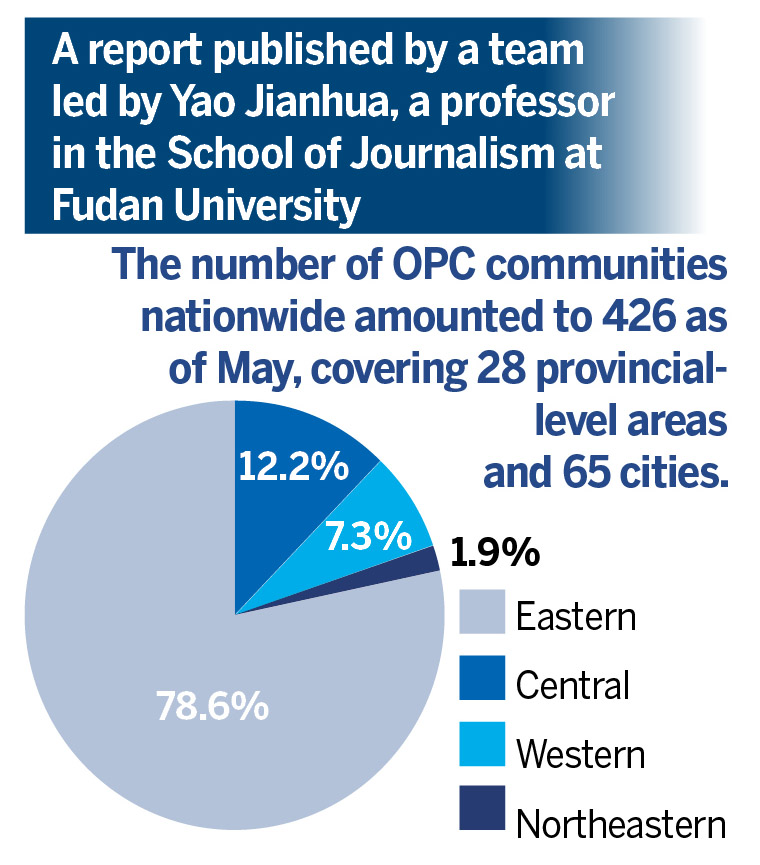
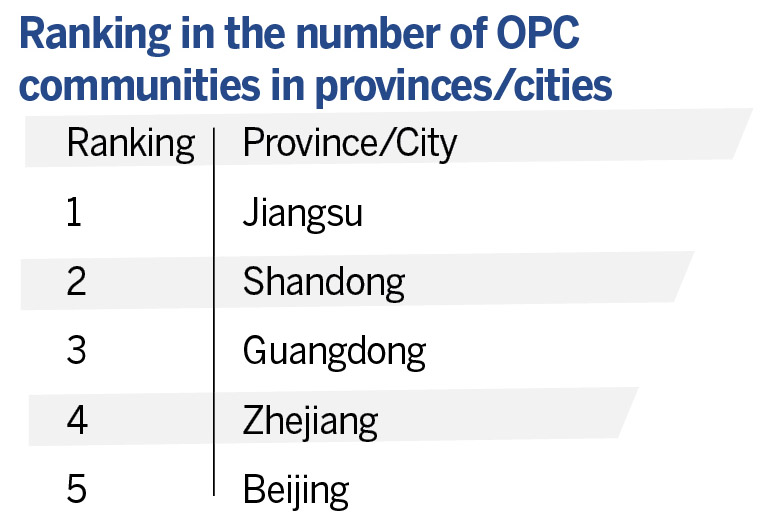
According to a report published by a team led by Yao Jianhua, professor of the School of Journalism at Fudan University, the number of OPC communities nationwide had reached 426 by May, covering 28 provincial-level areas and 65 cities. East China’s Jiangsu province topped the number with 158 OPC communities, accounting for 37.1 percent of the nation’s total, followed by East China’s Shandong province and South China’s Guangdong province, which had 40 and 36 OPC communities respectively.
Encouragingly, the “FOMO”, or “fear of missing out”, mentality outlined by Ye is gradually fading. Local governments and OPC community operators increasingly recognize that successful OPC development depends not on how quick preferential policies are introduced or how many incubators are being built, but on establishing a robust industrial ecosystem tailored to solo entrepreneurs.
Building ecosystem
“Whether an OPC community can foster the growth of solo entrepreneurs hinges on whether its operator truly understands the development logic and operational needs of this emerging business group,” says Wu Xi, head of operations at Angel Family — one of the first group of OPC communities in Shenzhen. “An OPC community should not serve merely as a property landlord. Instead, it should build a system that covers venue, policy, capital, application scenarios and services.”
Moreover, it should give full play to its role as a “translator” between governments and OPCs, facilitating targeted policy implementation by authorities and fostering sustainable growth for startups, Wu says.
“On one hand, we know exactly what difficulties OPCs are facing. We organize them into practical suggestions and pass them on to policymakers to help improve policies. On the other hand, policy documents are hard for many entrepreneurs to understand. We translate those policies into something they can really comprehend and use.”
ALSO READ: AI data platform to be launched in Shenzhen to support OPCs
Peng suggests that besides building a sound industrial ecosystem for OPCs, local governments should develop tailored OPC policy frameworks by leveraging their respective industrial foundations and institutional advantages.
In the Guangdong-Hong Kong-Macao Greater Bay Area, Shenzhen could build on its strengths in scientific and technological innovation and high-end manufacturing to strengthen technology supply and expand global market channels, serving as a cradle for OPC technological innovation, says Peng.
Capitalizing on its commerce and transportation hub status, Guangzhou could foster an open and inclusive ecosystem of application scenarios and professional services to develop into a commercial and operational hub for OPCs, he notes.
Meanwhile, Dongguan and Foshan, with their solid manufacturing base, could strive to nurture industry-focused OPCs in niche markets, Peng says.
“This will help form a complementary OPC industrial ecosystem across different cities, preventing homogeneous competition and redundant construction, thereby further enhancing the Greater Bay Area’s overall competitiveness in the global economic landscape.”
Contact the writer at sally@chinadailyhk.com
