

During a book launch, the artist discusses the limitations of technology and the timeless appeal of his bilingual comic adaptation of the Yi Jing, Yang Yang reports.

AI is capable of providing highly accurate answers, yet it lacks the ability to think independently and be creative. The key to effectively utilizing AI lies in asking precise questions and skillfully filtering through vast amounts of information, said 78-year-old cartoonist Tsai Chih-chung.
Tsai acknowledges that AI can enhance efficiency and reduce costs in comic creation. However, when it comes to traditional comic styles, AI falls short. "AI is just a tool; the ultimate control always remains in human hands," he noted, while addressing a question about AI's influence during the book launch ceremony of the English-Chinese bilingual edition of his comic book Yi Jing at the Beijing International Book Fair in mid-June.
READ MORE: The tireless cartoonist
The original Yi Jing (Book of Changes) is an ancient Chinese text known as the "foremost among the classics", and elucidates the principles of change in the universe and provides guidance for personal conduct and interaction with the world. For millennia, it has enriched the spiritual lives of the Chinese people.
"Mr Tsai, with his signature Zen-inspired artistic style, has vividly illustrated the various life situations depicted in the 64 hexagrams (divinatory symbols) in Yi Jing, breathing new life into this ancient classic in the modern world," said Zang Yongqing, deputy general manager of China Publishing and Media.
"He transforms the profound wisdom of Chinese culture into a visual language that appeals to people of all ages and tastes using just a single paintbrush," Zang added.
In 1984, Tsai founded a cartoon studio with the aspiration of becoming the world's most influential cartoonist. He asked a critical question: What kind of comic could be sold in over 100 countries, endure for thousands of years, sell more than 100 million copies, and be translated into multiple languages worldwide? The answer, he discovered, was comics about Eastern thought.
His initial comic adaptations of ancient Chinese classics included Zhuangzi Shuo (Zhuangzi Speaks) and Laozi Shuo (Laozi Speaks). To date, Tsai has adapted more than 40 Chinese texts, transforming Chinese philosophy into engaging, thought-provoking works with a clear, Zen-inspired style.
These adaptations have been translated into 27 languages and published in 67 countries and regions, with total sales surpassing 60 million copies, making them among the most widely read Chinese comics globally.
In 1990, after settling in Vancouver, Tsai began working on a comic version of the Yi Jing. However, he paused at the 27th chapter due to difficulty understanding many parts of this arcane ancient Chinese text. He resumed the project in 2011, with the Chinese-language version published in 2020.
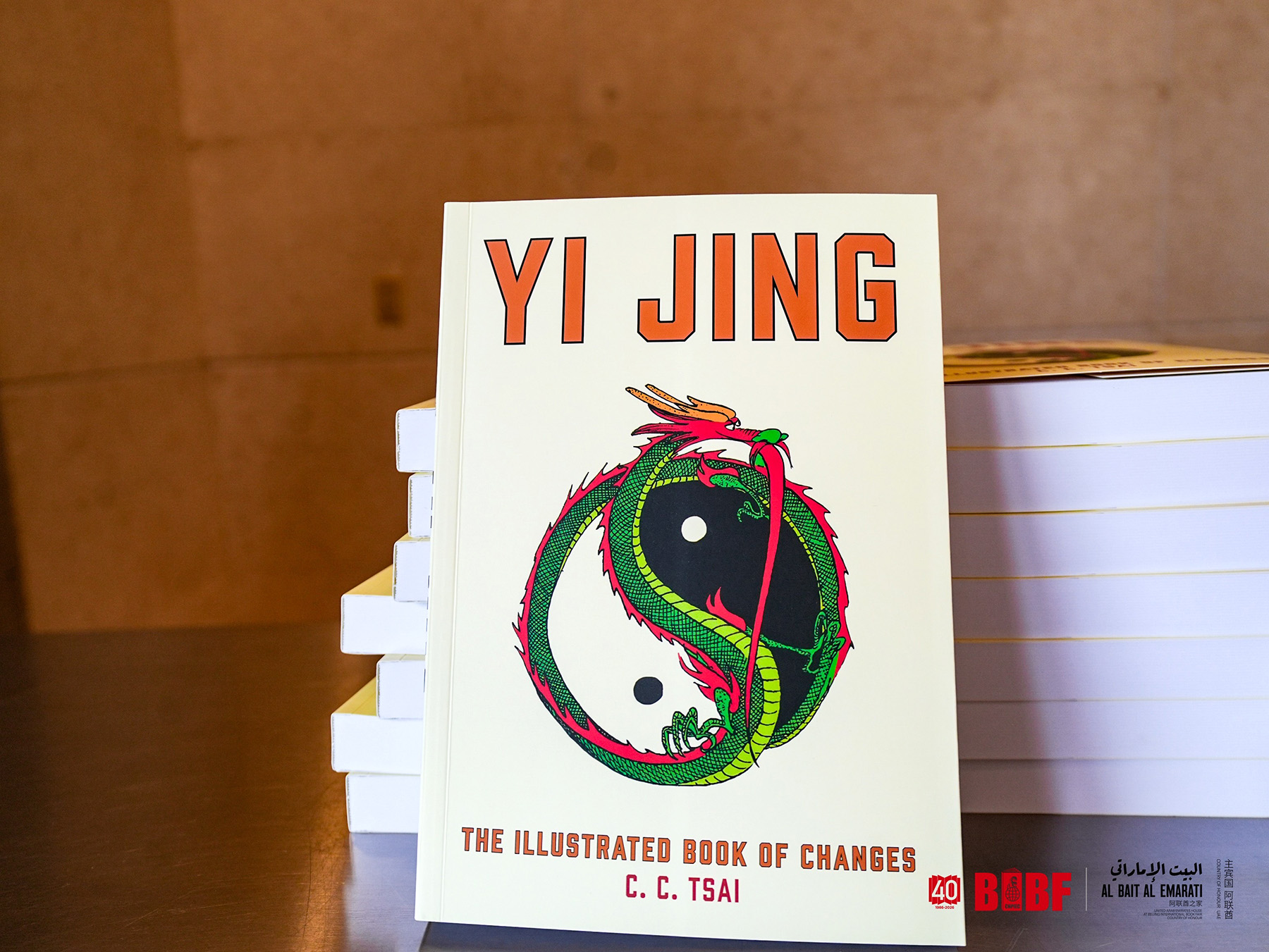
When drawing the illustrations for Yi Jing, Tsai explained that he first deconstructed each hexagram from the ancient divination text into its six lines. After drawing the hexagrams, he incorporated interpretations by Confucius and by Shao Yong from the Northern Song Dynasty (960-1127). Shao's work, Huangji Jingshi, is derived from studying the Yi Jing.
"Many people ask me, 'Is it easy to learn the Yi Jing?' My answer, 'It's very difficult.' There are two layers of meaning of Yi (changes). One pertains to the sun and the moon, the cycle of day and night, and the transformations occurring in the world. The second meaning is 'lizard' (its Chinese name is xiyi, named for its morphological changes), particularly a chameleon, which also symbolizes 'constant change'," he explained.
Tsai used the Qian Hexagram to address a young reader's question about how to navigate a world full of change and uncertainty. He explained that lines in this hexagram, such as "Hidden dragon, do not act", "A dragon appears in the field", and "A dragon flies in the heavens", emphasize the importance of understanding timing, preparation, and knowing when to advance or retreat at different stages of life.
"The whole logic of this hexagram is to tell people to maintain a calm, balanced mindset, build a strong foundation, evaluate the situation, and act accordingly," he said.
For Tsai, the Yi Jing possesses a timeless charm. One of the key reasons is its ability to offer positive psychological guidance when facing change and uncertainty. Even when confronted with "bad" hexagrams, one can find opportunities through the concept of "turning extreme adversity into prosperity".
He believes that this wisdom — of facing and understanding change and finding hope within it — is why the Yi Jing continues to resonate with people today.
In the early 1990s, Brian Bruya, now a philosophy professor at Eastern Michigan University, reached out to Tsai, expressing his wish to translate Zhuangzi Shuo into English. The translation was later published by Princeton University Press.
PUP has long been dedicated to the publication and dissemination of Chinese classics. In 1967, it published an English version of The I Ching, or Book of Changes, translated by US psychoanalyst Cary F Baynes based on German Sinologist Richard Wilhelm's German translation, and featuring a foreword by Swiss psychologist and psychiatrist Carl Jung. This edition became a crucial resource for the English-speaking world to understand the Yi Jing.
In 1992, Bruya's English translation of Tsai's comic book Zhuangzi Shuo was published by PUP as Zhuangzi Speaks: The Music of Nature, launching a 30-year-plus collaboration that translated eight key works from Tsai's comic adaptations of Chinese classics into English. Bruya translated seven of them, including The Way of Nature, Dao De Jing, The Analects, The Art of War, and The Ways of Zen.
Starting in 2018, these works were collected into PUP's series "The Illustrated Library of Chinese Classics". The latest addition to this series is the bilingual English-Chinese comic Yi Jing, published last month. This edition presents the text in a side-by-side format with clear English and the original Chinese, offering a visually engaging and accessible way for readers worldwide to explore the Yi Jing.
ALSO READ: Illustrating science for all
Christie Henry, director of Princeton University Press, said that The I Ching, or Book of Changes, is already a bestseller for the publisher, but its impact extends far beyond sales.
"Its philosophy helps us navigate the world, which is itself a very, very big book of changes," she said.
For her, Tsai has illustrated, with incredible creativity, some of the most formidable and enduring books of philosophy known to humanity at a time when humanity most needs its philosophical grounding.
"In this new vibrant original edition, Tsai Chih-chung brings to the Yi Jing a new chapter, a new life. And through his artistry and imagination, we will also be able to build bridges to new readers," she said.
Contact the writer at yangyangs@chinadaily.com.cn
