

Discoveries piece together the past of a settlement carved from rammed earth, a multicultural community and the development of an urban kingdom, Bai Shuhao reports in Turpan, Xinjiang Uygur autonomous region.
More than 1,000 years ago, during the Tang Dynasty (618-907), poet Cen Shen (c. 718-769) arrived one September evening in Jiaohe, an ancient city in what is now Turpan, in northwestern China's Xinjiang Uygur autonomous region.
On his way there, he passed the towering red peaks of the Flaming Mountains. Scorching winds stirred up dust along the road, and the heat left him drenched in sweat. He captured the journey in a poem, wondering why Heaven had made this place so unbearably hot, and why it had withheld the rain and snow.
Jiaohe (also known as Yar City) was featured in several of Cen's poems, as he was then serving on China's northwestern frontier. A document unearthed in 1973 even recorded the grain and fodder the seven horses he consumed during one of his visits.
In Cen's descriptions, the landscape was harsh and the climate unforgiving. Few birds were seen. Yet the city had its pleasures, too, including its fine wine.
READ MORE: Mountain of relics
Today, Turpan remains one of China's most climatically extreme regions. Summer temperatures can exceed 50 C, while winter lows approach — 30 C.
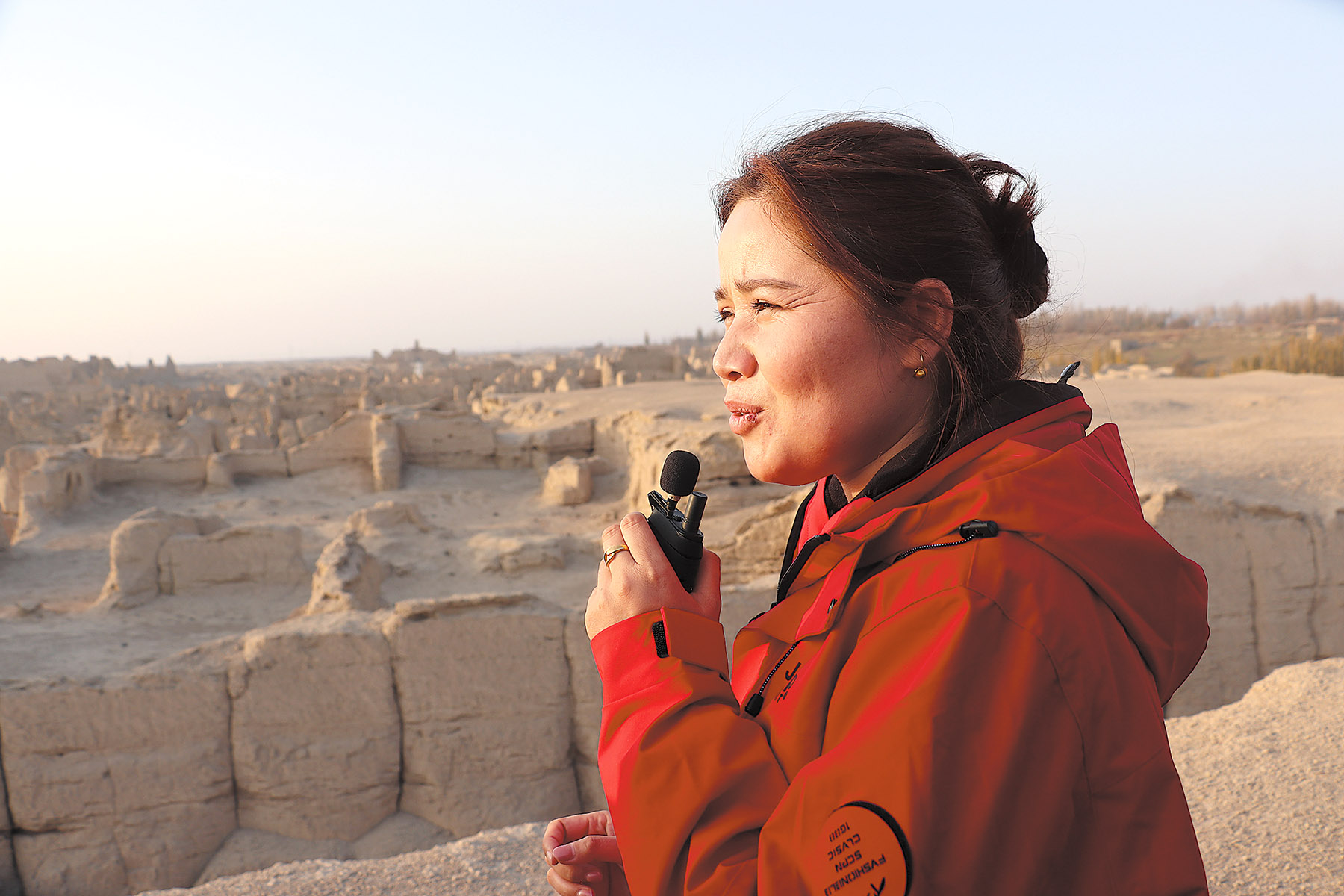
Jiaohe, however, has long since fallen silent. Its residents are gone, leaving behind an abandoned city whose past is now pieced together through archaeological remains and the tour guides' explanations.
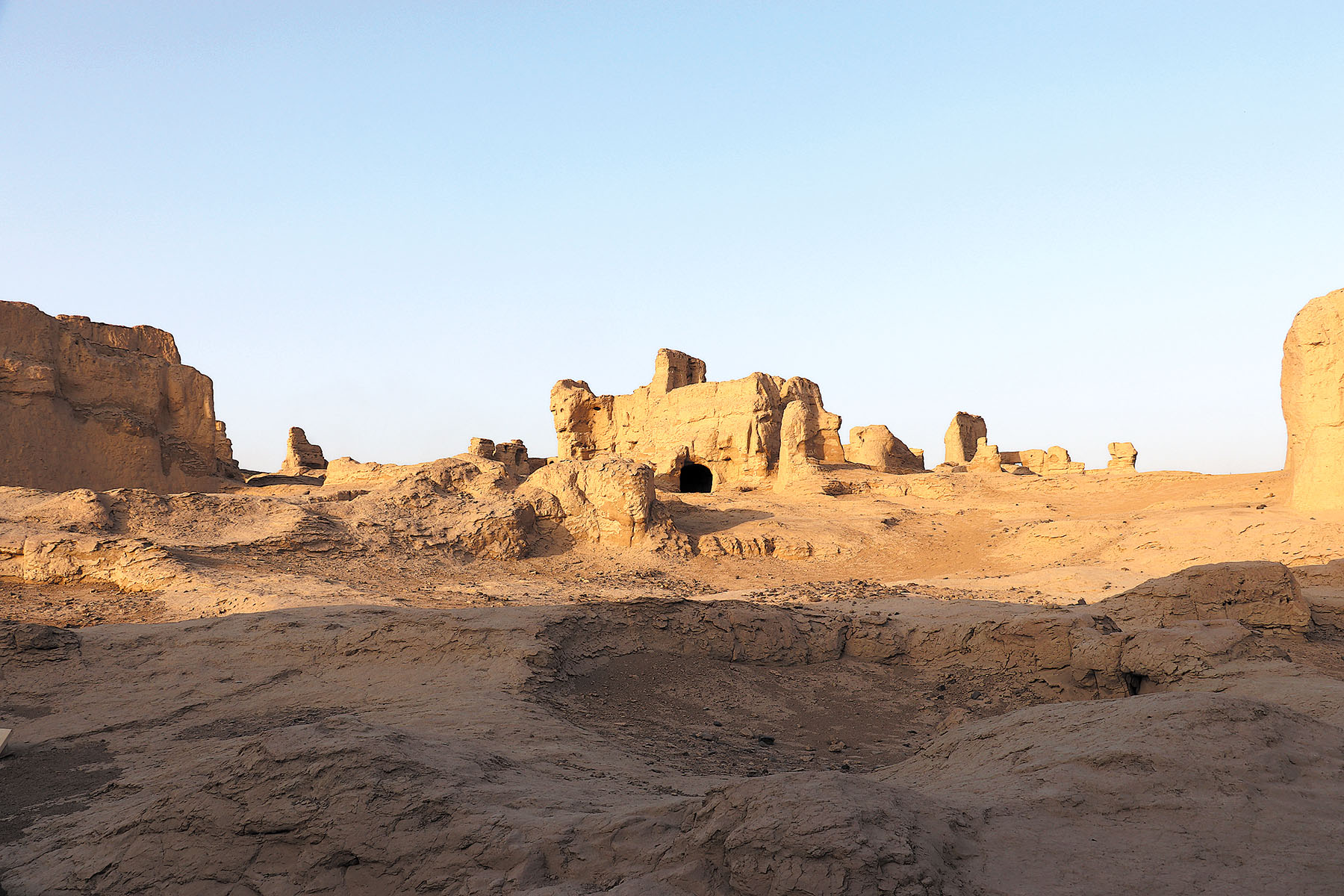
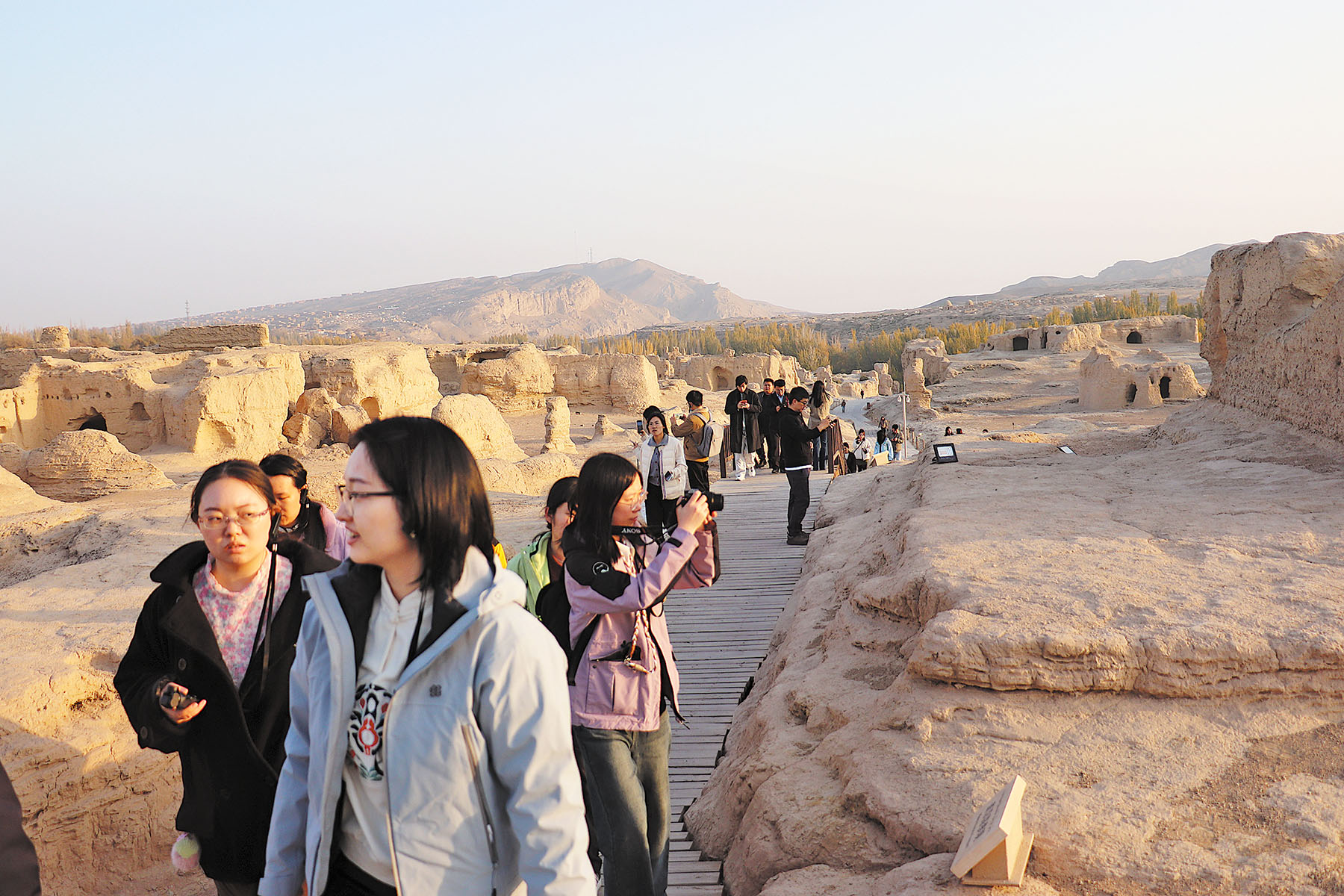
Earthen walls rise and fall across the landscape, some towering, others worn down to low ridges. Their broken edges intersect at irregular angles, while weeds have taken root in the cracks. Only from a raised viewing platform, where the remains stretch toward the horizon, does the city's former scale begin to emerge.
Jiaohe is one of the world's largest and best-preserved ancient urban settlements built primarily from rammed earth. Surrounded by river valleys, it occupies a plateau about 30 meters above the surrounding ground. The city stretches about 1,750 m at its longest point and 300 m at its widest. Seen from above, its outline resembles a willow leaf.
"The city connected the northern and southern parts of the Tianshan Mountains and occupied a strategic position along the Silk Road," says Wang Jiandong, director of the Jiaohe Ancient City Cultural Relics Management Office.
"People from the Han, Mongolian and Uygur ethnic groups and other peoples from the Western Regions (also known as xiyu, area that covers present-day Xinjiang and part of Central Asia) once lived here." Archaeological discoveries suggest that seven religions were practiced in the region, where 19 writing systems and 25 languages were used, Wang says.
This diversity stems from the city's long history as a crossroads of people and cultures.
Between the second century BC and the fifth century AD, the ancient Jushi kingdom established its capital here, laying the foundations for Jiaohe's development as an important urban settlement.
The Book of Han, a history of the Western Han Dynasty (206 BC — AD 24), describes its location: "The river divided into two streams and flowed around the city below, hence the name Jiaohe," which means "river junction".
Wang believes the island-like plateau between two river channels was chosen partly for protection. Its natural defenses helped shield inhabitants from rival tribes and wild animals, while the settlement's development marked the Jushi people's transition from a nomadic society to an urban kingdom. But Jiaohe's most striking feature may be the way it was built.
Unlike conventional cities, which are constructed upward from the ground, Jiaohe was, in a sense, carved out of the earth.
Its builders used a technique known as subtractive construction. Rather than building walls with bricks or stone, they removed the surrounding earth, leaving the remaining soil to form walls and other structures. Doorways, windows and rooms were then carved directly into them.
The technique was closely tied to the local environment, Wang says. Turpan offered few suitable building materials, making locally available earth a practical choice. The region's extremely dry climate also helped preserve the structures, while their thick walls offered protection from the summer heat.
Yet neither the city's defensible position nor its distinctive architecture could spare it from conflict.
Jiaohe stood at a crucial gateway to the Western Regions, serving both the Chinese empires in the Central Plains and nomadic peoples moving south from the north.
Between 108 and 60 BC, Han Dynasty forces and the Xiongnu, a powerful nomadic confederation to the north, fought five battles in the area. After the Han emerged victorious, they established the Protectorate of the Western Regions in nearby Luntai to oversee the region.
The Han court subsequently set up an agricultural garrison at Jiaohe. Its troops cultivated farmland and stored provisions to help secure the Silk Road and maintain the empire's presence. The city also developed an increasingly diverse culture.
Jiaohe reached its height during the Tang Dynasty. Early in the dynasty, the Tang court established the Anxi Protectorate General's Office there, the country's military and administrative authority in the Western Regions. Its first head was Qiao Shiwang, who was married to a Tang princess.
Cen Shen also served in the Anxi Protectorate, although by the time of his appointment its headquarters had moved to Qiuci, another important city in the Western Regions. Jiaohe nevertheless remained a major urban center.
"At one point, Jiaohe was a political, economic, military, and cultural center of the entire Western Regions," Wang says.
Silk and porcelain from the Central Plains were traded alongside spices and other goods brought from the West. People of different ethnic backgrounds moved through its streets, creating what Wang describes as a "multicultural community".
One of the clearest examples of this diversity emerged in 2005, when archaeologists excavated a cemetery belonging to the Kang family in Jiaohe.
An inscription on the tombstone of a family member, Kang Yanyuan, identified the family as Chinese. However, archaeologists believe the Kangs were not Chinese in the conventional sense. They were Sogdians, an Iranian-speaking people from Central Asia who had settled in Jiaohe.
"They intermarried with local people along the Silk Road and gradually integrated into local society," Wang says.
"It is difficult to say that any particular ethnic group built this part of Jiaohe. The city was developed and shaped collectively by different peoples over different periods."
The city's religious life also reflected this diversity. Archaeologists have identified over 50 Buddhist sites in Jiaohe. Buddhism traveled from India through the Xinjiang region before reaching the Central Plains, developing distinctive local forms along the way.
To understand Jiaohe, however, its history must be viewed within the broader context of life in the Turpan region, says Lyu Wenli, deputy director of the Institute of Chinese Borderland Studies at the Chinese Academy of Social Sciences.
"Unearthed documents show that people of different origins settled in Turpan, registered as residents, shared roads and irrigation channels, took part in agriculture and other forms of production, and formed connections through marriage and religious practices," Lyu says.
"These materials offer concrete examples of how different ethnic groups interacted, communicated, and became integrated, providing a local historical perspective on the formation of Chinese civilization as a diverse yet unified whole."
By the 14th century, years of warfare had devastated much of the Turpan region. Jiaohe suffered extensive damage and was eventually abandoned.
ALSO READ: Therapeutic treasure is lying buried in the dunes of Xinjiang
In the more than 600 years since then, wind, temperature fluctuations and occasional heavy rainfall have continued to erode its fragile earthen structures.
For visitors, the city's unusual construction remains one of its greatest surprises. Cai Junming, a 73-year-old visitor from Singapore, was struck by the ingenuity of its ancient builders. He says he had never imagined that an entire city could be created by digging into the earth.
For Wang, who oversees the cultural relics, Jiaohe has always been part of the landscape of his childhood. He grew up in Turpan knowing that an ancient city stood nearby, but knew little about the history behind its ruins.
Now, he spends much of his working life walking among them, trying to preserve what remains and telling the stories of the people who once called the city home, and how people of different ethnic backgrounds came together over centuries to shape the city's history and culture.
His favorite moment comes in the late afternoon, when he stands on the viewing platform and watches the sun sink toward the horizon. Golden light settles over the earthen walls, bringing out their uneven contours and weathered surfaces.
In that quiet moment, he says, the weight of centuries seems almost tangible.
Contact the writer at baishuhao@chinadaily.com.cn
