

Mature performers defy convention to express themselves via unexpected musical genres
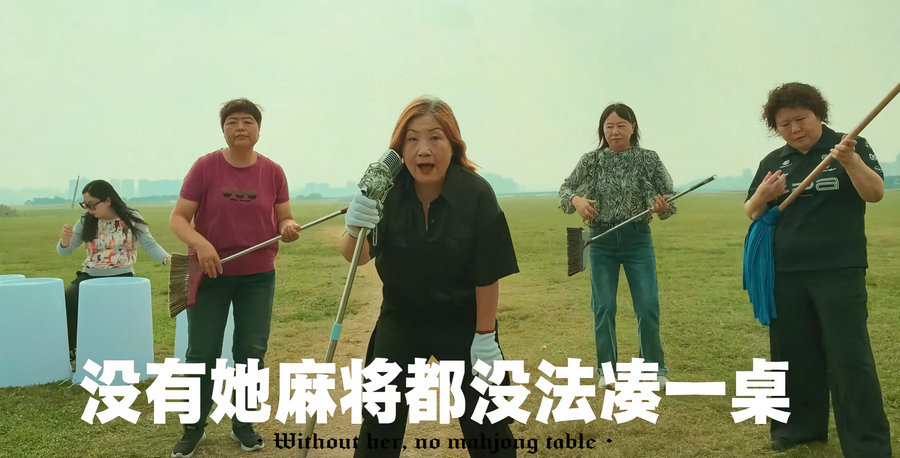
"Yesterday, another one of my girlfriends died.
The day before, we were still blaming her for not being there, saying we couldn't get a full table of mahjong without her. One by one, they've all gone … I'm terribly afraid of dying."
The words are delivered in a strong regional accent over a rap beat by a woman in her 60s. There is no cool music video, choreographed performance or manufactured hip-hop image. Instead, she speaks openly about death, friendship and the people disappearing from her life.
The song, Yesterday, Another One of My Girlfriends Died, is the work of Gui Xiang, a 62-year-old woman from Suzhou, Jiangsu province, who has found an unlikely fan base through rap.
Her unconventional performances are growing in popularity on Chinese social media, where her age, raw delivery, accent and irreverent humor defy images usually associated with hip-hop artists. She has 215,000 followers on Xiaohongshu (Red-Note) and 575,000 on Douyin, where her videos have accumulated more than 12.35 million likes.
READ MORE: Acing it
Gui is part of a growing cohort of middle-aged and older Chinese women indulging in unexpected musical roles, from rappers and rock musicians to singers who have turned public parks into their stages.
Their stories point to a broader shift in how some Chinese women are approaching later stages of life. Instead of restricting their leisure activities to familiar pursuits, such as square dancing in public parks, practicing tai chi or doing morning exercises and looking after grandchildren, they are experimenting with fresh artistic expression, including genres and subcultures traditionally associated with younger people.
A growing interest in tech skills and an appetite for late-life learning are also improving their capabilities to pursue new interests. The 2025 New Silver Generation Lifestyle Report, published by Beijing News, found that more than half of the respondents — those aged over 60 — had attended or were attending interest classes or training courses. Nearly one-fifth were learning new skills, ranging from using digital devices and photography to handicrafts and short-video editing.
The report also found that short-video platforms have become an important part of older people's lives, with nearly 60 percent of respondents using platforms such as Douyin and Kuaishou.
Sociologist Zhang Hexuan, who holds a doctorate from University College London, said this generation is entering old age equipped with new digital tools and skills.
They have diverse sources of information and a strong desire to explore, he said, while retaining a preference for social interaction and collective activities.
"Personal growth and a sense of belonging to a group are developing simultaneously in this generation," he said.
China's community networks provide a foundation for the more varied, multi-interest lifestyles they are seeking, Zhang added.
Hip-hop pioneer
Older women experimenting with alternative music offer a striking expression of that desire for self-development and self-expression.
Gui said rap is a way to say things she might otherwise leave unsaid. Before becoming an online sensation, she worked as a music teacher and performed kuaiban, a traditional Chinese rhythmic storytelling art accompanied by clappers. She also sang on the streets of Suzhou.
Her route into hip-hop was self-directed. During the 2026 season of the online rap program Rap to Top, her videos began attracting attention. She subsequently developed a storytelling style that combines everyday observations, her regional identity and a relaxed, conversational approach.
"I didn't expect to become an internet sensation in my 60s. I studied all these techniques of hip-hop music through my own research, simply because I enjoy the music," she said.
"I think rap gives me a way to express what I really think and feel. I can talk about things I've experienced, things happening around me, and even topics that people are discussing in society."
ALSO READ: When age opens doors
Her performance earlier this year for a Chinese dairy brand took her to an even wider audience. Wearing pink glasses and a matching outfit, she performed a playful promotional rap for a strawberry-flavored sweetened milk, repeatedly singing about drinking "a pink liquid" with her friends.
The offbeat video became an internet favorite, attracting over 1 million likes and more than 3 million shares on Douyin.
But it is her more personal work that reveals why she connects deeply with people.
In Yesterday, Another One of My Girlfriends Died, Gui turns the fear of aging and mortality into an unfiltered conversation among friends. Her lyrics recall the women who once gathered around a mahjong table, and the growing realization that some of them will never return.
The music video was released on Oct 18, the day of the Chongyang Festival or Double Ninth Festival, a traditional Chinese holiday honoring the elderly. It received nearly 4 million views on Chinese video-sharing platform Bilibili.
One viewer on Xiaohongshu praised the honesty of her writing, noting that Gui had found something she genuinely loved, an outlet for her emotions and a way to express herself without pretending to be someone else.
"Why shouldn't someone my age rap?" Gui said. "I just want to make music I enjoy and express myself in my own way."
"Learning something new makes me happy. I don't think age should stop anyone from trying something they love."
Taoranting 'Shakira'
In Beijing, another mature woman has found her own musical outlet, although her approach is more traditional.
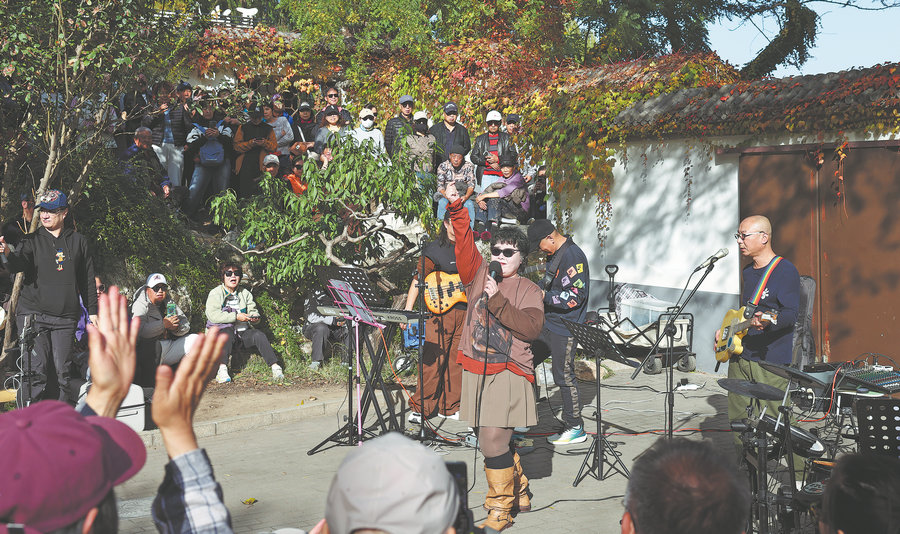
Bao Jian, 56, has become a familiar presence in Taoranting Park, where she performs every Friday with YE Xing Band, a group of musicians all over 50. Her powerful voice and easygoing stage manner have earned her the affectionate online nickname "Taoranting Shakira".
The moniker took off after a video of her singing Waka Waka, Shakira's 2010 FIFA World Cup anthem, went viral two months ago. Even Bao's mother learned about her park performances through social media.
On a recent autumn afternoon, Bao emerged from the crowd with a broad smile, prompting an immediate burst of cheers. Taking the microphone, she apologized for keeping everyone waiting.
"I'm very sorry I'm five minutes late," she said. "I had four cartloads of stuff to bring, but I forgot the microphone. That wouldn't do, would it?"
The audience erupted in laughter.
"I even skipped my afternoon nap to come and see you!" an older audience member called out.
READ MORE: Two Chinese women named among FAO's 100 Women Heroes
Without missing a beat, Bao announced her first song: Up! by Canadian country-pop singer Shania Twain.
The weekly performances are less a career revival than a continuation of a long-standing passion.
She studied bel canto opera singing for three years at a teachers' college and worked as a music educator after graduating. Later, she joined the military while continuing to sing with different bands, participating in music programs and competitions in her spare time.
The musicians who make up YE Xing Band are old friends, many of whom spent decades in the music industry. They now play for free in the park, attracting regular listeners, curious passersby and people who have come just to hear them.

Their choice of venue is partly sentimental. The musicians grew up visiting Taoranting, once a popular weekend destination for children in Beijing.
"When we were young, Taoranting was one of the most enjoyable parks in the city," recalled Meng Jun, the band's bassist and keyboardist. "There was a big artificial snow mountain and an iron suspension bridge. We came here on weekends and made many happy memories."
For the musicians, the park also offers something commercial venues may not: an audience without expectations or obligations. Anyone can stop and listen, or simply keep walking.
Bao said the most rewarding moments are not the applause or online attention, but the occasions when people sing along or clap their hands.
"Being able to bring people happiness and make them feel something through music is what keeps me singing," she said.
Outside her weekly performances, she spends much of her time at home, looking after her flowers and fish, enjoying the sunshine and cooking herself something delicious.
"When you are young, you have a job, a family and responsibilities to take care of. You can't always do whatever you want," she said. "Now I genuinely feel that life is wonderful. I can live the way I want."
Rock of ages
The desire to experiment with music also took root among a group of middle-aged women who had never performed in a band before.
This June, at a university graduation concert in Hubei province, five dormitory supervisors aged 46 to 53 traded their familiar work roles for punk-inspired outfits and musical instruments. Years of enforcing bedtime reminders and dormitory rules were turned into a rousing rock performance.
At Hubei Engineering University, the women performed an original song, Kuai Qu Fa Guang (Go Shine), in the local Xiaogan dialect. Its lyrics, packed with humorous references to dormitory life, had more than 2,000 students waving glow sticks and cheering.
Drummer Liu Shuangqing, a novice, practiced for the performance at home by arranging pots and pans and using chopsticks to follow online tutorial videos.
Guitarist Zeng Huizhen was given lessons by her husband. The women kept rehearsal volumes low and drew the curtains to avoid disturbing students.
The song was a collaboration between teachers and students, drawing on the supervisors' everyday interactions with residents. References to students staying up after lightsout, hiding food deliveries in wardrobes and neglecting to clean their rooms turned familiar reminders into playful rock lyrics.
After 18 revisions of the lyrics and 78 rounds of AI-assisted adjustments to the music, the amateur band spent more than a month preparing for the performance.
For students who had known the women for years as the people responsible for keeping their dormitories in order, seeing them onstage in punk outfits was an unexpected revelation.
After the concert, the five women returned to their regular duties, with the lights still on in the dormitory duty room.
"I think what makes this performance so special is the contrast. These women are usually the dormitory supervisors who remind students to turn off the lights, keep their rooms clean and take care of themselves," said Wang Yinqin, a professor at the university's school of literature and journalism and communication.
"But this time, they put on punk outfits and turned all those everyday interactions — even their reminders and little bits of nagging — into rock lyrics. It was a chance for them to show their passion and personality, and for students to see a completely different side of the women they had known for years. It brought out the warmth of their relationship in a way that no lecture ever could."
