

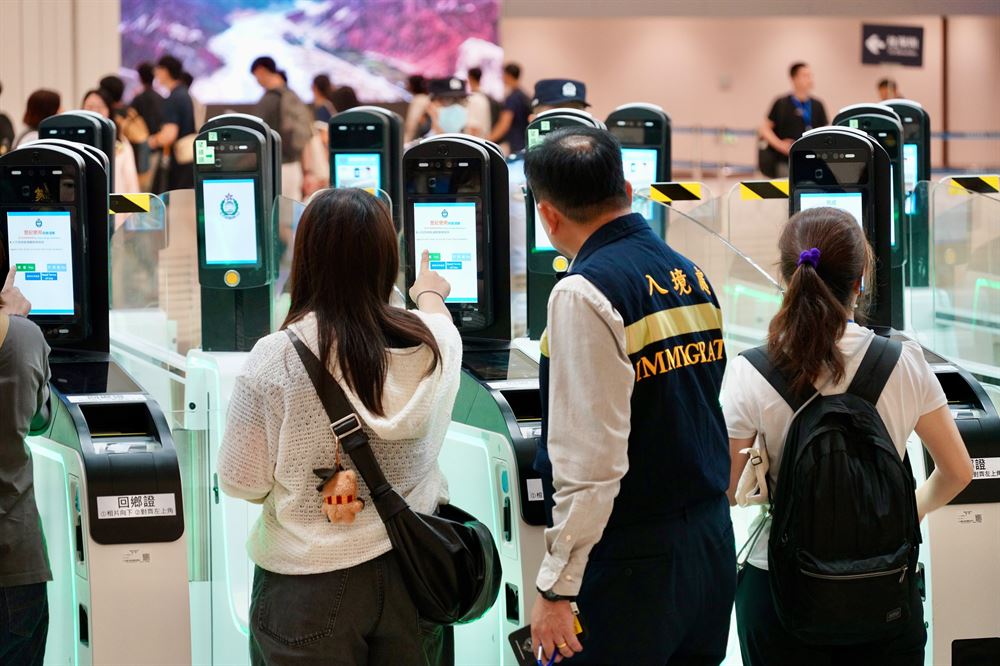
More than 10,000 civil servants of the Hong Kong Special Administrative Region on Saturday took part in the first stress test of passenger and vehicular flows with Shenzhen’s relevant units at the rebuilt Huanggang Port ahead of its official opening.
The drill, marking the first trial of the “collaborative inspection” automated channels for passenger clearance, went off smoothly, Chief Secretary for Administration Eric Chan Kwok-ki said after inspecting the exercise.
Once it’s confirmed by both sides that the port is ready for safe and smooth operation, the governments of Guangdong province and the HKSAR will decide on the new land crossing’s opening date.
Civil servants from more than 70 bureaux and departments were instructed to take different modes of public transport to arrive at Huanggang and practice immigration procedures before departure. They participated in cyclical trials involving over 400 departures using vehicles dispatched by public transport operators to simulate the flow of people and vehicles arriving at and leaving the port.
RELATED ARTICLES
- 5,000 join 2nd large-scale drill at Huanggang Port Hong Kong Port Area
- First large-scale drill at Huanggang Port's HK port area 'goes smooth'
- HKSAR, Shenzhen sign deal on Huanggang port colocation arrangement
- HKSAR authorized partial jurisdiction over new Huanggang port
After departing through the “collaborative inspection” automated channels or manual counters at the departure hall using Chinese mainland travel permits for Hong Kong and Macao residents, the participants returned through the automated channels or manual counters at the Shenzhen side’s departure hall with their Hong Kong identity cards.
The stress test also included a “crowd concentrated-flow test” in which a large number of participants were held on designated floors and subsequently released in several major batches within a short period of time. It was aimed at simulating a situation where a large number of arriving passengers proceed to the public transport interchange during peak hours.
During a vehicle-flow stress test involving nearly 1,000 vehicle trips on the “joint one-stop” vehicle-lane level, vehicles were instructed to enter the port through the new connecting road in batches.
They later simulated the process of undergoing risk assessment by the Hong Kong Customs and Excise Department at the “Customs front kiosks” and the process of queuing up to enter the “joint one-stop” vehicle lanes for inspection and clearance or going to the inspection area for further checks.
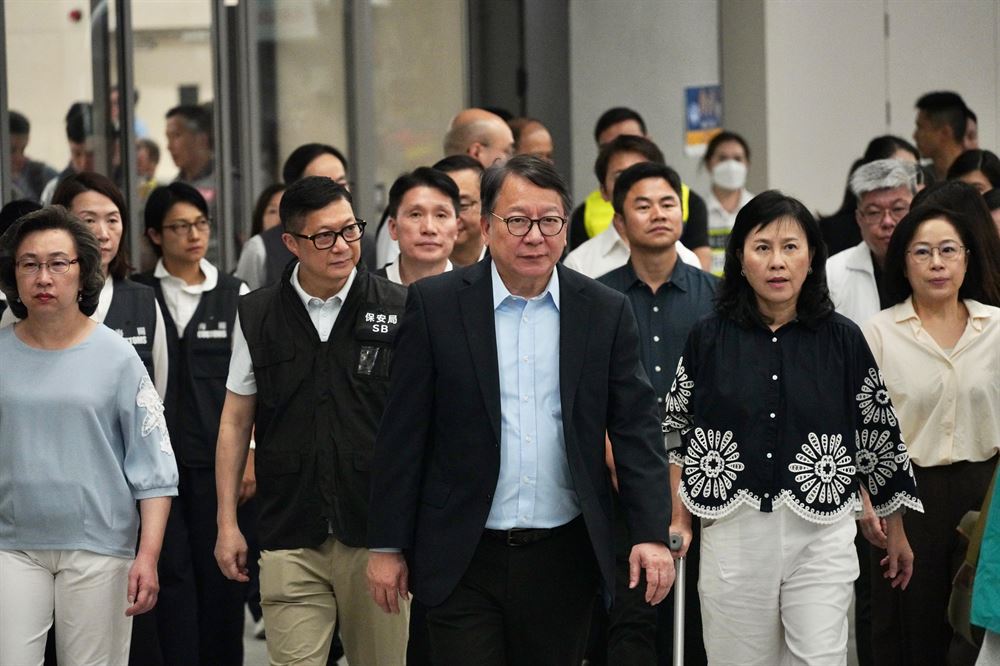
Chan said a large number of passengers and vehicles entered and left the port building in an orderly manner, adding that the public transport interchange also proved to be capable of absorbing substantial passenger flows within a short period of time.
He hoped that all parties would summarize their experiences from the drill, continue refining details, and work closely with the Shenzhen side to press ahead with the various preparatory tasks at full steam.
Secretary for Security Chris Tang Ping-keung, Secretary for the Civil Service Ingrid Yeung Poi-yan, and Secretary for Transport and Logistics Mable Chan Mei-po accompanied Eric Chan in inspecting the exercise.
Earlier, the SAR authorities announced that more than 100 tests and drills will be conducted to assess traffic flow, crowd control and anti-terrorism measures of the new port ahead of its official opening.
On Aug 13, approximately 1,000 civil servants from over 20 departments were mobilized during the first large-scale test at the Huanggang Port Hong Kong Port Area. Two days later, the second large-scale exercise at the facility mobilized about 5,000 civil servants from around 30 departments.
