

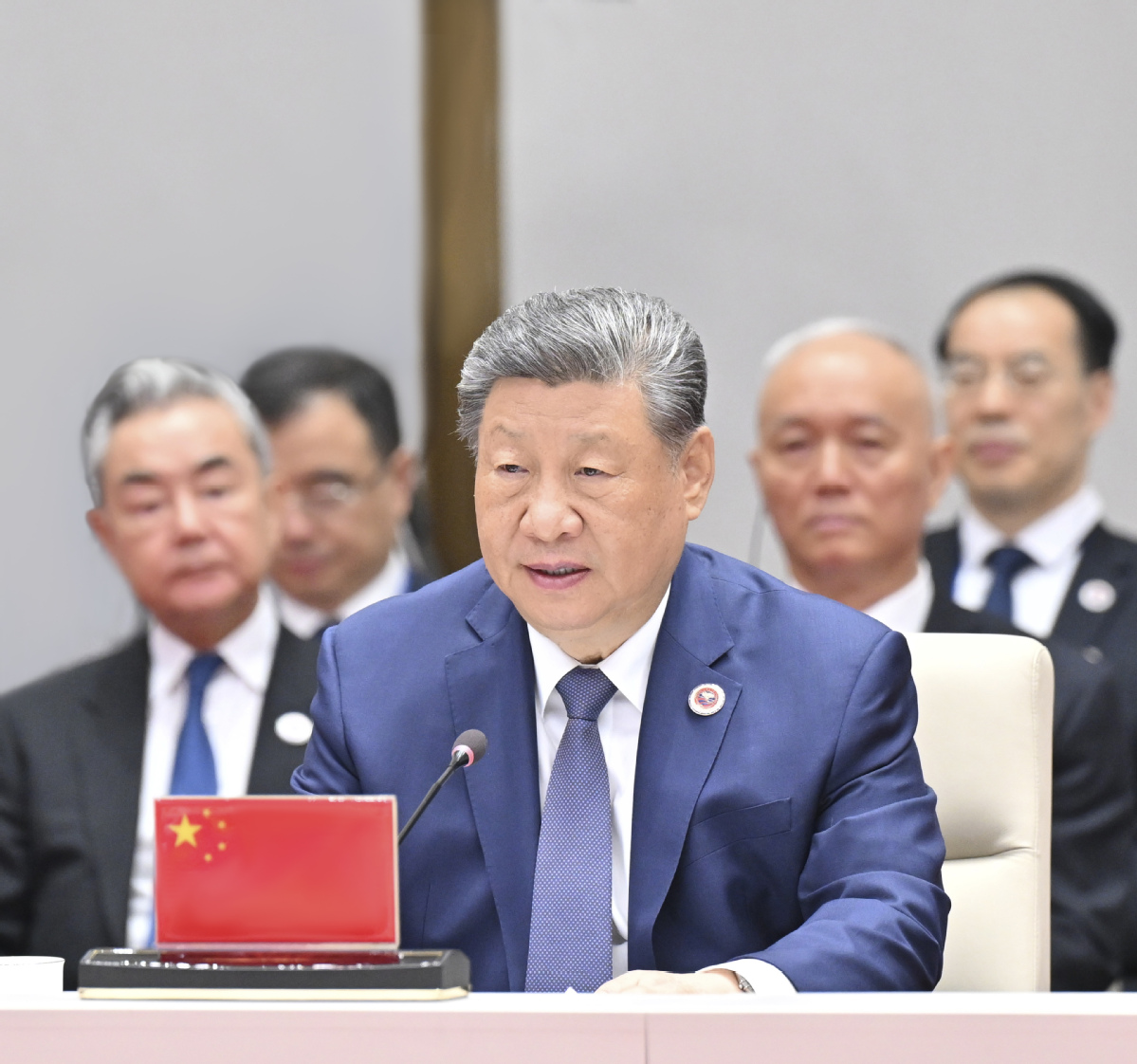
Chinese President Xi Jinping returned to Beijing on Thursday morning after attending the Shanghai Cooperation Organization summit in the Kyrgyz capital of Bishkek and concluding state visits to Kyrgyzstan and Egypt.
Officials and experts said the five-day trip, covering more than 20 bilateral and multilateral events across Central Asia and the Middle East, responded to international calls for peace, stability and development with concrete efforts, offering Chinese solutions and insights to a world of intertwined changes and turbulence.
Speaking at a news briefing in Cairo upon the conclusion of the trip, Foreign Minister Wang Yi said that with solidarity and cooperation as its central theme, the trip was significant for building consensus on cooperation and for reforming and improving global governance.
In Bishkek, Xi attended the 26th Meeting of the Council of Heads of State of the SCO as the organization marked its 25th anniversary this year.
At the summit, Xi announced that China would establish a China-SCO port economic cooperation center in Tianjin and a China-SCO basic education cooperation center, and implement 100 technological cooperation projects with other SCO countries over the next three years.
RELATED ARTICLES
- Development, security key to SCO, Xi says
- Xi urges new Middle East security steps
- Chinese leader calls for closer friendship with Egypt
- Xi hails momentum of strong China-Russia relations
Leaders of the member states signed and issued the Bishkek Declaration, approved the protocol on amendments and additions to the SCO Charter, and adopted 28 outcome documents covering areas such as security, economic and people-to-people cooperation, as well as organizational development.
The strategic blueprint drawn up at last year's Tianjin summit is becoming a reality step by step, Wang said, noting that the SCO now has a more optimized structure, more efficient operation and stronger cooperation.
According to Wang, in Kyrgyzstan, the two heads of state reached important consensus on further deepening the two nations' comprehensive strategic partnership for a new era and advancing the building of a China-Kyrgyzstan community with a shared future. Bilateral relations are now at their best in history, he said.
Wang said the most important political outcome of the visit was the signing of the treaty on permanent good-neighborliness, friendship and cooperation. The treaty enshrines the two countries' commitment to lasting friendship in legal form and opens broader prospects for bilateral relations, he said.
Kyrgyz Foreign Minister Zheenbek Kulubaev told reporters that as a result of Monday's meeting of the heads of state, Kyrgyzstan and China have raised the strategic partnership to a high-quality level of development.
This reflects the high level of political trust and confidence between the two countries and their readiness to further deepen cooperation, he said.
Xi's trip to Egypt was the first state visit to the country by a Chinese president in a decade and coincided with the 70th anniversary of the establishment of diplomatic relations.
According to Wang, Xi has emphasized that China, whether in the past, at present or in the future, is Egypt's trustworthy and dependable comprehensive strategic partner.
Wang described Xi's historic visit to Egypt as both a journey to renew friendship and one to expand cooperation, calling it a milestone that fully demonstrates the strategic and exemplary nature of China-Egypt relations.
Zoon Ahmed Khan, a researcher at the Belt and Road Institute of Tsinghua University, said Xi's visit reflected an ongoing transformation in which the two ancient civilizations are advancing from mere markets and transit corridors into creators of their own shared agency.
"The true vitality of this partnership lies in its tangible momentum," she said, pointing to industrial hubs, local-currency financing, space technology and job-creating projects as examples of political trust being translated into productive capacity and practical South-South cooperation.
Ayman Mohseb, a member of Egypt's House of Representatives, said that closer China-Egypt coordination could help ease regional tensions, promote dialogue and political settlements, and contribute to a more balanced and equitable international order.
During his talks with Egyptian President Abdel Fattah El-Sisi, Xi put forward a four-point proposal on building a new security architecture in the Middle East via upholding a vision of common, comprehensive, cooperative and sustainable security.
He called for fostering the internal driving force for regional security, adopting a comprehensive approach to advancing common security in the region, consolidating the foundation for common security through development and strengthening international coordination.
Wang also highlighted the cultural and people-to-people dimensions.
Peng Liyuan, Xi's wife, took part in cultural activities with Aigul Japarova, the wife of the Kyrgyz president, and Entissar El-Sisi, the wife of the Egyptian president. The activities added a warm cultural dimension and helped strengthen mutual understanding, people-to-people bonds and cultural exchanges, Wang said.
Contact the writer at mojingxi@chinadaily.com.cn
