

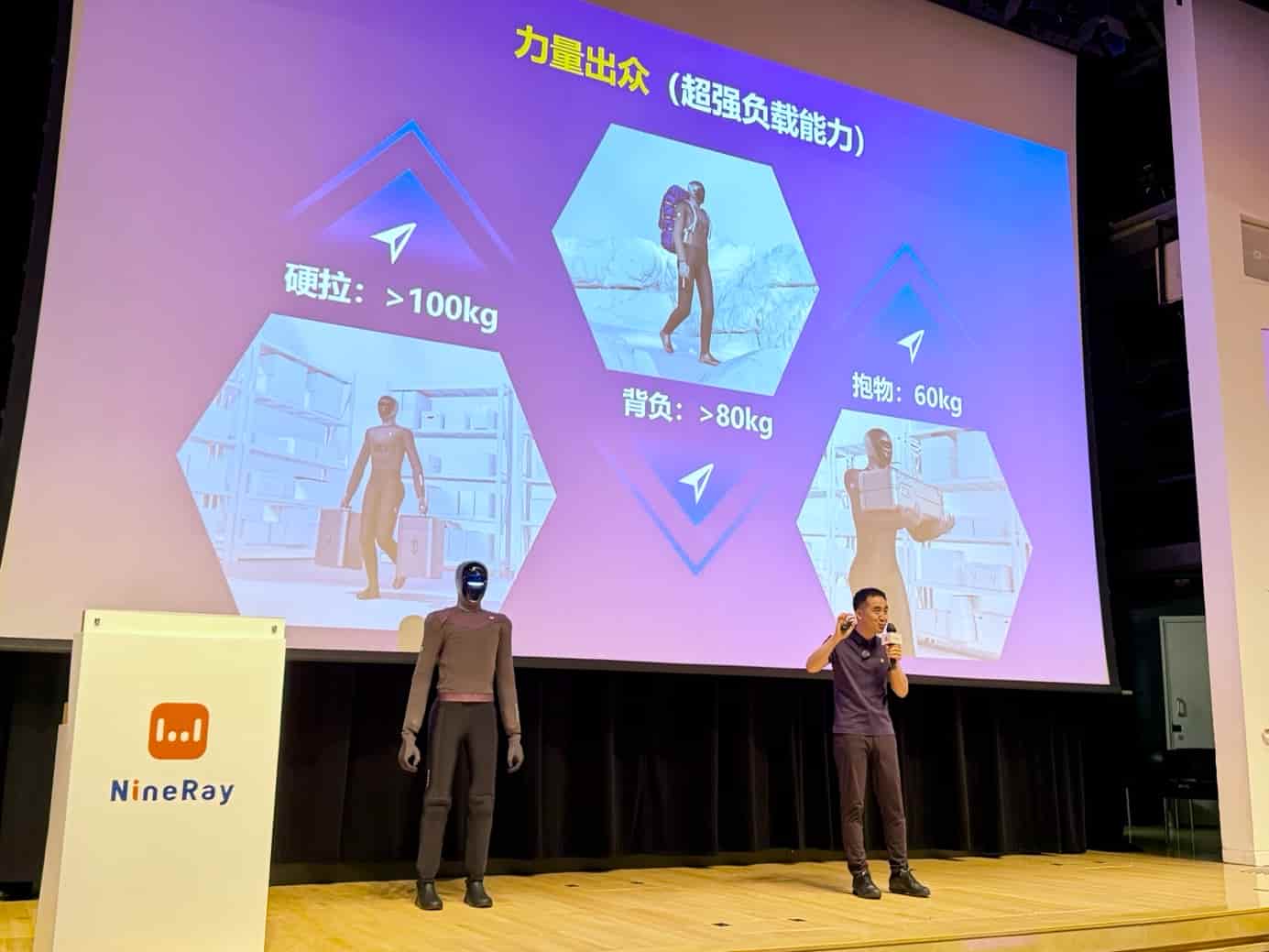
NineRay Technology, a Chinese mainland stalwart in the ascendant embodied-intelligence robotics field, unveiled its newest humanoid robot in Hong Kong on Monday, amazing city officials, industrial leaders and veteran technologists.
Dubbed RayNex G3, the model was unveiled at the Hong Kong Science Park, one of the city’s most fervent innovation grounds that now accommodates over 2,500 technology firms, among them NineRay’s regional base.
Embodied AI refers to the field that lodges AI within physical vessels — robots and other mechanical hosts — thereby allowing them to perceive the surrounding environment, learn from and adapt to unfolding events and carry out physical operations.
RayNex G3 stands 173 centimeters tall and weighs less than 60 kilograms, sized to fit most standard indoor and outdoor work settings as well as staffed operational spaces.
It is configured to execute the routine manual tasks of a male adult operator, able to carry 30 kg in operation, deadlift 100 to 200 kg, and hold 60 kg with both arms.
ALSO READ: Major scientific event deepens Hong Kong's status as global I&T hub
And with its sleek, humanoid profile, the robot boasts 32 degrees of freedom (DOF) — seven for each arm, six for each leg, and three each for the neck and waist.
DOF counts the independent ways a system or its parts can move, with six — three for spatial position and three for rotational orientation — as the spatial rigid-body benchmark. More DOF means greater agility and versatility.
Combined, these features make RayNex G3 equally suited for bulk conveyance and warehouse logistics as for intricate precision maneuvers, noted Xu Zhigen, who founded NineRay.
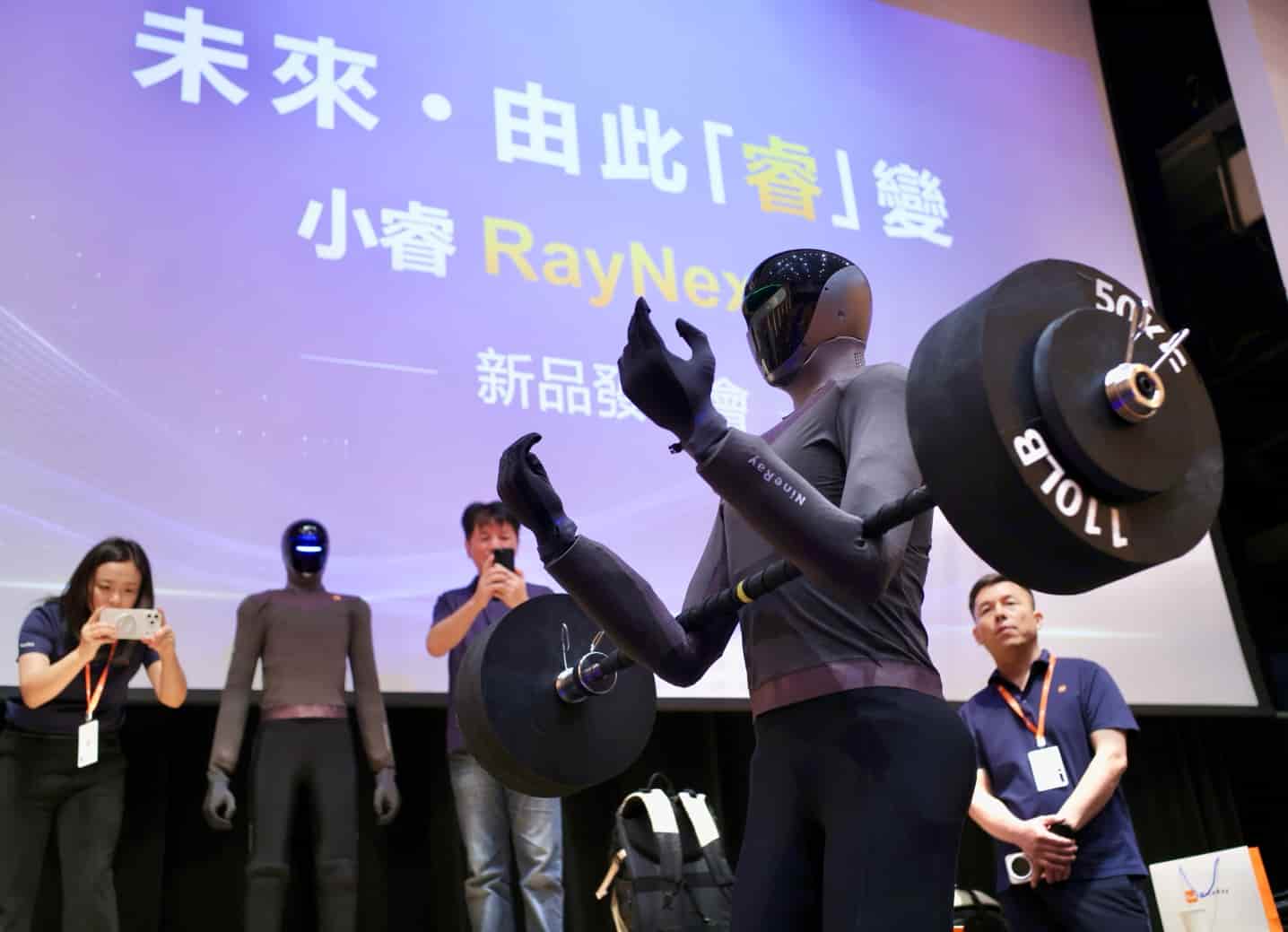
In a live display, the robot strode across the stage carrying over 60 kg, then returned for another round, this time walking with a barbell to simulate a heavy side-lift.
Xu disclosed that multiple firms — spanning food and beverage production to the nuclear power sector — have already approached the development team with a range of proposed applications.
Xu said NineRay has positioned Hong Kong as its “base for globalization”. “From here, we want to go global,” he said, adding that the city’s global market access, deep pools of talent and capital and robust research expertise of its world-leading universities have all been instrumental to the company’s growth.
He also applauded the SAR government for providing “concierge-style support” to technology enterprises, saying his company is prepared to play its part in advancing Hong Kong’s goal of achieving international innovation and technology hub status.
READ MORE: Profitability takes center stage as AI stocks swing in Hong Kong
“We’re glad to see NineRay putting down roots in Hong Kong,” Terry Wong Ping-sau, CEO of Hong Kong Science and Technology Parks Corporation, said at Monday’s launch.
Wong said he hoped that NineRay would continue to draw on the Guangdong–Hong Kong–Macao Greater Bay Area’s full-suite industrial ecosystem to refine its core technologies, actively explore real-world applications, and steer humanoid robots out of the lab and into the commercial sphere at scale.
He added that the science park will keep strengthening its innovation pipeline — building, on one front, the computing, research and talent infrastructure needed to support breakthrough science; and on another, steadily deploying funding instruments for new industrialization and industry orientation to attract innovative companies to Hong Kong and help them grow.
READ MORE: HSTECH to expand constituent stock number, tech themes
Lu Yang, associate dean overseeing mainland affairs at the University of Hong Kong’s Faculty of Engineering, said at the event that he was “truly amazed” after watching RayNex G3’s demonstration.
Humanoid robots, he noted, are one of the primary physical vessels of embodied intelligence — a discipline that represents a multidisciplinary frontier combining AI, advanced materials and structural mechanics.
Lu observed that Hong Kong is already home to a substantial community of embodied intelligence specialists, and that the city’s tertiary institutions are now gearing up to build on that base, with the aim of attracting more global talent for robotics research and industrial application development.
“It’s a pivotal direction,” Lu said, not only for fostering new quality productive forces, powering new industrialization, but also for propelling AI-empowered innovation forward.
Contact the writer at wanqing@chinadailyhk.com
