

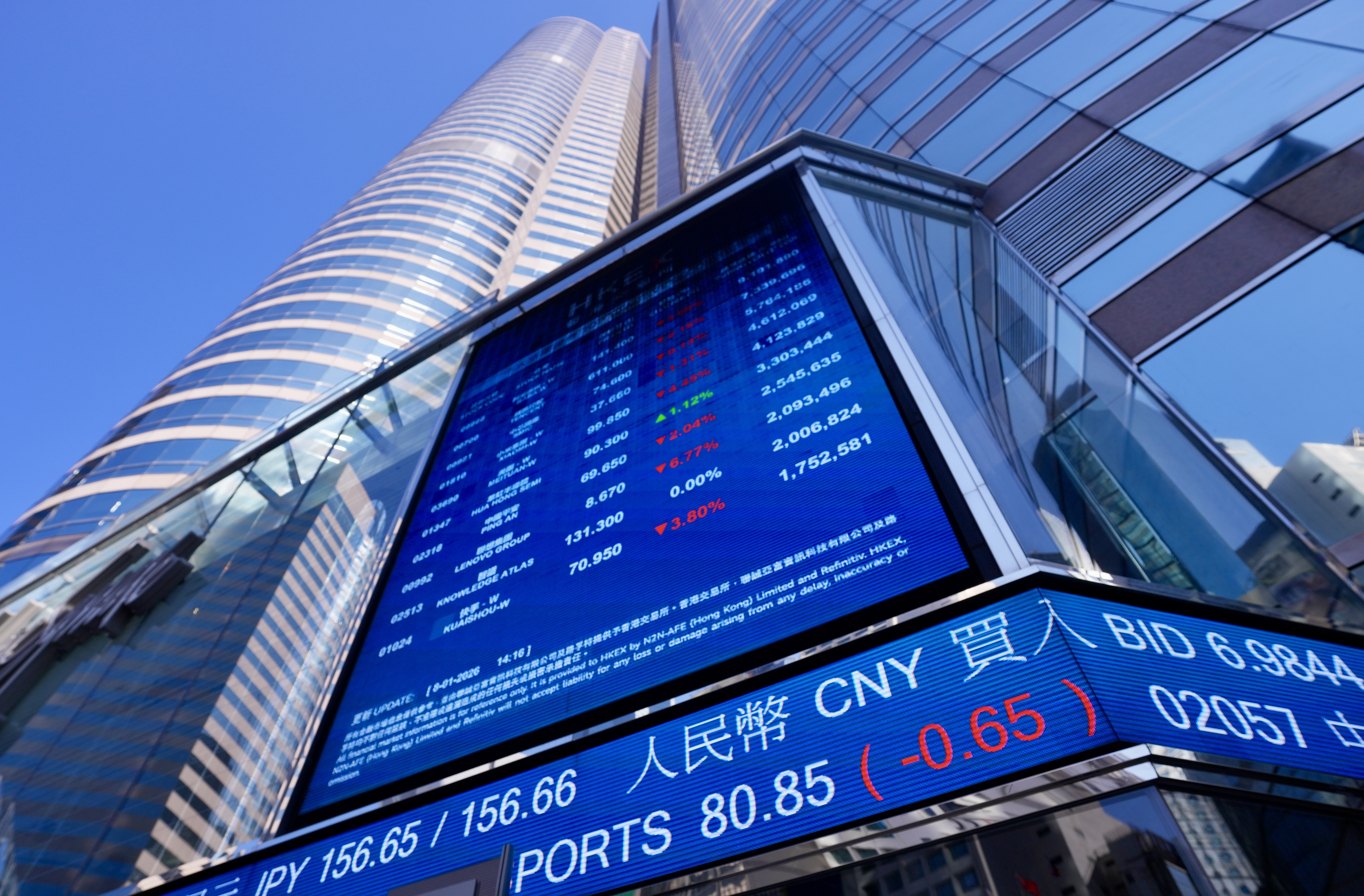
As Hong Kong-listed technology companies gear up to release their second-quarter earnings, artificial intelligence and cloud computing have been the most widely watched themes. Analysts said structural opportunities remain in the mid-to-upstream segment, while the market narrative for the second half of the year is expected to shift toward companies’ profitability.
The benchmark Hang Seng Index dropped 1.1 percent to close at 25,652.8 points on Tuesday. The Hang Seng Tech Index, which tracks the 30 largest technology companies listed in the city, fell nearly 2 percent to 4,824.4.
AI-related stocks have shown mixed performances. Leading AI firm MiniMax’s Hong Kong-listed stock rose more than 1.7 percent to HK$328 ($41.80) per share. Counterpart Z.AI dropped almost 4.8 percent, while Sunny Optical Technology slumped 2.2 percent.
ALSO READ: HSTECH to expand constituent stock number, tech themes
Despite the recent volatility, Hong Jiajun, chief analyst for the overseas TMT (technology, media, and telecommunications) industry at China Industrial Securities, said an apparent structural capital rotation has been seen in the Hong Kong market’s computing power chain.
“This rotation is concentrated in companies related to wafer foundries, packaging and testing services, server provision, optical interconnect solutions, and data centers. Share prices of those with solid orders and earnings have rebounded more strongly than concept stocks,” Hong told China Daily.
Investors are increasingly turning to internet and software firms with established computing resources and monetization models, as the global AI industry shifts focus from infrastructure build-out to earnings realization.
READ MORE: Mainland AI chip designer Moore Threads plans Hong Kong listing
This trend is particularly reflected in the strong southbound capital flows. AI-related shares have dominated the top 10 most actively traded securities through the Shanghai-Hong Kong and Shenzhen-Hong Kong Stock Connect programs’ southbound channels, including internet giants Alibaba and Tencent, leading model developers Z.AI and MiniMax, as well as upstream infrastructure and material providers Kingboard Laminates and Yangtze Optical Fibre and Cable.
Looking ahead to the second half, Hong said he expects the mid-to-upstream segment of the AI industry to continue to present opportunities.
However, the market’s major driver is expected to transition “from valuation-driven momentum to order-and-profit-realization”, with more capital likely to spread into downstream AI applications and software at the same time, he added.
Hong also pointed to the potential concentrated shipping window for multiple next-generation AI chips in the fourth quarter, saying it is likely to lift global AI infrastructure investment, as it may provide a short-term catalyst for the upstream hardware segment while lowering costs and benefiting the downstream application layer.
READ MORE: Hong Kong's IPO fundraising soars 154% in first seven months
Yang Delong, chief economist at First Seafront Fund, had a similar view, noting that tech companies with solid earnings and orders are likely to continue performing well and may even reach new highs. Those relying only on speculative themes without substantial profits could risk declines, he added.
Yang said that after a two-month market drag, the bubble-squeezing in semiconductors and computer algorithms is nearly complete, paving the way for a bounce-back. Meanwhile, sector rotation has begun toward other primary beneficiaries of the AI era, such as humanoid robotics and innovative pharmaceuticals.
In its latest report on the Chinese internet sector, Goldman Sachs outlined expectations for major companies ahead of their second-quarter earnings announcements, highlighting themes such as cloud growth and upward revisions to full-year capital expenditure guidance.
The investment bank forecasts that Alibaba will deliver 9 percent year-on-year revenue growth in the second quarter, with Alibaba Cloud’s growth accelerating to 45 percent. Tencent is also expected to post a revenue growth of 9 percent, with attention centered on AI-related capital expenditure.
Both giants are set to release their second-quarter results on Aug 20 and on Wednesday respectively.
Contact the writer at gabylin@chinadailyhk.com
