

New vehicle aims to back tech firms while offering an alternative to assets
Hong Kong is in the final stages of launching its offshore renminbi venture capital fund, aimed at fueling the global ambitions of Chinese technology firms while giving overseas investors an alternative currency choice.
Hong Kong Investment Corp CEO Clara Chan Ka-chai made the remarks to China Daily in an exclusive interview on Friday.
“Everything is ready in terms of demand, supply and construct,” Chan said. She added that sovereign wealth funds from the Middle East, long-horizon institutional investors in Southeast Asia, and pension funds have expressed interest in collaborating, and banks are also expected to participate.
Unlike investment deals executed on a case-by-case basis, the new fund will be established as a partnership vehicle open to key investors, she said. “Many of these investors see the great potential and benefits of renminbi internationalization and are looking for long-term products and services.”
Chan said HKIC has been in discussions with companies in its ecosystem, and many have welcomed the prospect of additional funding alternatives, given that most existing investment funds are denominated in US dollars or other international currencies.
While satisfied with the fund’s progress, Chan said that it will begin on a modest scale. This reflects both the typically smaller size and longer investment horizon of venture capital funds, as well as HKIC’s commitment to ensuring that development proceeds in tandem with “security, stability and safety”.
ALSO READ: HK targets Aug 3 launch of 5-year RMB treasury bond futures
Chan’s remarks came shortly after the government-owned investment arm released its annual report in mid-July, which referenced the forthcoming offshore RMB venture fund and outlined a year of portfolio expansion and rising returns.
As of the end of June, HKIC had invested in more than 200 projects across three strategic sectors — hard and core technology, biotechnology and health technology, and new energy and green technology — with 10 portfolio companies listed in Hong Kong and more than 30 others having submitted listing applications, or preparing to submit within the year, according to the report.
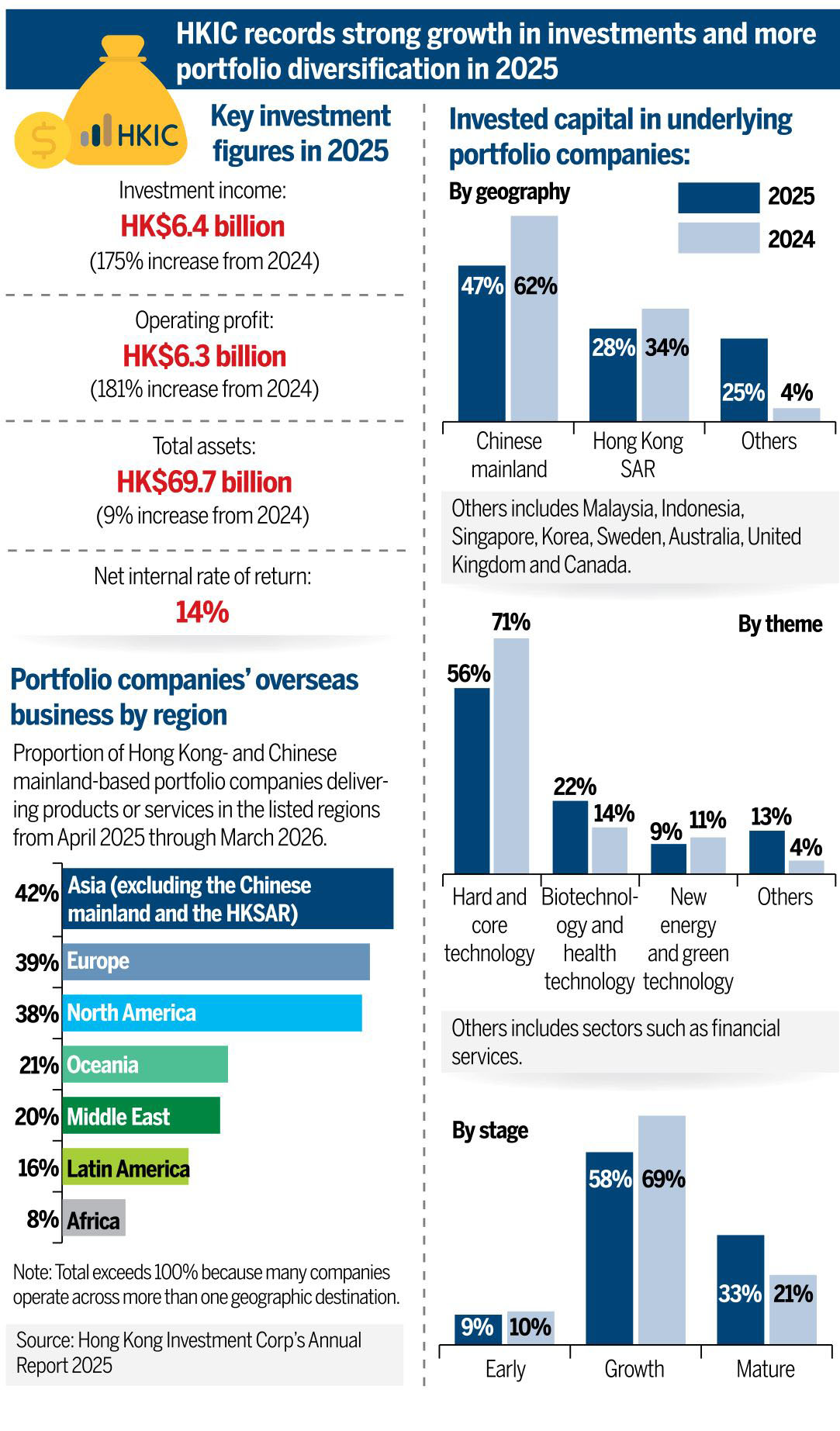
In 2025, HKIC recorded investment income exceeding HK$6.4 billion ($816.1 million), up 175 percent from the previous year, while the portfolio’s net internal rate of return (IRR) reached 14 percent by year-end.
Over the same period, HKIC reported a capital multiplier effect of more than 1:8, meaning that each Hong Kong dollar invested has attracted over HK$8 in additional long-term market capital, including those from overseas sovereign wealth funds and pension institutions.
From a financial returns perspective, “if you look at private equity and venture capital funds of similar vintages, which are public benchmark information, we believe we have beaten the benchmark”, Chan said.
READ MORE: HK to provide more offshore RMB services
Moreover, the corporation generated positive IRR in both 2024 and 2025, its first two full years of operation, diverging from the typical J-curve pattern seen in many PE and VC funds, which often post negative returns in their early years.
“2024 was the very first year in which we had full investment operations. By 2025, we basically came to a place where we could say we have turned promise into proof,” she added.
As a professional institutional investor, HKIC speaks the same language as its global peers and operates under internationally recognized market standards, Chan said. This helps build trust with long-term partners and makes them more inclined to expand cooperation once a working relationship has been established. Chan said she expects the capital multiplier ratio, currently above 1:8, to climb further as those collaborations deepen.
Invest for the future
Despite the early performance, Chan said HKIC remains at the beginning of its growth trajectory and still has a long way to go.
“This long journey is commensurate with our (identity) as patient capital,” she said. “We invest across cycles to bring cross-sectoral, cross-generational benefits to society, not only in the Hong Kong Special Administrative Region, but also contributing to (the growth of) new (quality) productive forces for our country.”
This vision has driven HKIC to adopt a growth strategy that scales “from points to lines, and then to planes”; namely, shifting from single-project investment to systematically upgrading the ecosystem.
In artificial intelligence, for example, HKIC first backed developers of large language models before moving upstream and downstream into related fields such as robotics and is now facilitating cross-industry collaboration by linking AI enterprises with drug discovery companies and green energy innovators in an effort to accelerate research, reduce costs and improve efficiency, Chan said.
HKIC’s investment footprint has accordingly expanded beyond its original three priority tracks into frontier fields including next-generation AI, brain-computer interfaces, commercial aerospace, cross-border digital infrastructure and quantum computing.
While Chan said initial capital allocated to these cutting-edge sectors “won’t be a lot”, HKIC’s support is not limited to check-writing. For example, many founders are brilliant scientists with sharp innovative vision, but struggle to scout for their teams.
“We can leverage our market experience to help them find the best personnel and connect them with international capital,” Chan said. “For these cross-sectoral and longer-term themes, that’s actually the perfect fit for patient capital like us.”
Contact the writer at irisli@chinadailyhk.com
