

In summer, visitors flock to the Kumtag Desert to experience ancient Uygur sand therapy
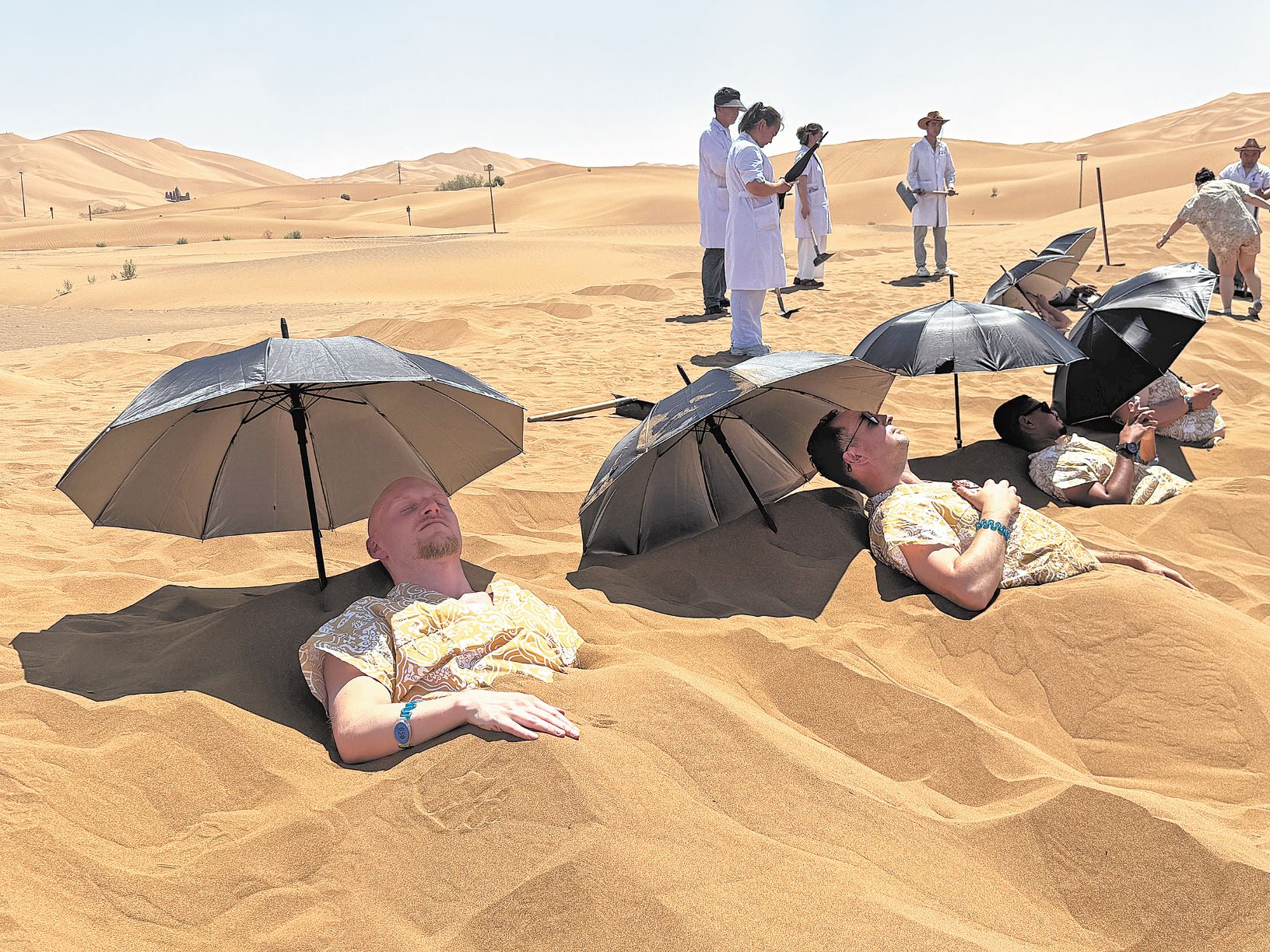
Remember when, as a child, you'd visit the beach with your family, and your older siblings, or maybe your parents, would bury you up to your neck in the sand? At the time, you probably thought it was just seaside shenanigans, but believe it or not, people travel thousands of miles to do just that, citing a variety of health benefits.
That's because, at the edge of the Kumtag Desert in Shanshan county of Turpan in Northwest China's Xinjiang Uygur autonomous region, the summer heat heralds the season for sand therapy. From June to August, visitors flock to the dunes to participate in a traditional Uygur medical practice — being buried up to their chests in hot sand.
READ MORE: Sand therapy turns Xinjiang's deserts into a tourist magnet
Imagine a sauna, but instead of a little wooden shack next to a frozen Nordic lake, it's the open desert and you're under a sun umbrella, breathing in crisp, hot, dry air. That, in essence, is sand therapy, as described by Tswelopele Makoe from South Africa, who experienced it on June 19.
"Ethereal" was the word she chose for the roughly twenty-minute session. "It's almost like I'm on cloud nine — super relaxed, (like I'm) floating, very calm," she said, while lying in the sand.
Turpan, sitting in China's lowest basin, is one of the country's hottest and driest places. Summer temperatures regularly touch 40 C, and annual rainfall averages only 14.7 millimeters, according to the city's website.
Yet this harsh environment has provided a natural remedy, as locals harness its conditions to combat ailments like rheumatic and rheumatoid arthritis.
Guljannat Emar, a staff member at the county's Uygur medicine hospital, which has run the therapy base since July 2024, explained that the sand can reach nearly 50 C. This warmth induces heavy sweating, stimulates the metabolism, aids blood circulation and detoxifies the body through the pores.
Trace minerals penetrate the skin, and the combination of the dunes' natural magnetic properties and the massaging effects of the sand itself offers holistic physiotherapy, she said.
She added that the therapy also benefits those with chronic eczema, vitiligo, dysmenorrhea and menstrual irregularities, and relieves fatigue and muscle soreness.
However, the effect that has generated the most buzz on social media — where short videos of sand therapy have gone viral for the past two summers, a trend that is continuing this year, too — is its potential to draw out shiqi (internal dampness) and hanqi (cold energy).
In traditional Chinese medical theory, shiqi is considered the root cause of most ailments, clouding the body from within and eventually leading to disease.
ALSO READ: Desert discoveries are a history buff's dream
Sand therapy in western China has been documented in multiple medical texts as early as the Tang Dynasty (618-907). It was listed as a national-level intangible cultural heritage in 2014.
According to Guljannat Emar, the base received 31,000 visits last year for sightseeing or sand therapy, with more than 19,000 during peak season.
Khaled Elshamy from Egypt noted similar practices in the Siwa Oasis in Matrouh governorate of his home country, where the therapy is often combined with tourist itineraries. "Both Egypt and China, with their rich histories and cultures, are nations of wisdom and abundant resources. This knowledge of sand therapy deserves further development and utilization," he said.
If you go
First-time visitors can book in person at the base. For subsequent visits, you can connect via WeChat.
Wear comfortable cotton clothes, or use the sand therapy suits provided, which are similar to beachwear. Bring your own water bottle — herbal tea is available on-site.
Sun umbrellas are also provided.
A single sand therapy session costs 46 yuan ($6.75). The post-therapy medicinal or salt bath costs around 80 yuan.
Treatment cycles range from three to five days for short courses to seven to 10 days for full ones, with each session lasting about 20 minutes.
Heavy sunscreen application is not recommended, as direct skin contact with the sand enhances the therapeutic effect.
It is not advised for women who are menstruating and people with severe cardiovascular conditions or skin lesions to undergo sand therapy. A basic health checkup, including blood pressure testing and pulse diagnosis, is necessary and carried out by professionals.
Mao Weihua in Urumqi contributed to this story.
Contact the writers at fangaiqing@chinadaily.com.cn
