

Grassroots Party workers go the extra mile online to turn around fortunes of villages across nation

From the ancient Liaohe River in Tieling, Liaoning province, to the beautiful villages in Jiangxi province, from the harmonious countryside by the Yangtze and Huaihe rivers to the snowy forests beneath the Greater Xing'an Mountains, grassroots Party workers are using mobile phones as new tools, the internet as a new platform and livestreaming as a new means of communication.
They are bringing agricultural fields into livestreaming rooms, sending local cultures onto cloud platforms and connecting policies that benefit the people to thousands of households.
Every afternoon, Hu Yuming, 44, appears on time for his livestream, interacting with netizens from across the country to promote the unique charm of Hejiaxin village in Tieling. He highlights the village's lush grasslands, vibrant wetlands, rich ecological foundation, profound revolutionary heritage and distinctive folk culture.
READ MORE: Deepening roots of understanding
Hu, the first Party secretary stationed in Hejiaxin, has broken new ground with an integrated model of new media, cultural tourism and public welfare. In collaboration with the countywide first secretary alliance in Tieling, he uses dedication and innovation to paint a real, new-era picture of prosperous industries, beautiful countryside and wealthy villagers.
In September 2021, Hu, who was selected by the Liaoning Police and Judicial Management Cadre College, came to Hejiaxin to serve as its first Party secretary. When his twoyear term ended in 2023, he resolutely applied for continuing work in the countryside.
"At that time, the village was seeing some progress in terms of rural development, such as the emerging revolutionary tourism. I hoped to help make it better, so I decided to stay," he said.
In March 2024, authorities in Tieling organized a series of training sessions for over 100 village-level first secretaries on topics such as new media technology and livestreaming, aiming to encourage them to promote local economic development through online platforms.
"The training helped me a lot. While I picked up technical skills, I also realized that the internet can drive economic growth and benefit the local people," Hu said.

In May last year, Hu did his first livestream on Hejiaxin's vast grasslands. "The two-hour session attracted some viewers," he said. "I kept talking as I wanted, introducing the beautiful scenery and local specialties of the village."
There has been no turning back. Hu continues to livestream from the grasslands, and has added memorial halls and farms to his location list. To date, he has helped villagers sell agricultural produce, such as sweet potatoes, corn and garlic sprouts, worth over 50,000 yuan ($7,375).
Hu often has his livestream audiences riveted to the screen with stories about the ancient river, the revolutionary history of Hejiaxin and the village's grassland customs, striving to create a characteristic cultural tourism IP.
In June last year, he planned and organized a grassland kite festival, featuring big displays, parent-child DIY sessions, folk experiences and internet celebrity check-ins.
Through livestreaming, short-videos and a comprehensive network matrix, Hejiaxin attracted over 30,000 tourists during the three-day festival, transforming the once sleepy village into a popular rural tourism spot in northern Liaoning.
Tieling has many first secretaries like Hu, who have dedicated themselves to front-line work and are empowering the countryside with the help of the internet.
The Tieling Municipal Party Committee's Organization Department has led the establishment of platforms and resource integration, forming 42 first secretary professional alliances, strengthening bonds among villages and achieving resource-sharing. Such collaboration has formed a comprehensive service system that uses livestreaming to promote agricultural produce and improve villagers' lives.
"As a member of the first secretary e-commerce alliance, I have participated in numerous cooperation and communication activities," said Hu. "We have supported each other, exchanged information and provided assistance for livestreams, achieving very good results."
Chen Jianguo, 46, Party secretary of Beishan village in Shangrao, Jiangxi, has revitalized the village using just a mobile phone and a livestreaming room.
A typical livestream starts with Chen adjusting his collar, placing a product — such as a jar of homemade preserved vegetables — on the table in front of the camera, and greeting viewers in his signature style: "Good evening, dear friends, and welcome to Beishan Secretary Chen's livestream".
With his professional demeanor, he has already become a local internet celebrity, driving annual agricultural sales worth more than 25 million yuan.
The economic transformation of Beishan is striking, given that the village was struggling to keep its head above water a few years ago.
Chen, who had left Beishan as a young man in 2004 to seek better opportunities in Zhejiang province, returned to his village after the Hefei-Fuzhou high-speed railway opened in June 2015.
"The convenience of high-speed transportation helped take Beishan's agricultural products outside, and brought Beishan's youth back home," said Chen, who closed his digital products store in Wenzhou, Zhejiang, and became a Party cadre in his village.
At a rural e-commerce training session organized by the government of Guangxin district, where Beishan is located, Chen chanced upon a whole new world. "The teacher talked about online programs that are helping drive rural vitalization, and I thought we could integrate resources to promote our agricultural products outside," he said.
In 2018, Chen was elected Beishan village secretary, and a year later, he opened an account on short video platform Douyin.
The start of his online journey wasn't smooth. "Villagers said that all I did was make videos with my phone. Some even went to higher authorities to complain that I was neglecting my duties," Chen said.
Instead of being demotivated by such skepticism, Chen engaged other villagers in making short videos and organized fun sports for farmers, giving everyone the opportunity to share the joy and experience the novelty of video-making through participation.
On May 26, 2023, Chen started his first livestream channel to help villagers sell their agricultural produce and other products. "I received 130 orders, although more than half were from my acquaintances," he said.
With policy support for agricultural e-commerce, Beishan started making big strides through livestreaming. Last year, the village's collective economy reached 500,000 yuan.
Today, Chen has more than 20,300 followers on Douyin, and the village has developed an effective sales and production cycle. It has also built a livestreaming base where villagers get 15 yuan per hour from packing and shipping work.
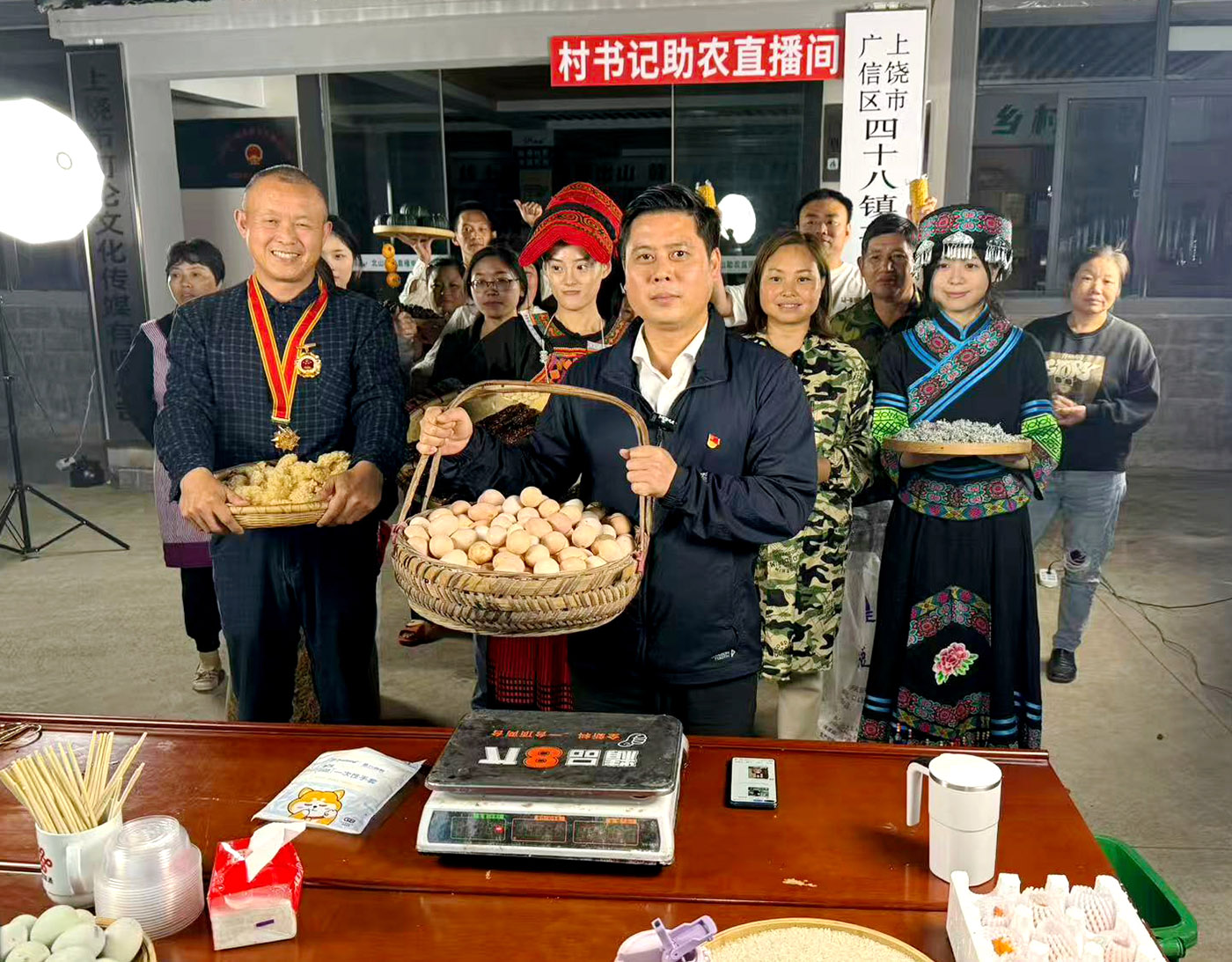
Over 330 livestreams throughout the year have linked the small village with outside markets and have reconnected villagers who had left home. Primary agricultural products have been developed into branded goods and cultural tourism items with increased value.
"When I returned to Beishan years ago, what I wanted to see most was young people serving their parents tea and tutoring their children at home," Chen said. "That dream is slowly becoming a reality."
Ding Jun, 42, deputy village Party secretary of Hehua in Mingguang, Anhui province, has transformed a small livestreaming room from an initial sales platform into a policy briefing platform to serve the community.
"I started livestreaming in October 2024, when my intention was to help villagers sell local agricultural produce such as gorgon fruit and water chestnuts," he said. "However, as my program began, the most frequently asked questions were about healthcare, pensions, social assistance and homestead issues."
Ding immediately readjusted his focus, interpreting official documents for villagers and breaking down complex procedures into simple steps.
"It is not an easy task, as I first need to thoroughly understand the relevant information," he said."The most challenging part is when many followers from other places ask me about their local livelihood policies."
To help these people, Ding jots down their questions, seeks details from relevant local departments and then shares the information during his next livestreaming session.
He has held over 300 livestreaming sessions to date, attracting 34,000 followers, with the total number of views exceeding 1.6 million. He has also mediated disputes and gathered public opinion on various local issues.
Hehua village is a microcosm of Mingguang. Since 2024, the city has organized village cadres and Party members to enter livestreaming rooms and bring their lectures to the fields. Using local dialects, they explain in a familiar way policies that benefit farmers.

Agricultural experts and sci-tech assistants have also joined some livestreaming sessions, teaching techniques step by step and solving farmers' problems.
This year, Mingguang launched 121 short videos on theoretical lectures, garnering 620,000 views. The city also livestreamed over 180 theoretical lectures, each of which attracted more than 1,000 views.
In early 2020, Du Bo crafted a vibrant story of cultural tourism revitalization in Northeast China, as she created a short video on epidemic prevention in the local dialect.
As the video garnered 750,000 views, Du, who was then director of the Culture and Tourism Bureau in Tahe county, Heilongjiang province, encountered the powerful reach of new media for the first time.
"The success inspired me to form my own new media team," she said."In my spare time, we filmed short videos or livestreamed to promote the icy landscapes, forest ecology and ethnic culture of Tahe."
In early 2023, when temperatures in the county hit a harsh — 20 C, Du donned traditional Oroqen attire to film a short video in a birch forest, titled White Deer Fairy. It went viral overnight.
ALSO READ: Grasslands' wealth unlocked by push for high-quality products
"Our endeavor coincided with the 70th anniversary of the Oroqen people settling down since they moved out of the mountains," she said. "We went to see their ethnic costumes and cultural products, and those were exquisite. After getting the owner's consent, I borrowed the costumes for filming."
As the director of the tourism bureau, Du's job was to promote local tourism resources. "I not only promoted tourism, but also planned and built a large number of scenic routes and cultural projects each year," she said.
In 2024, Du became deputy director of the Enterprise Investment and Service Bureau of Hulan district in Harbin, the capital of Heilongjiang. However, her efforts to promote local tourism and economic development continued.
Du and her team have released more than 1,000 videos to date, with total views exceeding 4 billion and the number of followers across all platforms reaching over 2 million.
Zhu Lixin in Hefei and Zhao Ruinan in Nanchang contributed to this story.
Contact the writers at zhouhuiying@chinadaily.com.cn
