

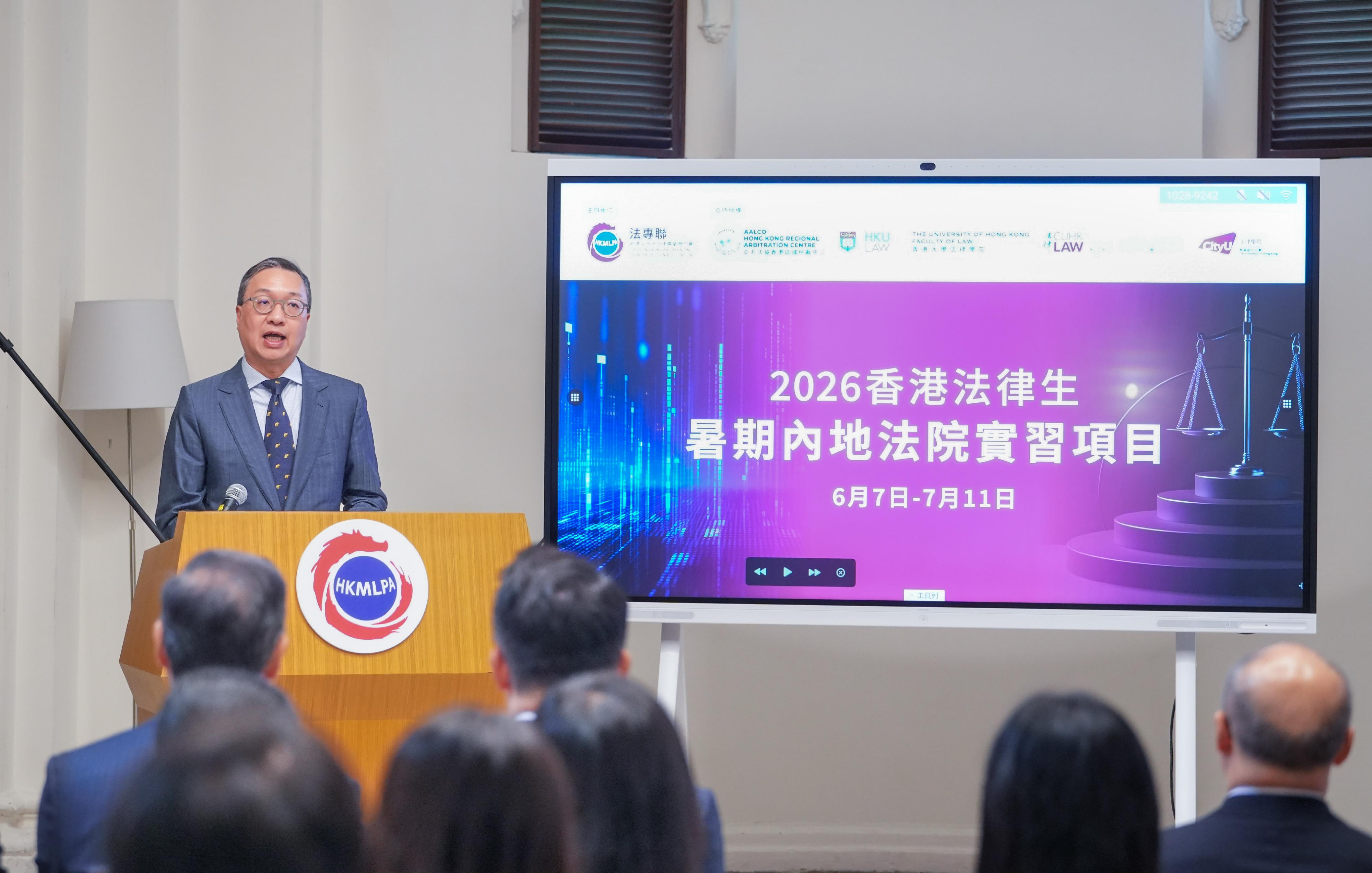
Law students in the Hong Kong Special Administrative Region are encouraged to deepen cross-border ties with the Chinese mainland and play a greater role in the nation’s foreign trade and economic cooperation, the city’s leading legal figures and educators said on Monday.
At the launch ceremony of a cross-border internship program for law students, they called on young professionals to gain knowledge of mainland judicial practices, hone their professional toolkit, and develop a strong sense of national belonging.
Starting Sunday, 34 students from the law faculties of the University of Hong Kong, the Chinese University of Hong Kong, and the City University of Hong Kong will participate in a five-week exchange program.
The students will spend a week in intensive studies at Tsinghua University in Beijing, with visits to key judicial authorities, including the Standing Committee of the National People’s Congress, the country’s top legislature.
They will then undertake a monthlong internship in courts across several mainland cities, including Shanghai, Nanjing, Hangzhou, Guangzhou and Shenzhen.
This year’s program — initiated by the Hong Kong and Mainland Legal Profession Association and backed by both the mainland and Hong Kong authorities — is themed “Let law guide actions, steady steps reach far: a national vision for Hong Kong youth”.
ALSO READ: HKUST’s medical school dean vows to contribute to GBA and nation
Addressing the ceremony, Hong Kong Secretary for Justice Paul Lam Ting-kwok said this year marks the opening of the nation’s 15th Five-Year Plan (2026-30), which presents a “valuable opportunity” for Hong Kong’s young legal professionals, particularly those aspiring to foreign-related practice.
“What is needed amid all these are legal professionals with a national outlook, mastery of common law, and a firm grasp of the country’s actual circumstances,” Lam said. “That is precisely the valuable opportunity now placed before Hong Kong’s young generation.”
Jeremy Poon Shiu-chor, chief judge of the High Court of Hong Kong, told students that as exchanges between Hong Kong and the mainland become more frequent, cross-border disputes — spanning technology, family law, intellectual property, data protection, and personal matters — offer “huge room for development” for practitioners in the city.
Liu Chunhua, director-general of the Legal Affairs Department of the Liaison Office of the Central People’s Government in the Hong Kong SAR, urged students to engage in practice, exchanges and mutual learning while building a deep sense of purpose grounded in their national identity during the program.
Xi Chao, dean of CUHK’s Faculty of Law, said such internships —blending knowledge sharing with judicial practice — play a crucial role in helping Hong Kong law students appreciate the inner workings of mainland rule of law and judicial operations.
Lin Feng, dean of CityU’s School of Law, said that increased familiarity with the mainland’s legal framework has become a vital competitive edge for Hong Kong’s legal practitioners.
Joey Chan, an HKU student who participated in the program last year, described the experience as having “reshaped my entire sense of professional purpose”.
A student with years of common law training, Chan admitted she initially had limited exposure to the mainland’s legal system. The internship deepened her understanding of mainland legal thinking and allowed her to see up close how its legal practice stays current and carries a humanistic touch, she said.
Contact the writers at wanqing@chinadailyhk.com
