

Floating catkins underpin the need to balance 'more green' with 'less disturbance'
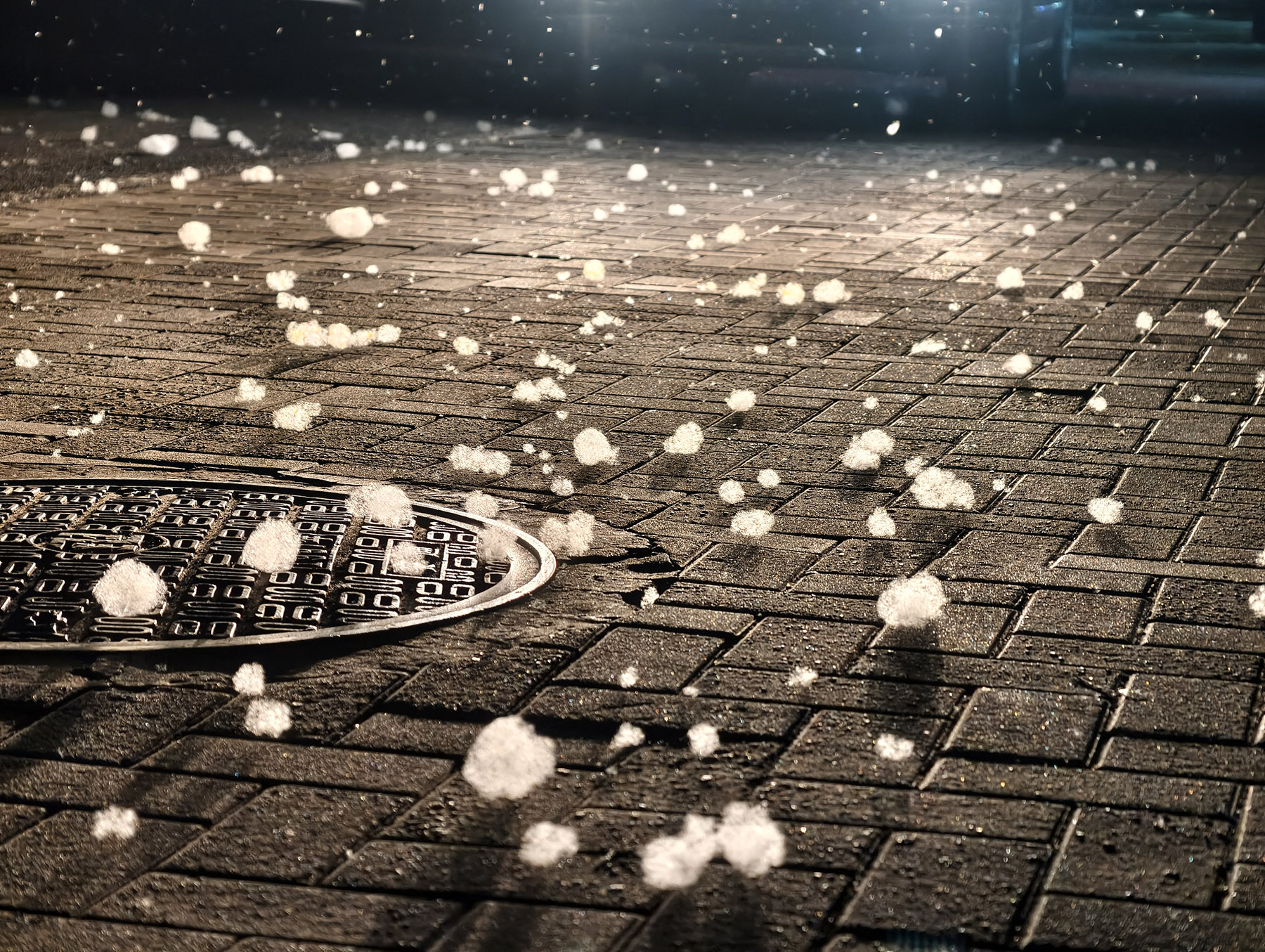
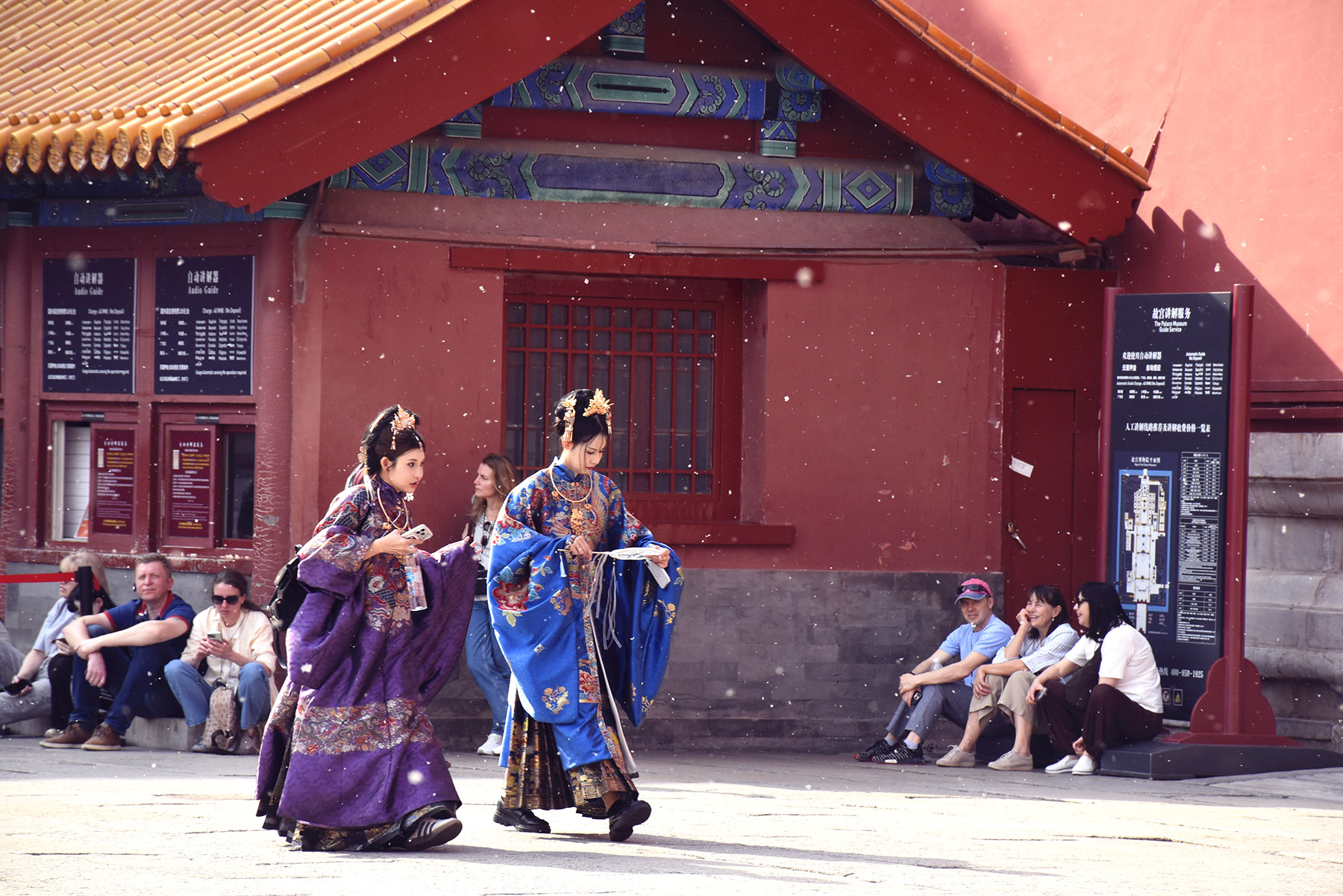
During the May Day holidays, Beijing is at its most inviting. Parks fill up, greenways hum with people, and spring seems to hit its stride. Yet for many residents, the season brings something else along with the sun and fresh leaves: fine white fluff drifting through the air.
It spins in loose swirls, slips into collars, sticks to camera lenses, and floats through the half-open window of ride-hailing driver Yang Shuquan's car. "Here we go again," he says, brushing it away with a wave of his hand. "Like snow that just hangs around."
From late April into May, as much of the country settles into spring, cities across northern China enter what locals half-jokingly call a season of "spring snow" — the airborne seeds of poplar and willow trees. The phenomenon can last for more than a month.
Yang has been driving in Beijing for years and knows this stretch well. "It's the toughest time of the year," he says. "You can't really open the windows. Once it gets in, your eyes sting, your throat feels off. After a while, it gets on your nerves."
He's hardly alone in this predicament. As temperatures climb, many northern regions move into peak fluff season. Data from the Beijing Municipal Forestry and Parks Bureau show that in 2026, the first wave began on April 6 and is expected to run through late May, roughly 50 days in total. The May Day holidays fall right in the middle of a second surge.
Nature turns into a hassle
What used to pass as part of the natural rhythm has, over time, turned into a recurring urban irritant.
For Hu Honghai, a resident of Changping district in Beijing, the situation is "messy". "You wash your car, and before long it's covered again," he says. "My eyes feel uncomfortable, my throat too. Sometimes I can't even tell if it's a cold or an allergy." He occasionally wears a mask or uses eye drops, though more often he just puts up with it.
That kind of quiet endurance is common. Wang Cheng, a researcher with the Research Institute of Forestry at the Chinese Academy of Forestry, points out that the fluff is part of a tree's natural reproduction cycle and has existed in northern China for centuries. "When it lingers and builds up, it starts to interfere with daily life and even health," he says.
For people who work outdoors or spend long hours on the road, the impact is more immediate. Yang notes that the fluff can affect not just comfort but safety. "If you're not careful, it can clog the radiator," he says. "In serious cases, that can damage the engine." He has installed a protective mesh to keep it out.
Add the cost of allergy relief, and the nuisance becomes something more tangible.
There's also a fire risk. The fluff contains plant oils and ignites easily. A stray spark is enough. There have been cases of piles of accumulated fluff catching fire due to cigarette butts or children playing with fire, with some escalating into larger incidents. Yang recalls lighting some fluff in a courtyard out of curiosity. "I ended up burning my shoe cabinet," he says. "A brand-new pair of leather shoes went with it."
Why it feels worse now?
The issue isn't only how much fluff there is. It's how close it is to where people live. Wang says that in the past, the catkins would drift into farmland, grasslands, forests, and rivers or wetland areas, where they would get trapped and not float in the air.
But urbanization has changed this. In cities, vast expanses of paved surfaces don't trap the fluff, so it keeps flowing back into the air. Wang explains that several factors come into play — the types of trees planted, how densely they are arranged, and the way urban spaces are built.
The age of the trees also matters, Wang emphasizes, with older trees producing more fluff. In the past, poplar and willow trees were often planted for timber and cut down before they ever reached the stage of heavy production of catkins. But with stronger urban ecological protection, they've been left to grow much longer in cities.
Given the discomfort, the first reaction of many residents is simple enough: why not just cut these trees down or replace them? The reality, however, is far more complicated than it seems.
Poplars and willows — especially populus tomentosa — once played a central role in greening China's northern cities. They grow quickly, tolerate harsh conditions, and provide long stretches of shade. Decades on, many of them now stand as towering trees and have become part of the city's ecological fabric.
Cutting them down is far from a simple fix. It would be expensive, ecologically costly, and at odds with the idea of ecological civilization. For many residents, it would also mean losing a familiar piece of the city's green memory and everyday landscape.
Hu puts it plainly: "Cutting them down doesn't seem realistic. But I've heard the city is replacing some of them." This is a common dilemma: people are bothered by the problem, but also recognize how complicated it is to manage.
A more targeted response
This year, though, things feel a little different. Hu says, "It seems better this year. I can see workers out there every night doing the cleanup. It feels like the issue is being taken more seriously. I've seen it covered quite a bit in the news, and my phone even pushes pollen forecasts."
Behind this perception lies a quieter, more systematic response — one that brings together satellites, big data, environmentally friendly agents, and even robotics. Beijing's catkin-control strategy in 2026 marks a shift from labor-intensive spraying and cleaning to a more precise, technology-driven approach.
At its core are prediction and targeted intervention. Jiang Yingshu, director of the Science and Technology division of the Beijing Municipal Forestry and Parks Bureau, explains that the city has integrated meteorological big data with ground-based monitoring to build a real-time forecasting platform. It provides street-level risk alerts on a five-tier scale, transforming response from reactive cleanup to proactive control.
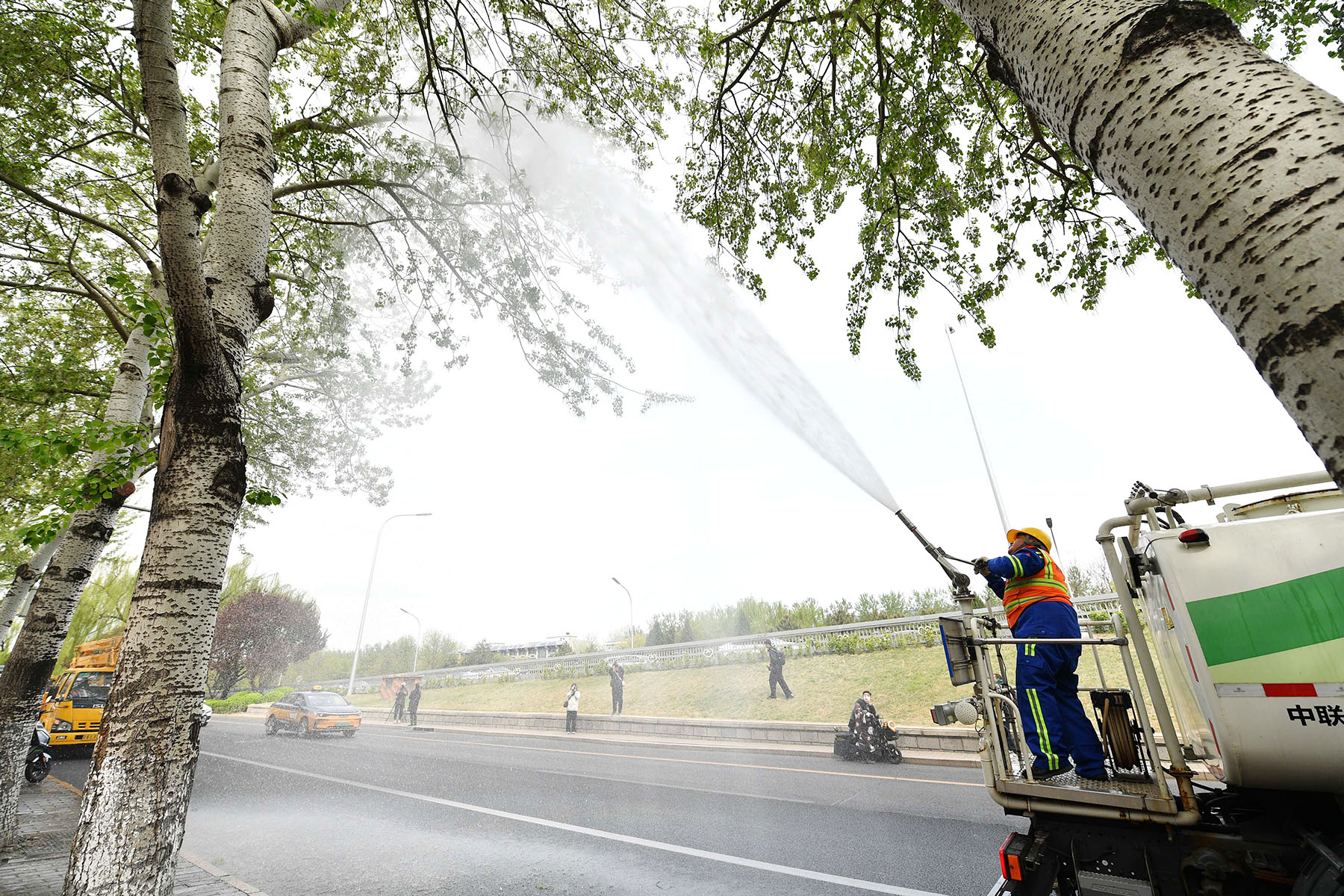
A key tool developed this year is an improved eco-friendly binding agent. A non-toxic polymer is sprayed onto tree canopies via high-pressure mist cannons or drones to form a thin "ecological film" that binds the fluff before it disperses. "A single application can reduce catkin release from an individual female tree by more than two-thirds, at a cost of roughly 10 yuan ($1.46) per tree," says Jiang.
If there is no heavy rain, one treatment can last the entire season. Large-scale spraying is carried out during calm periods, with fog-cannon ranges adjusted for different tree heights to maximize efficiency and minimize waste. The agent degrades naturally when it rains and in sunlight. Importantly, it does not affect tree growth or pollute the surrounding environment.
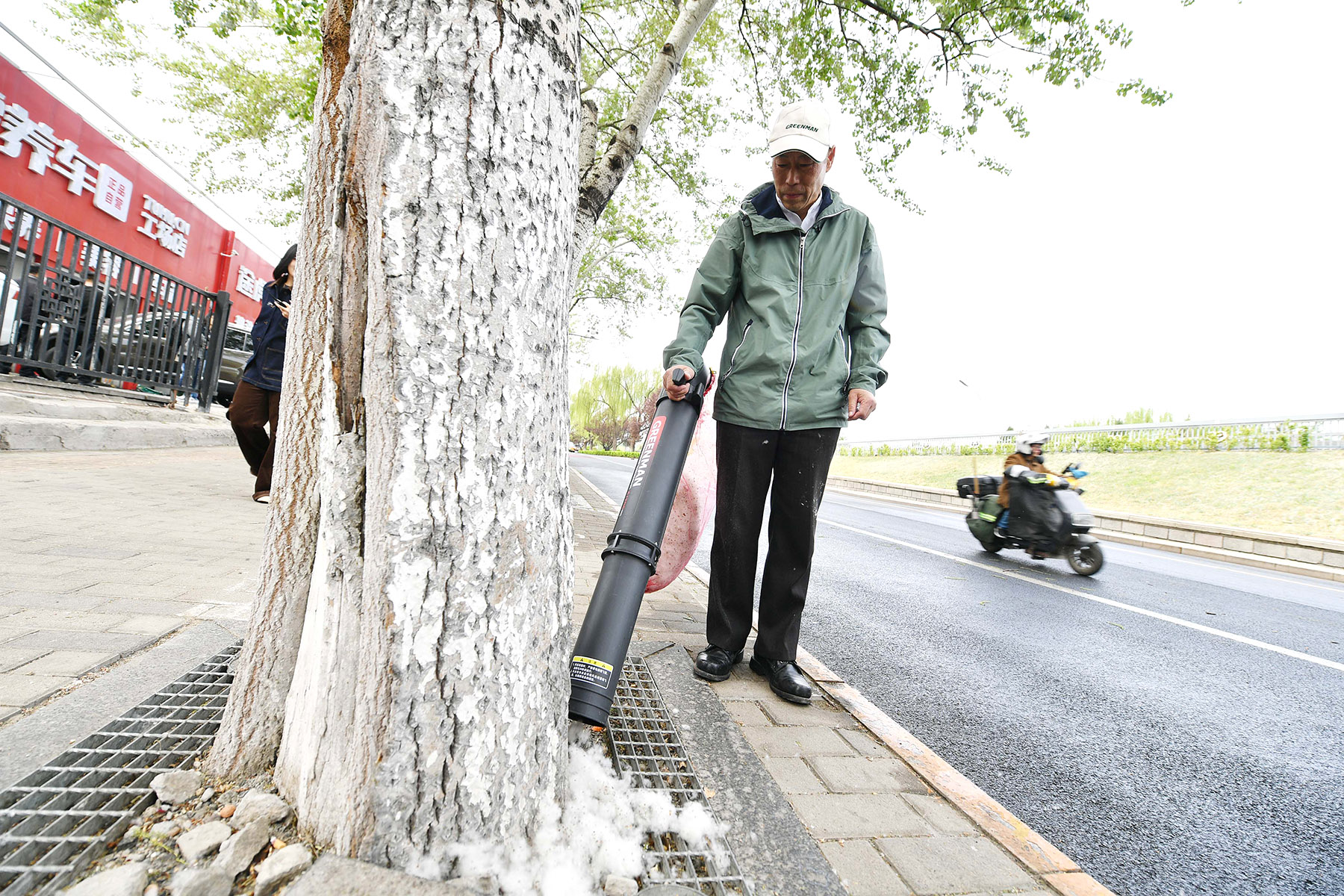
On the ground, new portable suction devices — developed by Lvyou Group — are being deployed to remove accumulated fluff. Unlike conventional vacuum cleaners, which blow the fluff around, these devices enable precise collection without disturbing other debris. Lightweight and easy to operate, they are particularly effective in residential areas and hard-to-clean corners, while also reducing fire hazards.
"Looking ahead, we plan to expand research into automated spraying robots and long-term biological suppression methods," says Jiang.
To manage the surge of visitors during the May Day holidays, Beijing's landscaping authorities have rolled out a targeted plan. In parks, scenic spots and transport hubs, crews will step up high-pressure water spraying, ground wetting and routine cleaning, with more frequent patrols on the ground.
Jiang also reminds residents to take basic precautions — wearing masks and protective eyewear, planning outdoor trips for early mornings, evenings or after rainfall when the fluff is lighter, and avoiding any open flames outdoors.
Technological interventions buy time — but do not solve the root problem. Beijing's approach now combines short-term control with longer-term adjustment. On the mitigation side, traditional measures — spraying, flushing, cleaning, and physical barriers — remain in place. Nighttime spraying, often observed by residents, helps both to knock down fluff and increase humidity, reducing the airborne spread of catkins.
On the structural side, the city has stopped planting female poplar and willow trees — the source of the fluff. Meanwhile, a quiet "tree replacement revolution" is underway. Researchers have collected nearly 400 low — or non-fluff germplasm resources and developed 16 improved varieties. Advances in tissue culture propagation now allow for the rapid scaling of new seedlings, with up to one million produced within two to three years.
Even so, change takes time. Wang suggests a gradual, targeted approach: replace problematic trees in residential areas, schools, and hospitals first; manage tree belts in parks to contain the spread; and leave trees in less populated areas as they are. "At its core, it is still an ecological question," he says."So it calls for ecological solutions."
Although the fluff itself is not always a strong allergen, it can carry dust, pollen and bacteria, triggering respiratory reactions. In March, the National Health Commission and the China Meteorological Administration jointly launched the country's first weekly pollen forecast.
Li Yi, a senior engineer at the Public Meteorological Service Center of China Meteorological Administration, explains that the system combines numerical weather prediction with expert calibration to help allergic people plan their activities.
But challenges remain. Current forecasts focus on total pollen concentration and cannot distinguish specific types, despite significant differences in allergenicity. Moreover, poplar and willow fluff is not yet included, as its dispersion depends not only on weather but also on tree distribution, surface conditions, and human activity — making modeling more complex.
"With denser monitoring networks and better data integration, more refined forecasts may become possible — distinguishing between pollen types. The aim is to move toward more personalized guidance, helping people decide when and where to go outside with fewer risks," says Fan Keqi, an engineer at the CMA Public Meteorological Service Center.
Living with it
For residents, coping with the fluff often means finding a balance between endurance and adaptation. "It's annoying, but you get used to it," Hu says. "Some people even treat it as part of what makes spring distinctive here."
That attitude reflects the complexity of the issue. Cities need greenery and ecological space. Residents, however, also expect comfort and quality of life. When the two collide, simple trade-offs rarely work.
"We shouldn't reject greening because of the fluff," Wang emphasizes. "The key is scientific planning and fine management to strike a better balance between ecological benefits and livability."
This thinking is gradually shaping policy and practice. From pollen forecasts to monitoring platforms, from new tree varieties to advanced control technologies, efforts are underway to shift from reactive responses to proactive management.
For many, the fluff is just a fleeting episode of spring. With the arrival of rain, the air clears and the white fibers disappear. But for the city, the issue does not end with the season. It raises deeper questions about species selection, urban planning, and ecological governance.
As people head outdoors during the May Day holidays to embrace the city's greenery, the drifting fluff serves as a quiet reminder: Every patch of urban green comes with choices — and trade-offs.
Finding a sustainable balance between "more green" and "less disturbance" may be the real challenge behind this annual phenomenon. It is not just about managing trees, but about how a megacity learns to coexist with nature — and to pursue ecological equilibrium alongside development. Beijing is already in the process of writing that answer.
Contact the writers at liwei@chinadaily.com.cn
