

The Shenzhen-Hong Kong land border crossings, which account for nearly half of the country’s total cross-boundary passenger traffic, are transforming from transit corridors between the two economic powerhouses into comprehensive hubs integrating trade, services, and innovation functions. Li Bingcun reports from Shenzhen.
Editor’s note: As key transportation hubs in the Guangdong-Hong Kong-Macao Greater Bay Area, the cluster of ports in Shenzhen and Hong Kong is seeking a leap in value with a refreshed outlook and more integrated functions to turbocharge industries and the cities’ respective economies. China Daily presents a three-part series to document the transformation, with the first article spotlighting the significant potential of the land-port economic belt.
A chain of cross-boundary checkpoints has mushroomed on both sides of the Shenzhen River and its adjacent bay areas, carving out an economic corridor that serves as a key gateway for the flow of people, goods and capital between innovation epicenter Shenzhen and world financial hub Hong Kong.
After the twin cities’ ups and downs for almost half a century, the crossings are undergoing a profound transformation to enhance their value, aiming to convert massive traffic flows into fresh economic momentum.
READ MORE: Express Rail Link optimizes cross-boundary travel arrangements
Desperate for new development opportunities, Shenzhen and the Hong Kong Special Administrative Region have turned their sights to the boundary areas, with the southern Chinese mainland boomtown upgrading crossing facilities and integrating industries to further unleash the capabilities of the strategic passages, and the SAR spearheading its ambitious Northern Metropolis project to reshape the once-desolate area.
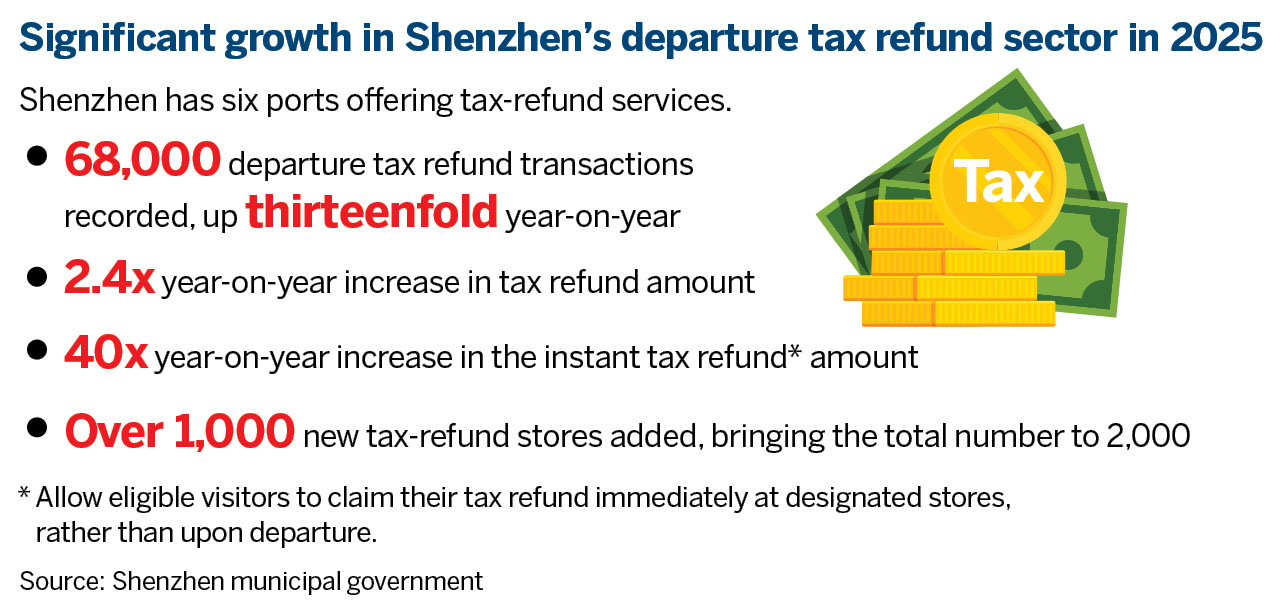
With greater development priorities, the future of this prime location is expected to be a strategic lever for both sides to address economic pain points, promote regional industrial upgrading and advance the country’s high-level opening-up.
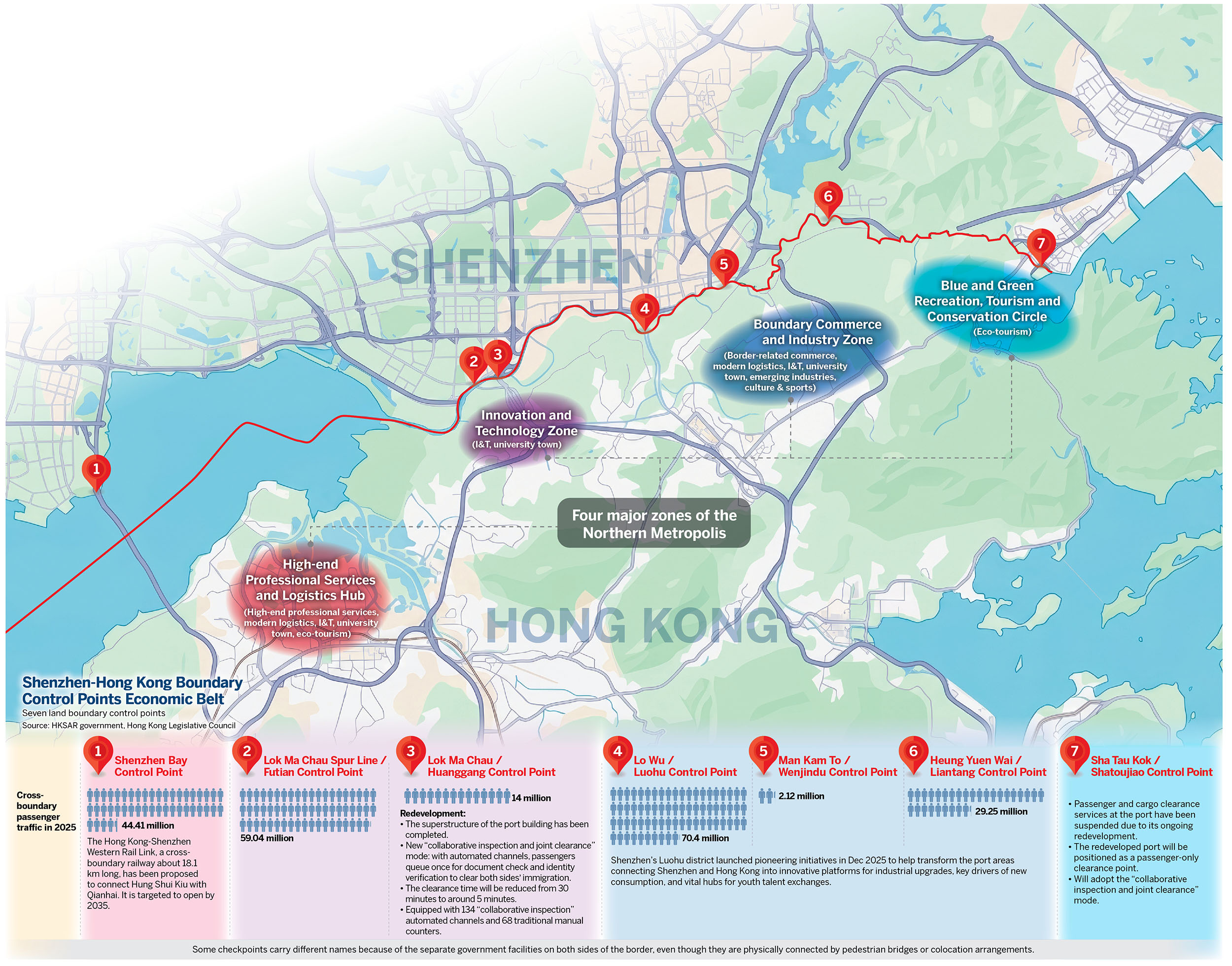
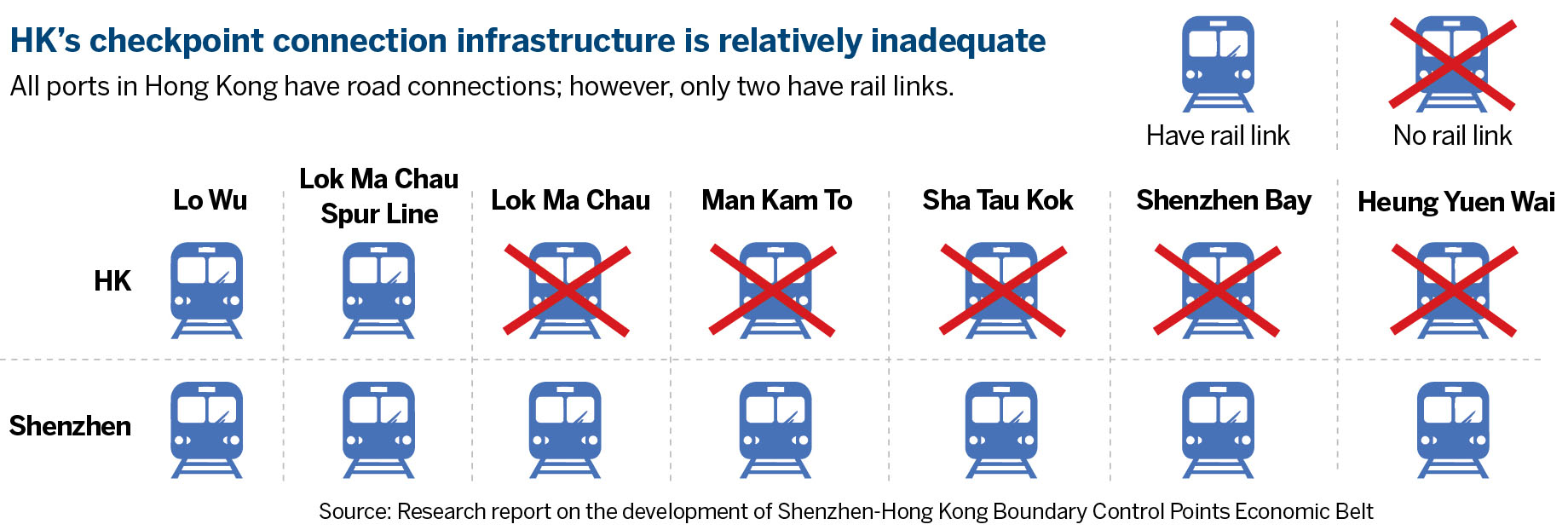
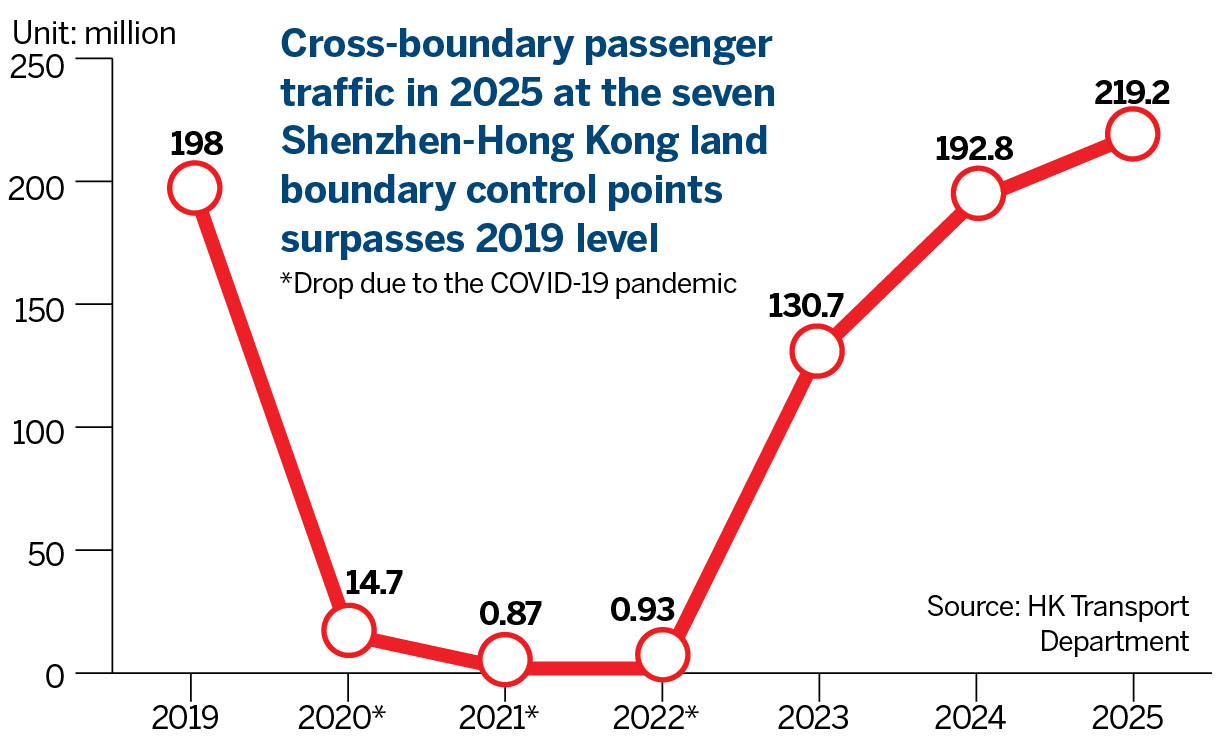
The seven land-boundary crossings between Shenzhen and Hong Kong currently handle over 200 million passenger trips annually, accounting for 40 percent of the nation’s total inbound and outbound passenger traffic. They include the three busiest ports — Luohu, Futian and Shenzhen Bay — complemented by the only round-the-clock checkpoint, Huanggang, as well as Wenjindu, Liantang and Shatoujiao.
The figures speak for themselves. Cross-boundary visits at all ports hit a record high of 273 million last year, up 14 percent year-on-year, with an average of 750,000 movements logged daily. Since Hong Kong’s return to the motherland in 1997, passenger throughput between the two cities has more than tripled, and the trade volume is up 10 times to 790 billion yuan ($116 billion), magnified by the opening of more crossings.
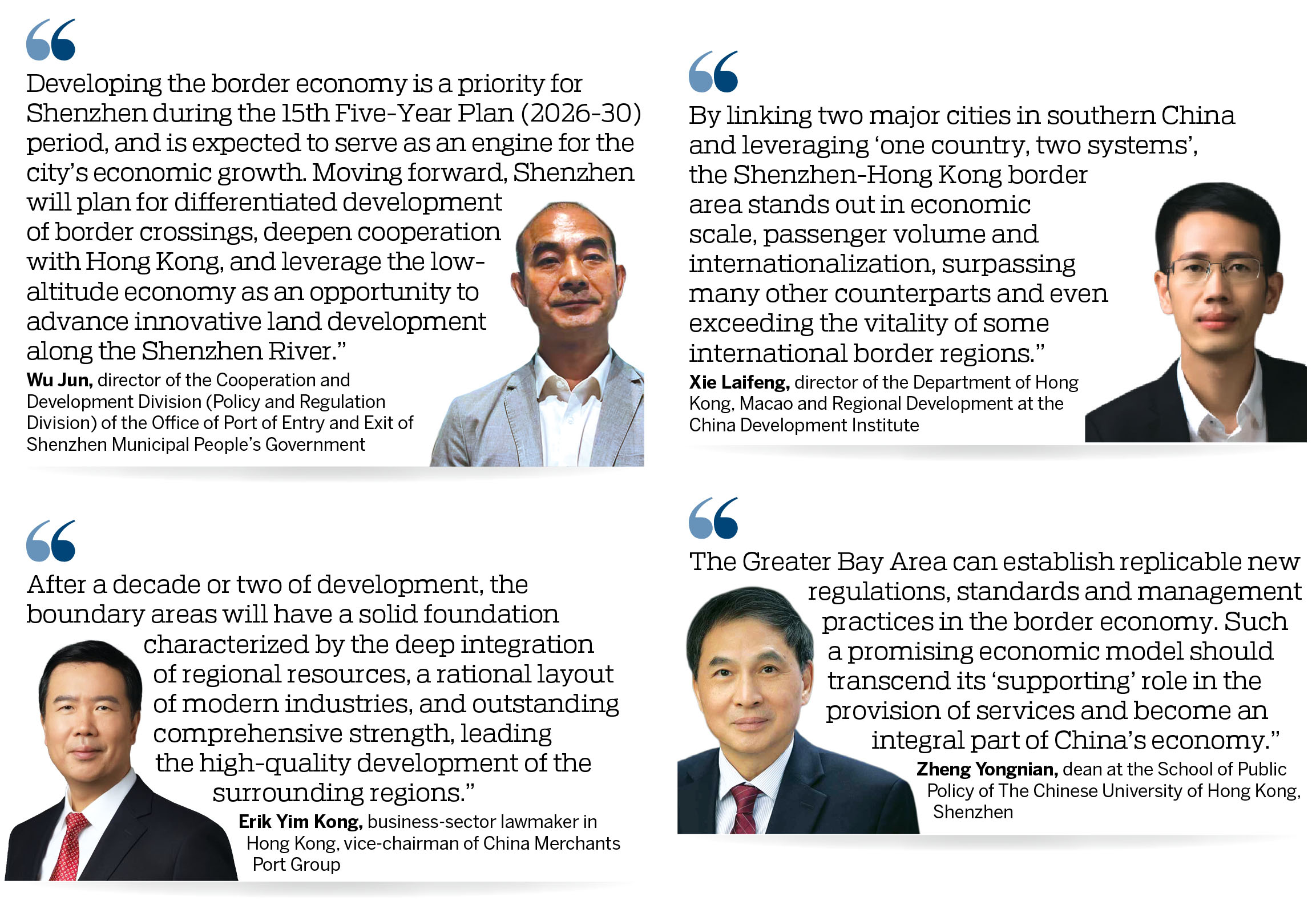
“Linking two core cities of southern China and benefiting from the institutional advantages of ‘one country, two systems’, the Shenzhen-Hong Kong boundary area, driven by trade and innovation-technology industries, is of unique significance to the country,” says Xie Laifeng, who heads the Hong Kong, Macao and Regional Development unit at the China Development Institute.
“Whether it is in terms of passenger traffic or internationalization, it outperforms many other counterparts and even surpasses the economic vitality of some border regions between countries,” he says. “As cross-boundary traffic continues to rise, and integration of the Guangdong-Hong Kong-Macao Greater Bay Area enters a new phase, the boundary crossings’ functions need to be further upgraded, with new economic models in place to promote deeper industrial, livelihood and cultural connectivity.”
Pursuing such lofty goals, China has made extraordinary efforts to evolve ports of entry from peripheral passages to regional economic engines. Under the 14th Five-Year Plan (2021-25), the country added and expanded 40 boundary crossings, bringing the total to 311.
New phase, new plans
Entering the nation’s 15th Five-Year Plan period (2026-30), Shenzhen has made boosting the boundary area economy a key priority, pledging to adopt varied strategies for developing different land ports. The city’s renovated Huanggang Port is due to open this year, while Luohu, Shatoujiao and Wenjindu ports will be upgraded in the next few years, according to Wu Jun, director of the Cooperation and Development Division of the Office of Port of Entry and Exit of the Shenzhen Municipal People’s Government.
The upgraded checkpoints will see streamlined customs procedures, greater processing capacity and more clearly defined functions, Wu tells China Daily in an exclusive interview. The new-look Huanggang Port will release 500,000 square meters of land to back up the development of the Hetao Shenzhen-Hong Kong Science and Technology Innovation Cooperation Zone.
In the long term, Shenzhen may create a dedicated crossing in the Hetao cooperation zone to facilitate the movement of scientific researchers, as well as the Qianhai checkpoint of the planned Hong Kong-Shenzhen Western Rail Link — a vital cross-boundary infrastructure that will connect the two cities in just 15 minutes.
In Shenzhen’s push to strengthen the border crossings’ integration with industries, western checkpoints will focus on modern services and high-end consumption, while those in the central areas will facilitate the flow of scientific and technological resources, and those to the east will create new scenarios for cross-boundary consumption.
Luohu district — home to three checkpoints — took the lead in launching initiatives last year to revitalize the port economy, focusing on cross-boundary trade, high-end consumption, emerging technology applications and talent communication.
“Along with the earliest-developed crossings, Luohu has the closest ties, most frequent exchanges, and the most active cross-boundary consumption with Hong Kong,” says Liu Xiaomei of the Luohu District Development and Reform Bureau.
The city hopes to leverage these advantages and nearby industrial resources to introduce lightweight, high-value-added industries along the boundary, such as coordinating with Hong Kong in developing a life-and-health industrial park, exporting financial and knowledge services, and expanding the trade of fresh food and agricultural products, she says.
Boundary crossings are also excellent platforms for showcasing products and promoting the consumption of smart home devices, wearable technology, senior-friendly technology, automobiles, as well as gold and jewelry.
“Previously, the crossings mainly functioned as transit hubs — busy but underutilized. The initiatives are set to leverage their geographic advantages to make them destinations for Shenzhen and Hong Kong residents to work, live and relax,” Liu says.
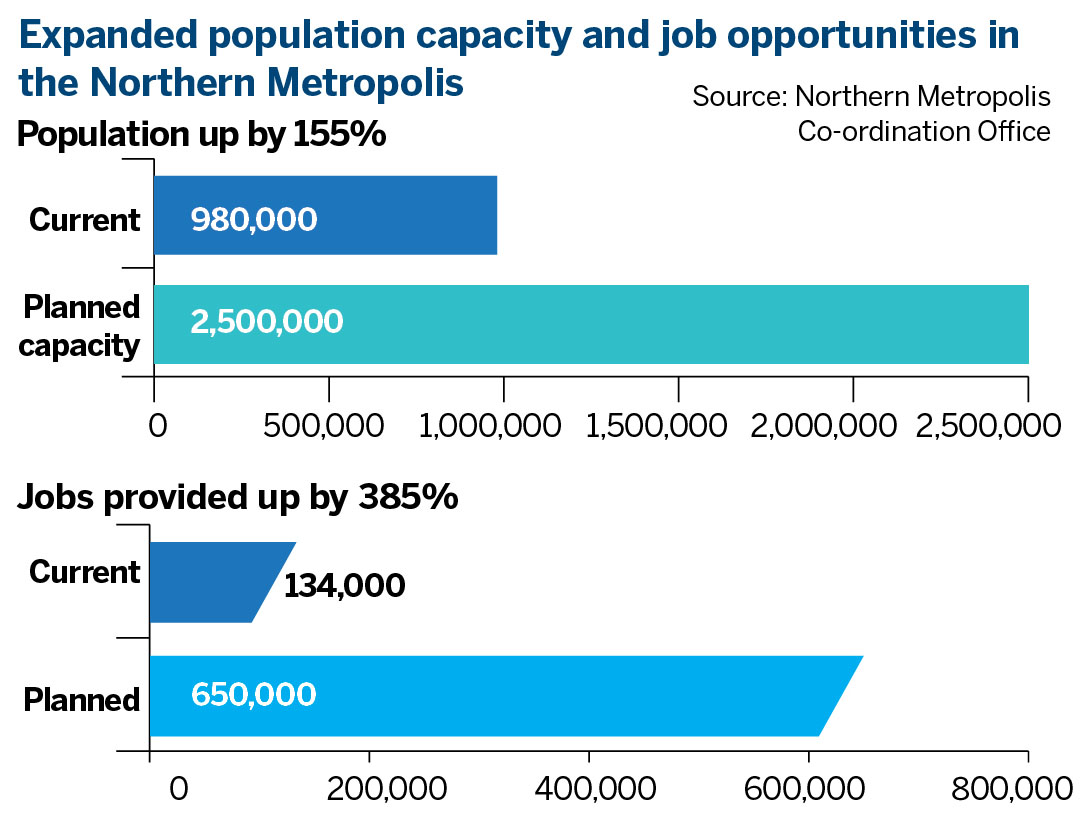
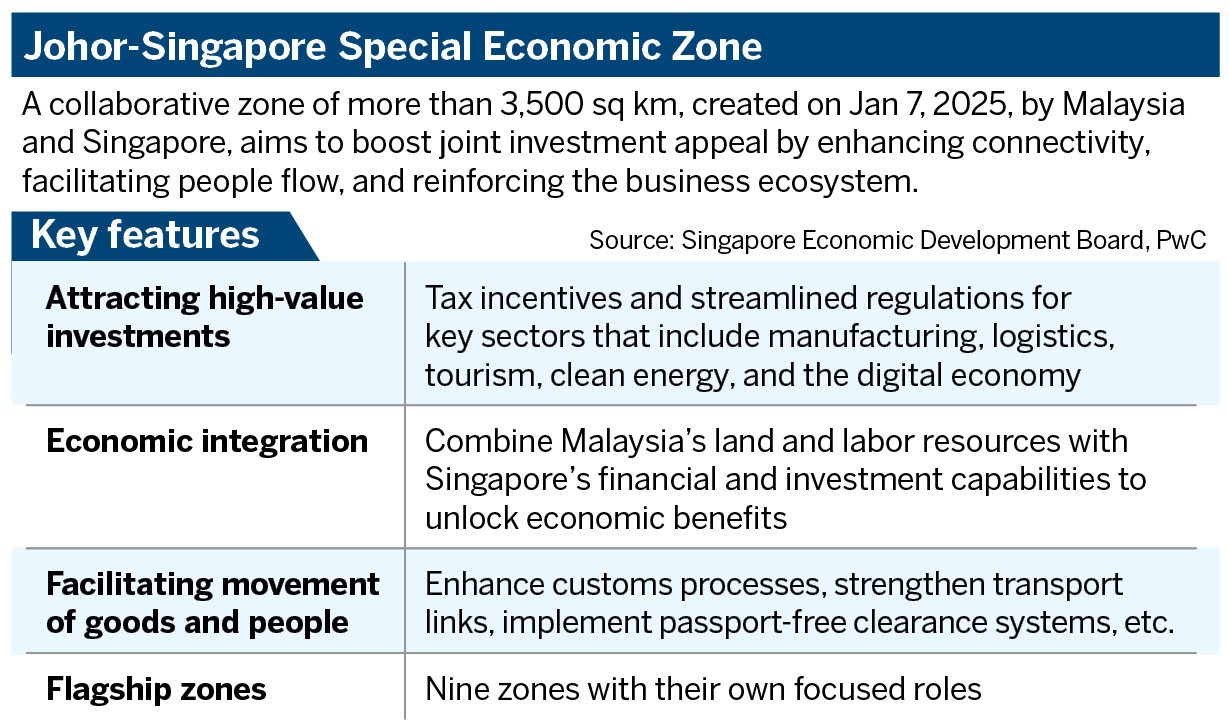
On the other side of the boundary, the 300-square-kilometre Northern Metropolis is rapidly taking shape, and is on course to be Hong Kong’s most dynamic area in the next two to three decades. Its core industries — tech innovation, the digital economy, low altitude aviation and higher education — along with a projected population of 2.5 million and a new transport network centered on the Northern Link, are poised to fuel the region’s economic growth.
Zheng Yongnian, dean at the School of Public Policy of The Chinese University of Hong Kong, Shenzhen, says the “port economy” represents an upgrade from the traditional “transit economy”.
“By leveraging the traffic of boundary crossings, it fosters the development of local industries, such as consumption, trade and logistics, achieving an extension of industrial chains and economic value-added,” he said.
“A growing number of crossings are undergoing such transformation. Many countries are promoting economic growth, employment and trade by establishing free trade and special economic zones, or port clusters at seaports, land border crossings or airports, transforming them from economic outposts into hubs,” Zheng says.
Hong Kong business-sector lawmaker Erik Yim Kong has compiled an insightful research report in this field, saying the port economy holds promise as a new economic driver for Shenzhen and Hong Kong that will strengthen the overall level of openness and industrial competitiveness of the 11-city Greater Bay Area.
As natural conduits connecting both sides, the port areas can further explore opportunities in customs clearance facilitation, cross-boundary data flow, and mutual recognition of professional qualifications, providing valuable insights for other free trade zones and cross-border cooperation zones across the country.
Connecting domestic and international markets, developing border ports can further improve the efficiency of cross-boundary logistics, passenger and capital flow, backing the country’s “dual circulation” strategy and high-level opening-up, says Yim.
Tailored strategies needed
Given the varying levels of development in the border regions of both sides, different project strategies are essential.
Xie says that Shenzhen’s port cluster, having matured after years of development, demands new business models and greater internationalization to unlock its worth. He calls for urgent attention to enhance older ports with haphazard layouts, aging infrastructure and severe traffic congestion. For new ports being planned, allocating more space for new consumption formats and for innovation and entrepreneurship would be ideal.
With Hong Kong’s inno tech parks running at high capacity, the boundary port areas are well-positioned to absorb spillover demand. Attracting more Hong Kong and international firms to the area would also spur development of the Northern Metropolis, he says.
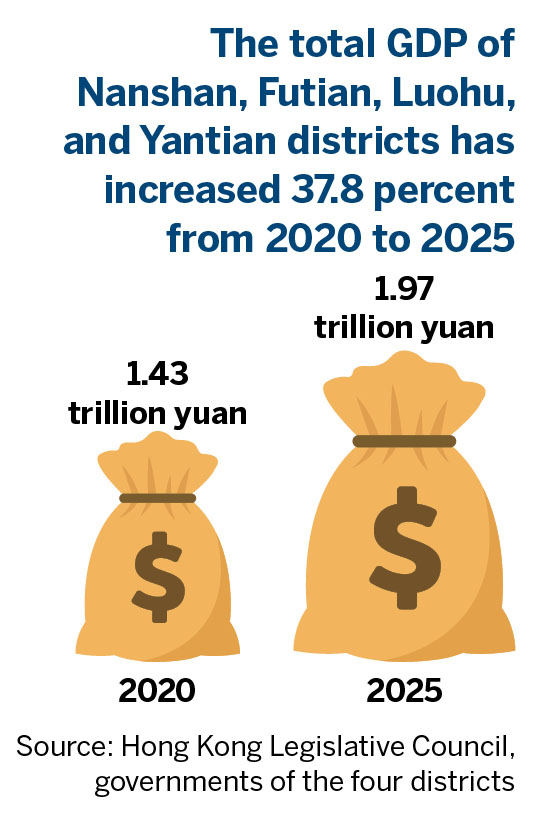
He said he believes Shenzhen’s crossings will see significant improvement under the 15th Five-Year Plan. With Luohu taking the lead, he hopes more areas will follow suit in scaling up port-driven economic development, pinning high hopes on Qianhai and Shekou in Nanshan district.
On the Hong Kong side, Yim says, developing the boundary areas has long been neglected, resulting in underdeveloped industries and inadequate supporting infrastructure. The authorities’ lengthy decision-making and implementation procedures have further slowed its pace of development.
He suggests forming a high-level Shenzhen-Hong Kong cooperation task force to elevate port development to the national level, jointly planned and developed by both sides to create complementary strengths. Hong Kong’s growth can be expedited through proposed dedicated legislation for the Northern Metropolis, which is set to innovate land development models and speed up project approvals.
In Zheng’s view, the port cluster should tap the SAR’s strengths to vigorously develop cross-boundary service industries — an area in which China’s economy has lagged and which is crucial to future international trade growth.
He advocates combining the policy advantages of both sides to make these checkpoints the first stop for companies going global. Building on the opportunities presented by the nation hosting this year’s Asia Pacific Economic Cooperation meetings in Shenzhen, the Shenzhen-Hong Kong port areas could further deepen policy openness on multiple fronts, including visa and tax-related measures, he added.
ALSO READ: HK passenger traffic at boundary control points up 12% in 2025
Zheng also recommends drawing on successful experiences of advanced port-economy models like Singapore, Dubai and Tokyo to develop diversified businesses at border ports, building free trade zones, and developing complete industrial chains in coordination with surrounding regions to ensure that the boundary corridor becomes an integral part of the national economy.
Next Actions
- Elevating the strategic positioning of the border economic belt to a “national-level Shenzhen-Hong Kong cooperation platform”.
- Jointly planning and developing the border region to achieve complementary advantages of the two sides.
- Strengthening spatial planning for existing border crossings and strategically integrating them with high-value-added industries based on their respective strengths.
- Reserving space for emerging industries, such as the low-altitude economy, as well as for innovation and entrepreneurship, when planning new border crossings.
- Taking advantage of the nation’s hosting the 2026 Asia-Pacific Economic Cooperation meetings to deepen policies on opening up the boundary areas, particularly with regard to visa and taxation matters.
Contact the writer at bingcun@chinadailyhk.com
