

Young entrepreneurs turn academic research into startups, bringing embodied intelligence into industry and daily life through curiosity and ambition.
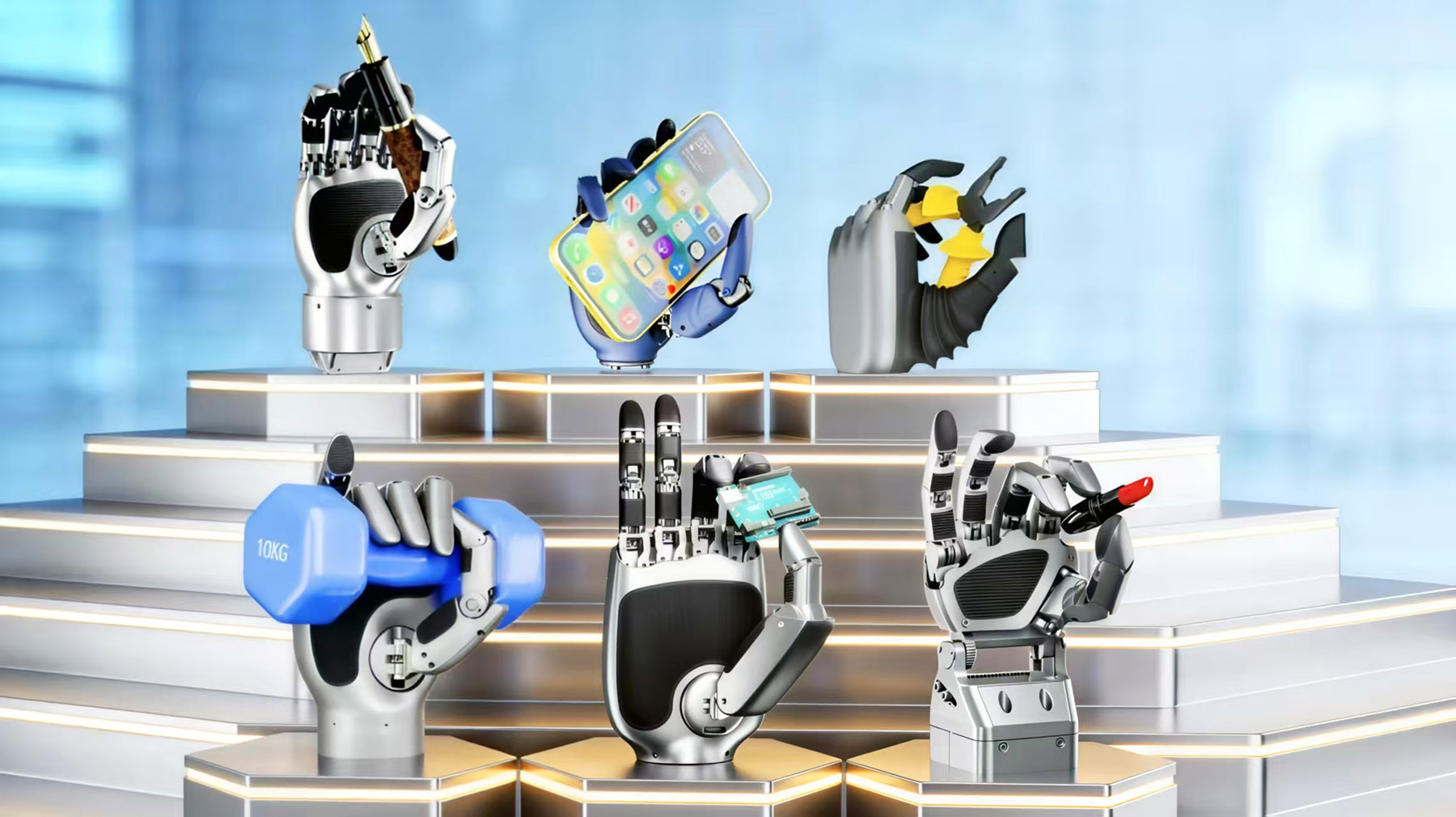
At Beijing's Zhongguancun Science Park, a robotic hand steadies a thin needle between its fingers, capable of threading it with precision. It can also play the piano, tighten screws, or even deliver a gentle massage — a glimpse of the range of tasks made possible by advances in embodied intelligence.
Behind this innovation is Jia Xiaoyou, a graduate student at Tsinghua University and co-founder of Linkerbot, a company working at the forefront of the global market for dexterous robotic hands. Her team is trying to bring a technology that was once niche and expensive into wider industrial and everyday use.
"For robots to truly integrate into daily life, agile mechanical hands are indispensable," Jia said. "Without them, robots can only handle simple interactions, rather than solving real-world problems."
READ MORE: AI with a human touch
Jia's devices are recognized globally for their flexibility and precision, with eight out of 10 similar units worldwide produced by Linkerbot.
"Our systems have been adopted by overseas universities for laboratory research, further development, and data collection, while in industrial settings they can perform delicate operations that would otherwise rely heavily on manual labor," she said.
Jia's entrepreneurial journey began in 2023, when embodied intelligence was still an emerging field. Even then, she saw the potential of dexterous robotic hands.
"Some overseas products cost more than 1 million yuan ($140,000) per unit, making them inaccessible for large-scale use," she said. "Our goal is to bring prices below 50,000 yuan, with entry-level models available for as little as 6,000 yuan."
Jia's efforts reflect a broader shift among young Chinese entrepreneurs. As Shenzhen prepares to host a major Asia-Pacific gathering later this year, themes such as openness, innovation, and cooperation are once again in focus — not just in policy discussions, but in the daily work of young entrepreneurs.
Many of them are part of the Zhongguancun U30 (ZGC U30), a program launched in 2015 to support founders under the age of 35.
Over the years, nearly 7,000 participants have taken part, with more than 300 selected as annual winners, forming a growing community of young innovators focused on cutting-edge technologies such as artificial intelligence, humanoid robotics, and life sciences.
For Jia, the program represents more than recognition — it offers a platform to exchange ideas and connect with peers.
"I have met many like-minded entrepreneurs," she said. "Support from local authorities has also helped us gain exposure at important events."
Lai Jiancheng, another ZGC U30 member and founder of Tachin, is working on electronic skin — a technology designed to give machines a sense of touch.
"Unlike conventional engineering products, electronic skin cannot be assembled from existing components," said Lai, a chemistry major. "It must be built from raw materials into a functional system, which involves a very long and complex industrial chain."
After years of work, his team has developed products with high sensitivity, a wide detection range, and strong flexibility, making them applicable in robotics, smart vehicles, medical rehabilitation, and wearable devices.
Yet moving from the lab to large-scale production proved difficult.
"There was no mature production line for this technology in China," Lai said. "We had to create everything from scratch."
By the end of 2025, his team had established their first production line — a milestone that required learning from multiple industries and integrating different technologies into a new system.
Building on a spirit of overcoming technical challenges, entrepreneur Yuan Zhichao, founder of i-Sense, is focused on developing key optical inspection modules used as core sensing components for defect detection and quality control in semiconductor manufacturing.
"High-end inspection systems have long relied heavily on imported optical components, making them a major bottleneck in efforts to achieve self-reliance in semiconductor equipment," Yuan said. "In late 2024, a second wave of sanctions accelerated the push for domestic alternatives."
In response, his company developed a new autofocus imaging system capable of detecting microscopic defects across multiple layers, overcoming some of the limitations of traditional optical technologies.
"Through sustained technological accumulation and reliable products, we aim to strengthen the domestic foundation for precision optical technologies and play a bigger role in the global supply chain," Yuan said.
Today, i-Sense serves more than 70 clients in wafer inspection and advanced packaging, while also expanding into Southeast Asia and planning to enter the Japanese and South Korean markets.
Reflecting on his experience, Yuan emphasized the importance of interdisciplinary thinking.
"The semiconductor industry brings together mechanics, optics, electronics, software, and algorithms," he said. "Academic training is essential, but entrepreneurship requires you to integrate knowledge quickly and solve real problems."
That same cross-disciplinary thinking inspired Fu Zhi, who turned an observation about energy use into a new business model.
During his doctoral research at Tsinghua University, Fu noticed a mismatch in energy use: green power is typically generated during the day, while consumption and storage needs often arise at different times.
"The same idea applies to computing power," Fu said. "Idle resources can be shared and deployed to meet demand elsewhere, just as unused electricity can be redirected to where it's needed."
ALSO READ: Tech empowers young entrepreneurs
In 2023, he founded ComNergy Tech Limited, an AI-driven scheduling platform for idle computing resources, and built a power-grid-style network that makes computing resources instantly accessible. The system now serves AI companies, research institutions, and developers, offering flexible and cost-efficient solutions.
Fu has also expanded internationally, enabling cross-border sharing of computing resources."Through this, we are creating a new model of global technological cooperation," he said.
Beyond commercial success, Fu hopes to reshape the mindset of Chinese tech entrepreneurs.
"Innovators in China are often seen as simply catching up. But we should aim to lead, not just follow," he said.
Contact the writers at guojiatong@i21st.cn
