

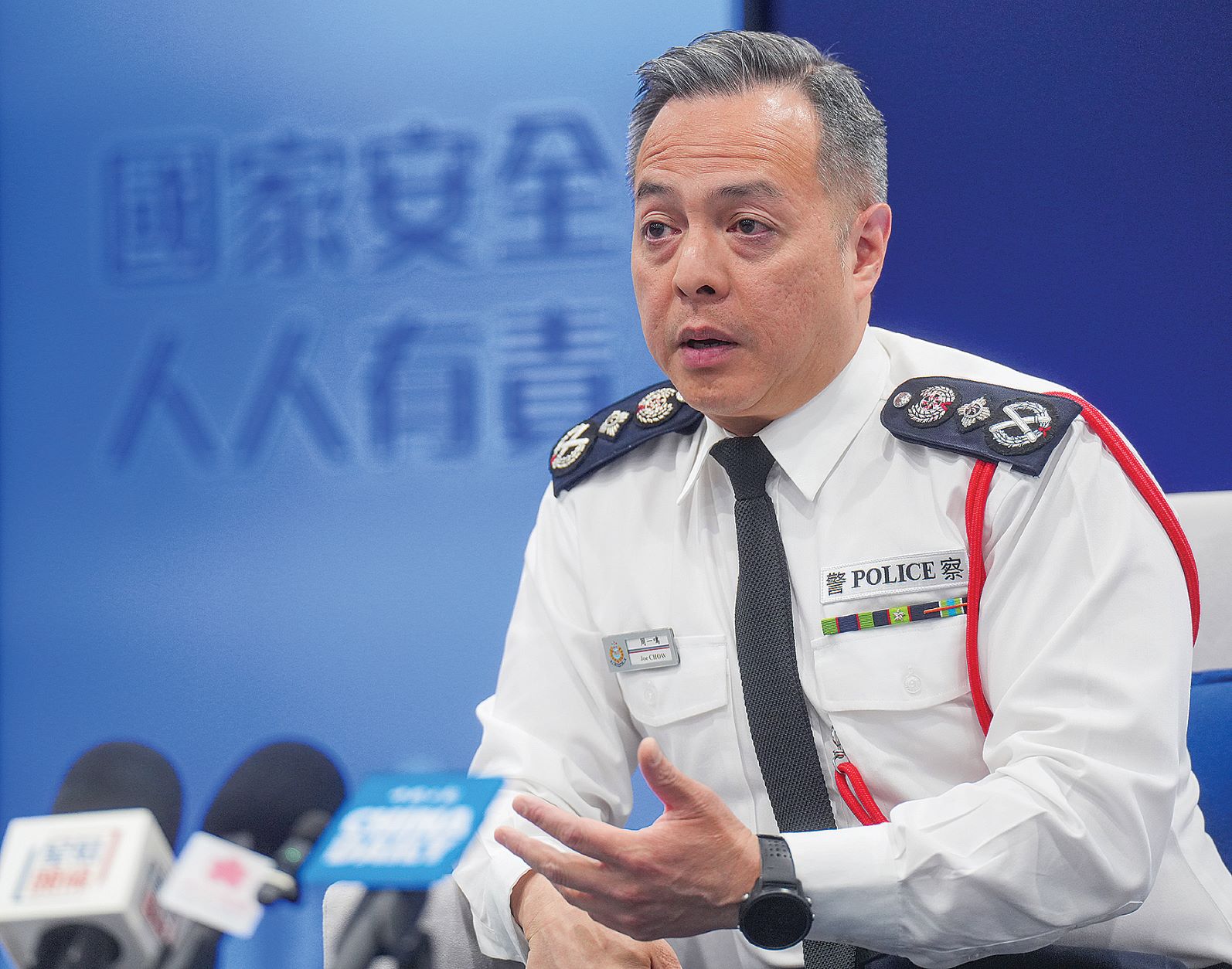
The central government's latest white paper on the Hong Kong Special Administrative Region provides "fundamental guidance" of "great importance" to the city's pursuit of high-standard national security, Hong Kong Police Commissioner Joe Chow Yat-ming said.
Chow has pledged to spare no effort in innovatively strengthening safeguarding efforts across law enforcement, public education, international cooperation and digital policing.
The white paper, titled "Hong Kong: Safeguarding China's National Security Under the Framework of One Country, Two Systems", was issued by the State Council Information Office in February, a day after former media tycoon Jimmy Lai Chee-ying was sentenced to 20 years in prison for violating the HKSAR National Security Law.
Chow recently briefed the media on the latest progress in the Hong Kong Police Force's national security work ahead of the upcoming National Security Education Day and announced a series of public events to mark the occasion.
READ MORE: Police Commissioner: HK sees decline in criminal cases in 2025, down 5.9% from 2024
These include a school outreach program to be launched next month, a police vessel display on April 12 at Harcourt Garden in Admiralty, and interactive quiz booths at Victoria Park during the weekend leading up to National Security Education Day on April 15.
"The international landscape has become increasingly complex, with geopolitical tensions, unilateralism and protectionism making everyone more vulnerable," Chow said. "How to spread the message and advocate our work in safeguarding national security is one of the key issues."
He said further enhancements to national security measures — while maintaining a balance between security and development — will depend on proactive, targeted law enforcement as well as education efforts to strengthen a sense of national identity among residents.
"This forms the bedrock of national security," he said.
READ MORE: HK police urged to fulfil duties with ‘iron will, compassion, insight’
Official figures show that since the HKSAR National Security Law took effect in 2020 and the Safeguarding National Security Ordinance was enacted in 2024, police have made 385 arrests related to national security offenses, with over 50 percent of the detainees prosecuted. The national security hotline has to date received 1.1 million tips, averaging 590 reports per day.
Chow stressed that the law affects "only a small portion of people" — those "harboring malicious intent and seeking to endanger national security". While police are "at the forefront" of safeguarding national security, "every resident is also a stakeholder," he said.
He added that the force aims to leverage Hong Kong's role as a "super-connector" — linking the mainland and the international community — to showcase its law enforcement capabilities, as well as the city's stability and prosperity under the "one country, two systems" policy, when it hosts the 94th Interpol General Assembly for the first time in November.
Chow also said improved public safety has begun delivering the "high standard security" outlined in the white paper as essential for high-quality development, crediting progress to the force's "smart policing" reforms.
READ MORE: Officials: HK advancing from stability to prosperity with NSL
These include the rollout of the "SmartView" citywide closed-circuit television network and broader use of technology-driven crime-fighting tools. By late last year, about 5,000 "SmartView" cameras had been installed across the city. In 2025 alone, the system helped solve 763 cases and led to more than 1,200 arrests.
He added that the system has accelerated investigations into serious crimes, with some robbery and homicide cases solved within days or even hours using surveillance footage.
Addressing privacy concerns, Chow said officers follow strict internal guidelines on data access and retention. All cameras are clearly signposted, and their coverage excludes residential interiors.
To stay ahead of emerging threats, Chow said a "smart policing" advisory panel comprising 14 experts from technology, academia and other sectors regularly meets with police to assess new technological trends. "We used to react to new crime methods," he said. "Now, we are predicting what criminals may attempt to do."
Contact the writer at gangwen@chinadailyhk.com
