

From an unexpected oasis and climbing tall dunes to millennia-old caves filled with murals and Buddhist statues, this city is rich with heritage, Richard Harris reports in Dunhuang.
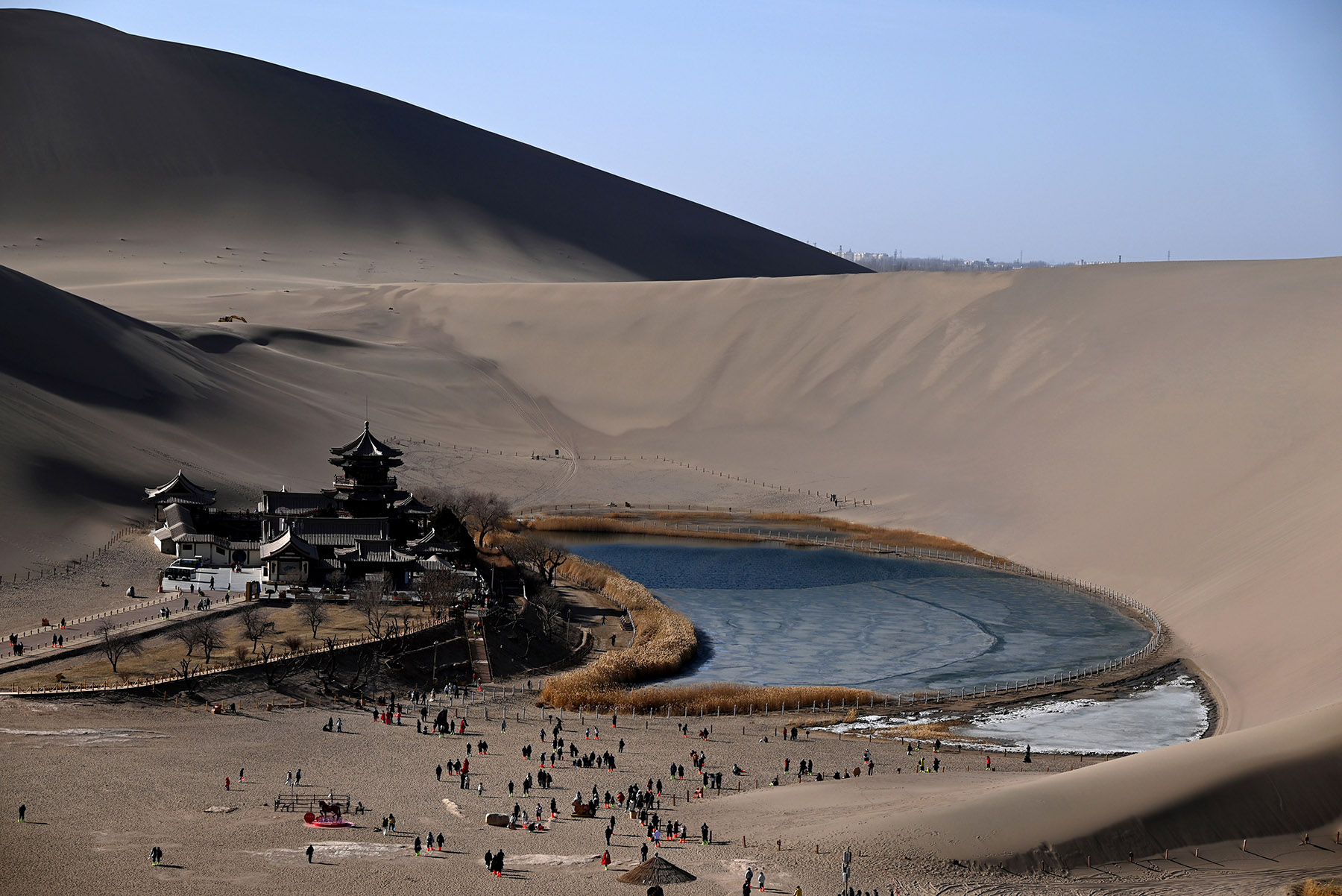
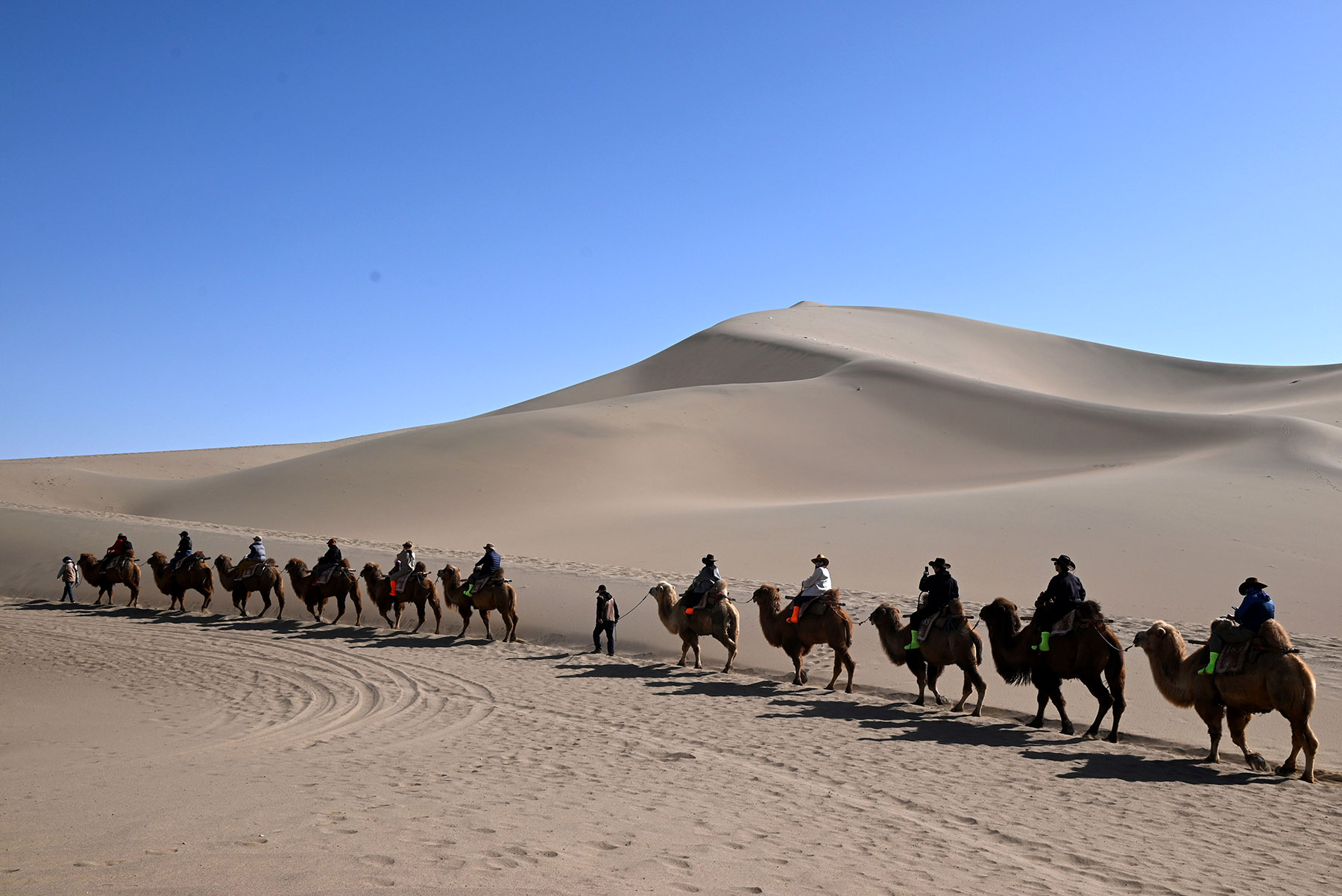
Camels have a reputation as bad-tempered, irascible beasts, but as mine slowly padded through the dunes of Mingsha Mountain in the middle of Northwest China's Dunhuang desert, I felt we had an affinity, the only sound being her feet hitting the deep sand.
The mountain and the oasis of Crescent Lake, where camel rides are offered, are highlights of any visit to Dunhuang in Gansu province. The dunes stretch for about 40 square kilometers and reach heights of hundreds of meters, an awe-inspiring sight for any visitor with the stamina to scramble to the top of one.
READ MORE: Journey through time, stars and flavors
Looking down from a dune crest, ancient travelers who had braved the journey across this sea of sand must have thought the curve of Crescent Lake was a mirage, a genuine oasis in the desert. Even in winter, with its waters iced over, the lake still reflects the adjacent pavilion, and would have been a much-needed resource for caravans traveling along the ancient Silk Road.
This corner of China is notable for its harsh environment, and just a couple of hours' drive away is the start of the Gobi Desert. Here one finds the Great Wall of the Han Dynasty (206 BC-AD 220), a 2,100-year-old fortification that stretches for approximately 136 kilometers. Built from compressed grass, gravel, sand, and clay, the wall played an important role in defending the realm but must have been a daunting and bleak posting for soldiers sent there from greener, warmer climes.
At this section of the Great Wall, considered to be the best preserved from that era, stands Danggu Beacon Tower, from which a large number of bamboo slips have been excavated. In these towers, soldiers would have scanned the surrounding desert for approaching enemies, creating smoke during the daytime and lighting fires at night to alert their comrades to prepare for battle.
Just a few kilometers from the tower are the ruins of Big Fangpan Castle. Also built during the Western Han Dynasty (206 BC-AD 24), the building once held supplies for the border guards keeping watch over the Silk Road and those stationed at the nearby former military stronghold of the Yumen Pass.
The weight of its history is palpable. Standing like a lone sentinel in the flat landscape, the pass was constructed around 110 BC under the orders of Emperor Wudi and served as a military garrison, controlling a strategic route in the Hexi Corridor valley.
It also helped guard trade on the Silk Road, and it is believed that jade from Hetian in Xinjiang was transported through the Yumen Pass, hence its alternative name, the Jade Gate.
Tens of thousands of merchants, caravans, villagers, and soldiers would have passed through the gate, perhaps including the famed Italian explorer Marco Polo, who is known to have visited Dunhuang. Not just an ancient structure, the Jade Gate is a witness to history and has held an integral role for centuries.
For me, though, the true splendor lies in its surroundings. From the adjacent viewing platform, one can look over the Gobi Desert: its grass, sand and a few pools of water may not be as spectacular as mountains, waterfalls and volcanoes, but the vast wilderness has an austere grandeur that, to use a cliche, emphasizes one's insignificance in the world. There is also life, although it is difficult to imagine how it exists; on the tourist bus between the three sites, I saw two goitered gazelles running from the engine's noise.
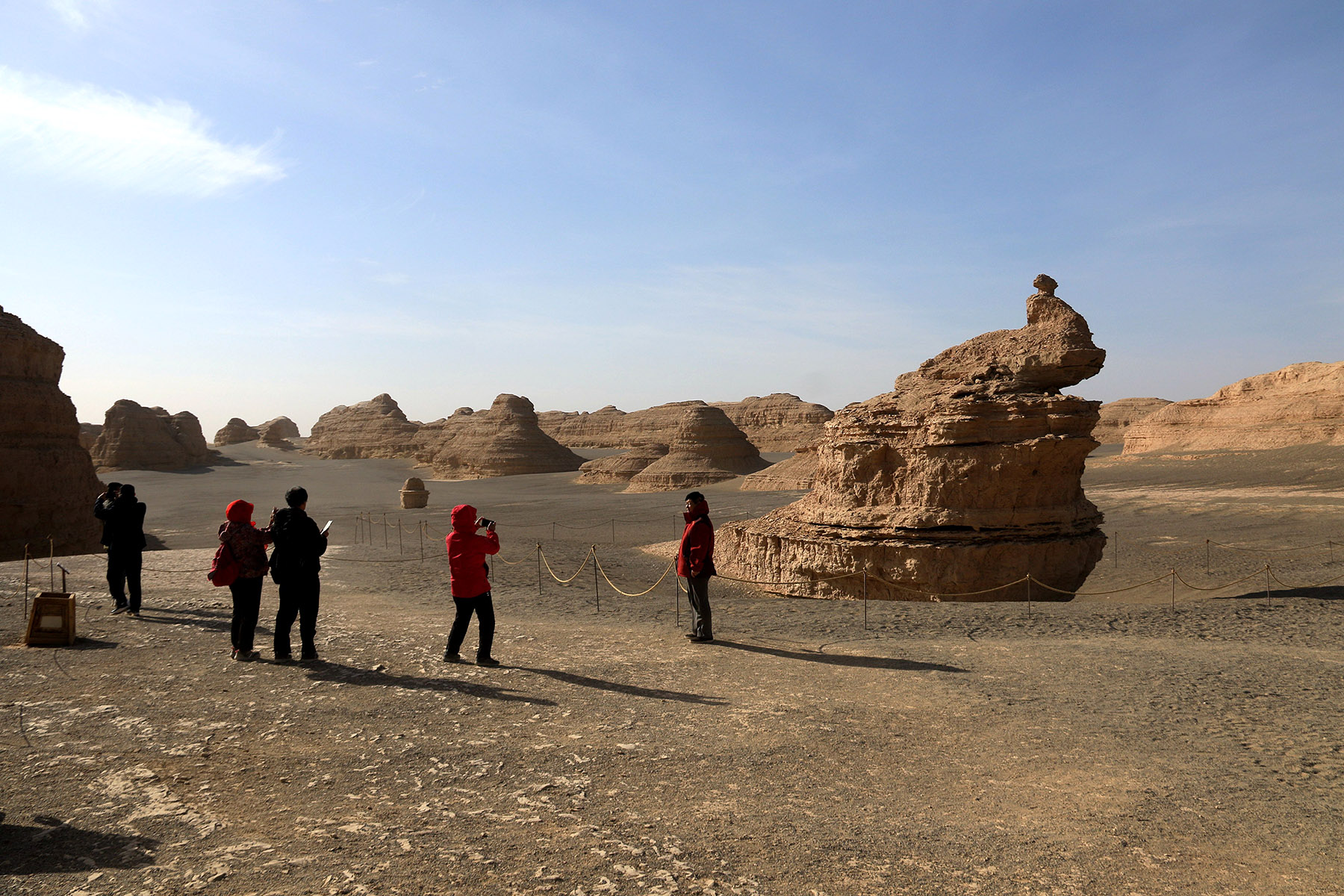
Just 50 minutes on from the Yumen Pass lies one of China's great geological phenomena — Dunhuang Yardang National Geopark — a place so otherworldly it could have been transported from the Martian landscape.
Spanning about 400 sq km, the park features thousands of rock formations — gouged out over millennia by wind, rain and ice — and made all the more imposing because they stand on a flat, featureless plain of near-black sand and gravel. Through the phenomenon of pareidolia, by which the human eye attributes likenesses in random objects, the rocks assume new identities. A lion, a sphinx, a peacock, and an armada of ships are among the shapes to have been sculpted by Mother Nature. Viewing these formations is almost eerie. Combined with the unfamiliarity of the landscape, the desert's deafening silence adds a spectral atmosphere to an already primeval landscape.
ALSO READ: An oasis of time and memory
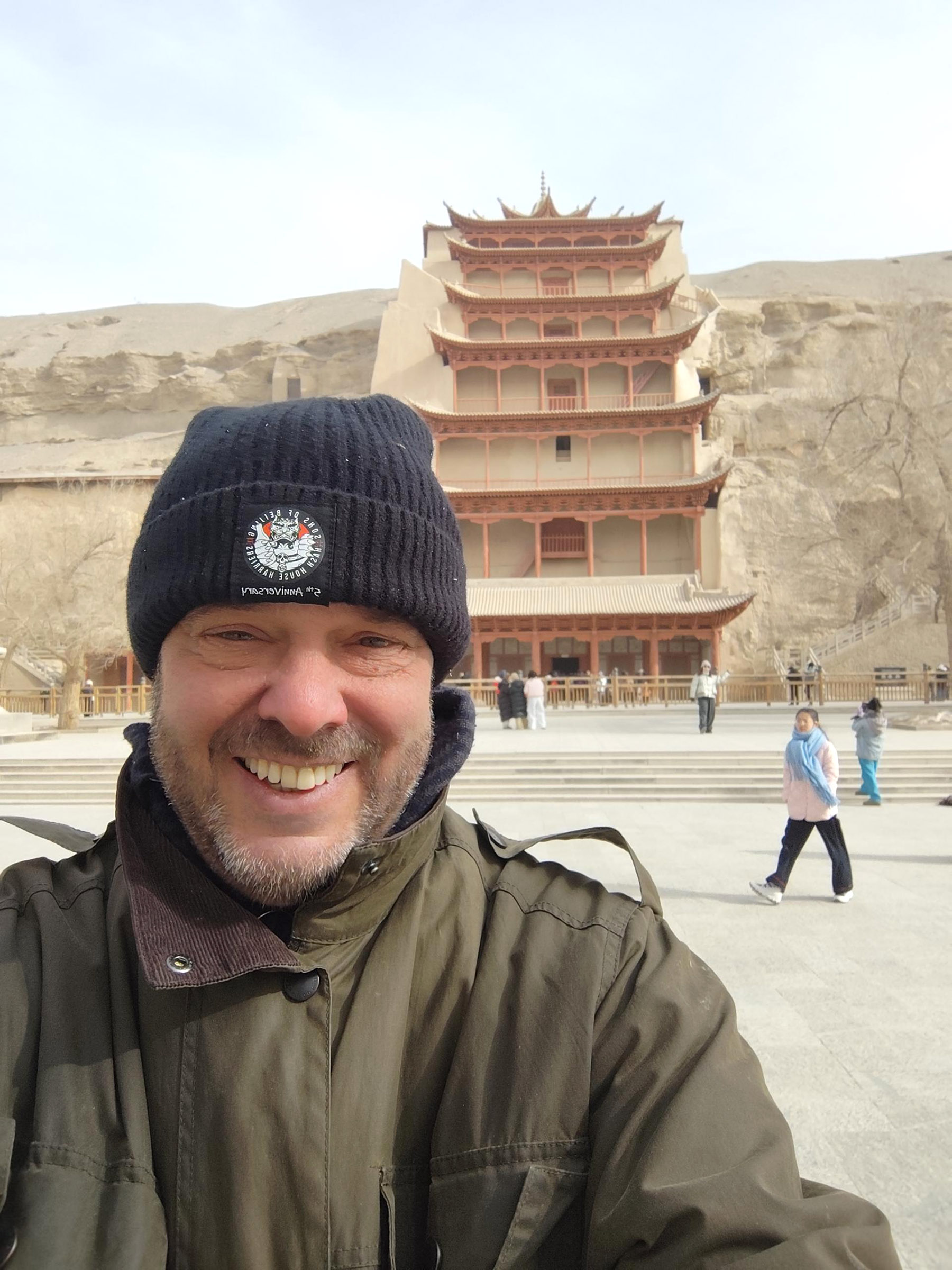
Dunhuang's greatest attraction, aside from the town itself, is the globally important Mogao Caves. Just a short drive from the city center to the tourist center and a quick shuttle bus ride to the site, the honeycomb of grottoes is a testament to human tenacity. Hewn from a sandstone cliff between the 4th and 14th centuries, the Buddhist caves feature detailed murals that coat the rock and are as great a tribute to religion as any temple or cathedral. Inscribed as a UNESCO World Heritage site in 1987, the caves are carefully preserved, with guided tours taking visitors to selected grottoes — a highlight of any visit to this wild, historic and beautiful corner of China.
Contact the writer at richard@chinadaily.com.cn
