

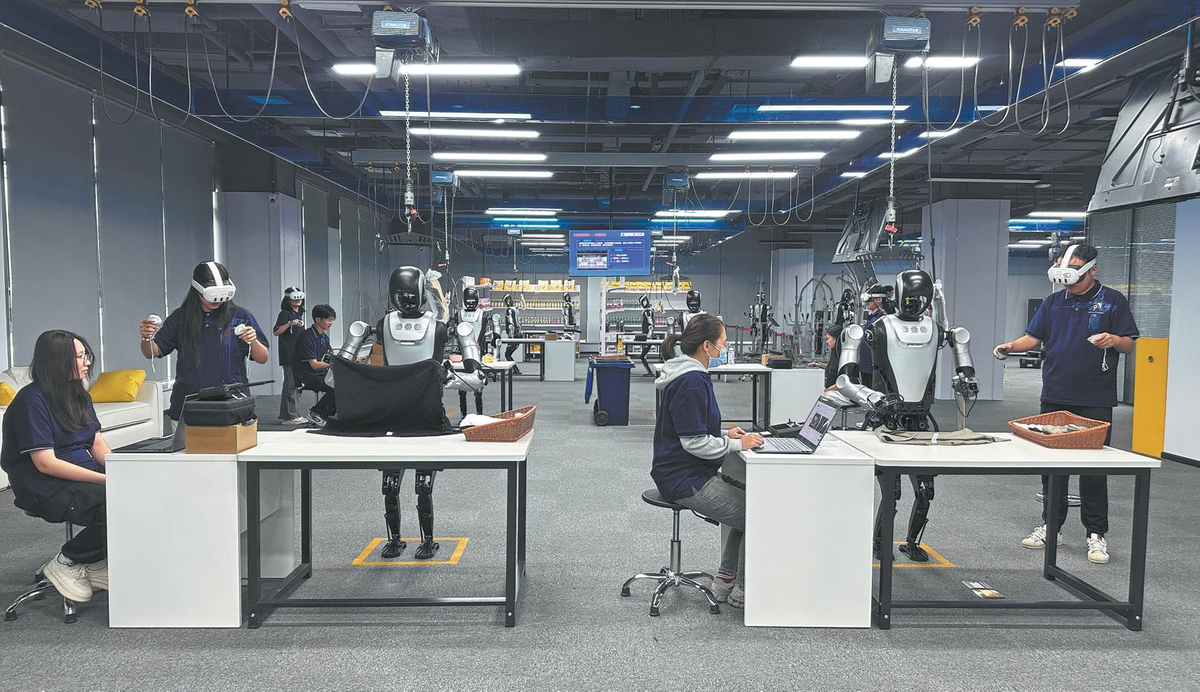
In an office building in Beijing's Shijingshan district, a special "school" is in full swing, with nearly 200 human teachers and 100 humanoid robot students.
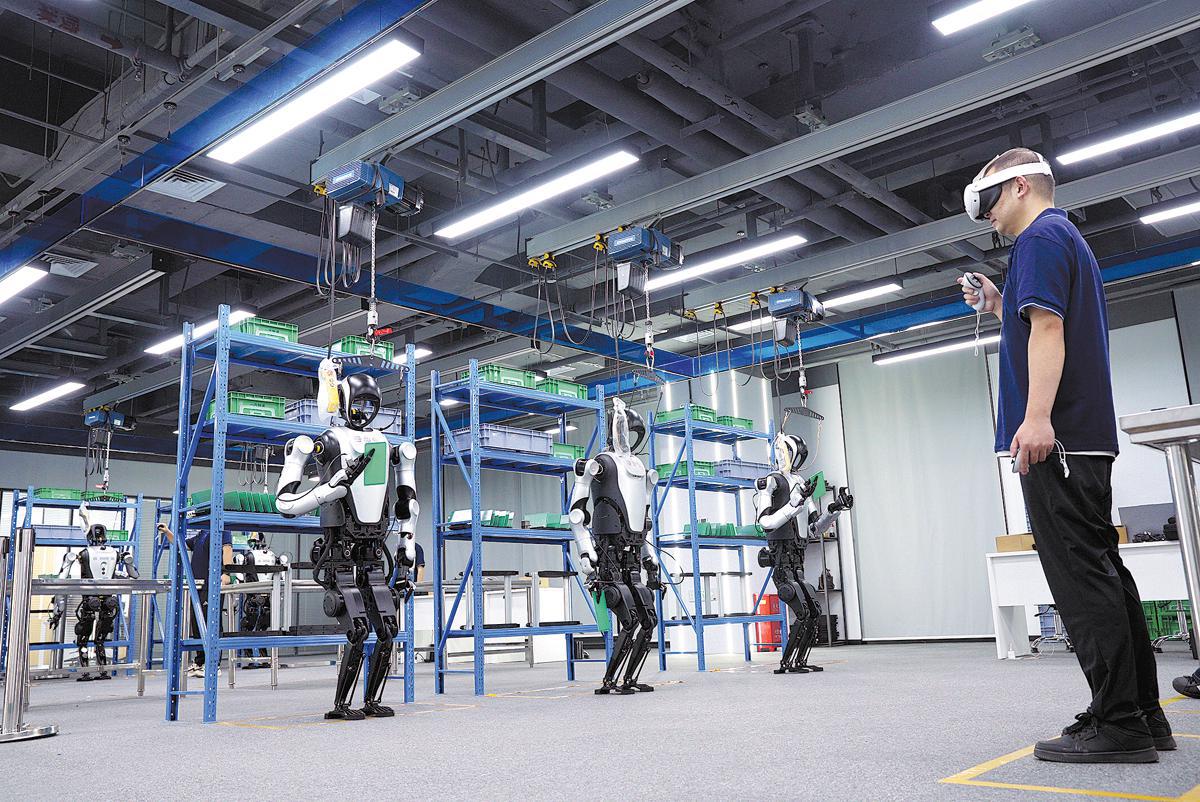
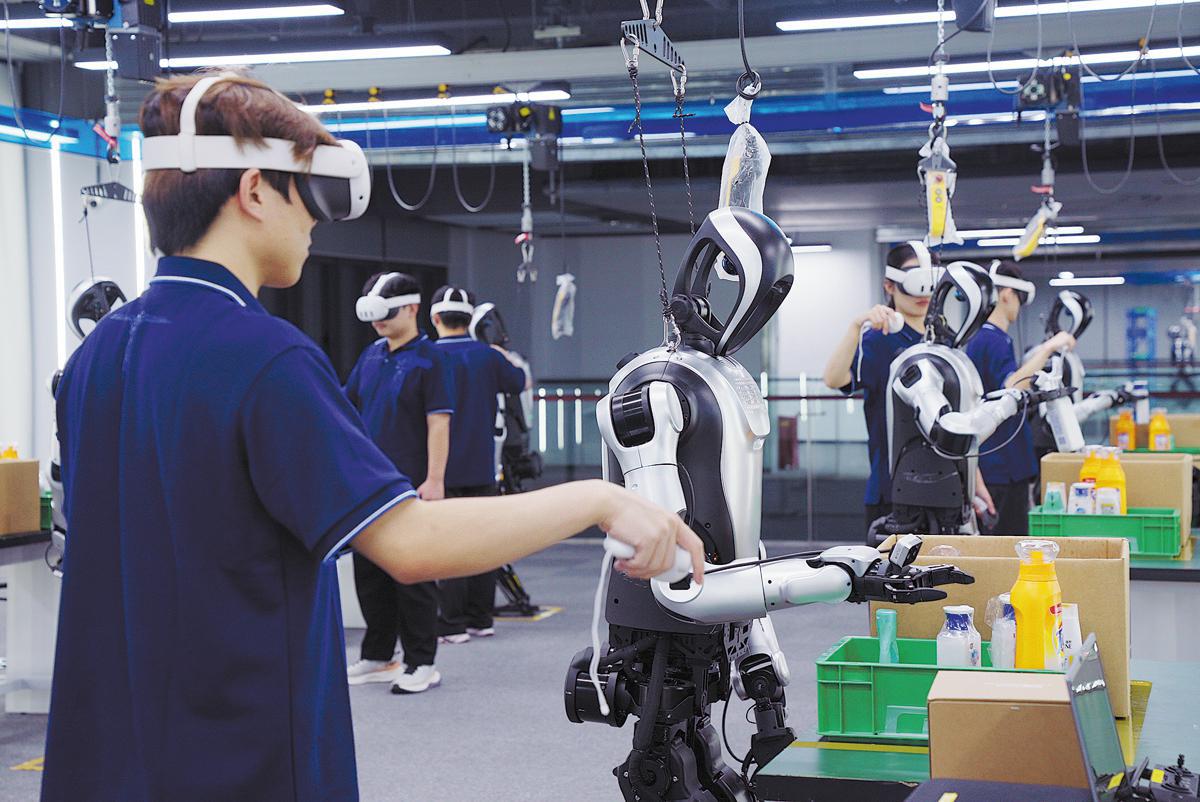
The instructors wear headsets, hold control levers and move slowly, while nearby 1.66-meter-tall humanoid robots mirror their motions. The curriculum is relentlessly mundane. The students repeat everyday tasks such as taking a medicine bottle from a cabinet, carrying goods in a factory, sorting parcels on a conveyor belt, and leafing through office files.
The campus is China's largest humanoid robot data-training center, co-built by the Shijingshan district government and Lejoin Intelligence (Shenzhen) Co, or Leju Robotics. The training areas reproduce factory and household scenes at full scale, with every detail faithfully replicating real working conditions.
Wang Qiang, technical director of Leju Robotics' embodied training center, said the facility has built 16 detailed real-world scenarios spanning industrial manufacturing, smart homes, eldercare services and 5G integration.
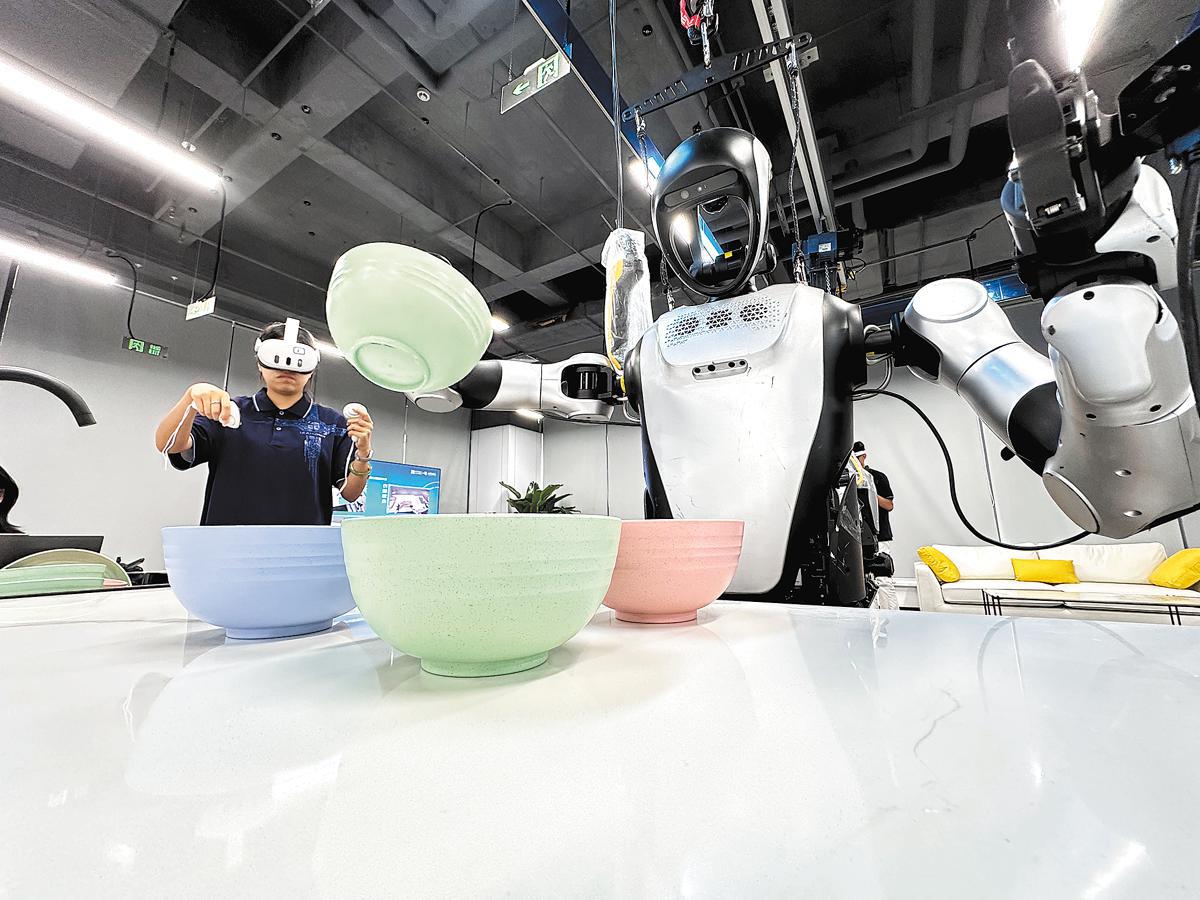
Sometimes instructors adjust the lighting, place obstacles in front of a cup or swap its contents so robots learn to handle a variety of situations. Depending on the difficulty of a task, a single data record can take from seconds to minutes.
Occasionally, a robot's hand slips and a cup falls. Wang said such failure data is vital as robots must learn not only what is correct, but also what is wrong.
Zhang Yusong, one of the trainers, said the job does not require a high level of education. A background in mechanics or computers helps, as does physical stamina, since the work involves repeating the same movements many times. After one or two days of training for the job, a teacher can work independently. The training period for a mature employee is about one month.
Zhang said training robots can be like teaching a toddler: trial and error, demonstration and correction. No amount of explaining can substitute for the repetitive process of the robots learning how to reach, grasp and balance in a world that does not pause for mistakes.
Experts generally agree that before humanoid robots can be widely deployed in real-world settings, they must first attend "vocational schools" as a necessary step before they enter society with a functioning "brain".
Engineers often describe humanoid robots as having three layers: a "brain", responsible for perception and decision-making; a "cerebellum", which manages motion control and coordination; and a "body", the physical frame equipped with motors, joints and sensors.
Consider a seemingly simple task such as fetching a glass of water. The brain must break the command into a cascade of judgments. What qualifies as a cup? Where should it be grasped? Where is the water source? How much is enough?
The cerebellum then translates those decisions into precise signals for dozens of joints, which decide how far, how fast, and how to maintain balance. Walking, grasping, pouring — each action depends on continuous, real-time calibration.
Fantastic future
If this is the quiet, repetitive work of training humanoid robots, the public recently witnessed a surprising spectacle.
During this year's televised Spring Festival Gala, they snapped off backflips in crisp succession and sparred with human performers without missing a beat.
The speed of androids' evolution has outpaced the public's imagination of how quickly the technology is supposed to advance, which begs a practical question — "When will I be able to buy one as a housekeeper?"
Watching the gala, Zhang Wenshan, a 42-year-old accountant from Shandong province, was stunned by the performance of the robots. She opened the Taobao app on her phone and searched for the keyword "robot nanny".
She imagined a versatile robot housekeeper capable of looking after her elderly mother, who has high blood pressure, picking up her 14-year-old child from hobby classes, and walking her dogs twice a day.
"When you become a middle-aged working woman, you carry much more burden. Your child is preparing for high school entrance exams. Your parents are getting old and need care. Hiring a nanny to handle all of these is expensive, even more than my salary … If I had a robot nanny, it could save me from being a housewife," she said.
She said she would be willing to spend her entire annual salary — about 100,000 yuan ($14,300) — if it could ease her household pressures.
However, scientists said the gap between flawless stage performances and a functional household helper remains wide. Before these machines can enter daily life, they said, the technology needs time to mature.
"Repeated rehearsals can produce a one-time perfect performance," said Yan Weixin, chief scientist at the Shanghai Artificial Intelligence Research Institute. "But replicating the same feats in factories and homes, where countless unexpected situations arise, is a different matter."
The robots on the gala stage, experts said, displayed striking advances in their "cerebellum". Their movements were fluid, coordinated and even expressive.
But the routines were meticulously preprogrammed. Without a capable "brain" to interpret new situations, they are, in effect, marionettes, they said.
Embodied intelligence
The primary bottleneck to full android functionality is not the body but the brain. That is why data centers are essential to humanoid robot development, experts explained.
For years, researchers have dreamed of enabling robots to think for themselves. The rapid development of artificial intelligence has given scientists hope that this gap can be closed.
Their goal is what they call "embodied intelligence". In simple terms, AI will no longer be confined to chatbots but will inhabit a physical form, perceiving, acting and making decisions in the real world.
"Embodied intelligence is an emerging industry where AI and robotics are deeply integrated. AI models act as the brain, responsible for thinking, while robots are responsible for moving and doing," said Leng Xiaokun, founder and chairman of Leju Robotics.
Embodied intelligence is now in a period of technological exploration. Multiple pathways are being tested, but one consensus is emerging — high-quality data will determine whether robots can leave the lab and enter society, Leng said.
Large language models are trained on vast oceans of text and images scraped from the internet. Robots, by contrast, cannot learn to move from words alone. They need real-world experience or high-fidelity simulations that approximate it at scale, said Chen Xiaobo, a senior engineer at a Beijing-based AI startup.
Wang from the data center said the instructor team already numbers more than 200 and will continue to expand. The center can produce more than 8 million multimodal data records annually.
The company said it has participated in the construction of nine humanoid robot training facilities nationwide, including the center in Shijingshan, making it the country's largest provider of embodied real-machine data. It also produces nearly 25 million real-machine data records annually.
The data, Wang said, not only supports the company's in-house robot development — using real-world feedback to continuously optimize robot brains — but can also be tailored to customer needs for targeted training. It is also supplied to AI model companies and data trading firms.
Real-world focus
Once mature, the models are deployed to robots so they can acquire new skills. This will be the core focus of humanoid robot development over the next two to three years, he said.
The whole point of building robots in human form, researchers argue, is to enable them to fit into a world designed for people.
"The advantage of humanoid robots lies mainly in their ability to adapt to environments without the need for environmental retrofitting," said Chang Ning, who leads the embodied intelligence simulation engine team at Feijie Kesi Intelligent Technology (Shanghai). "They can directly use spaces and tools made for people — things like door handles."
The first group of robots trained at the Shijingshan data center has "graduated" and started factory work. The company won the country's first publicly tendered humanoid robot project in the auto industry initiated by FAW Hongqi.
"In real-world settings, robots' work efficiency is about 70 percent of that of a skilled worker," Wang said.
For now, robots cannot handle complex tasks such as tightening precision screws, a task performed by senior technicians. Instead, they take on heavy, standardized and highly repetitive work — moving boxes of varying sizes, colors and weights, or sorting parts of different shapes.
Wang said those capabilities already meet certain industrial needs. First, robots can operate around the clock, while humans typically work eight-hour shifts. Second, assembly-line jobs are physically demanding and monotonous, making them hard to fill.
Within the next two years, humanoid robots are expected to begin large-scale industrial deployment. Their core industrial value lies in taking on dull, heavy and potentially dangerous roles, he said.
Zhang Yaqin, director of the Institute for AI Industry Research at Tsinghua University, is optimistic. He predicted that within the next decade, the number of robots could exceed the number of humans and that some human jobs would be replaced. In the future, he said, people might need to work only two days a week.
But a home is not a controlled environment. It is a fluid, unpredictable space filled with elderly parents, crawling toddlers and roaming pets.
Floors shift from carpet to hardwood to tile, each surface presenting different levels of friction and unevenness. With humanoid robots weighing more than 100 kilograms, a misstep does not just mean a failed task — it could mean someone gets hurt. "Whether they fall on a person or a pet, they will cause injury," Chang said.
That gap between promise and risk is why Chang remains cautious. "Although robots are developing fast, their current capabilities are still at a very rudimentary stage," he said.
In one or two years, he said, more specialized robots will appear in factories, hospitals and certain public spaces — hotel robots, for instance, paired with large language models, able to communicate naturally with people and assist with check-ins. But a robot housekeeper? That, he said, is difficult to predict, but added "maybe in 10 to 20 years".
Business needs
Still, Chang sees reasons for optimism. Chinese companies have an edge in local deployment and tend to focus on business needs. And because China has developed the full industrial chain across robot brains, cerebella and bodies, the pieces are already in place to accelerate progress.
In October 2023, the Ministry of Industry and Information Technology issued the "Guiding Opinions on the Innovative Development of Humanoid Robots", for the first time positioning them as "a groundbreaking product after computers, smartphones and new energy vehicles". The document set concrete targets such as mass production by 2025, and comprehensive strength at an advanced international level by 2027.
The market appears to be following the ambitious targets.

Omdia, a global tech market research firm, estimated roughly 13,000 humanoid robots would be shipped worldwide in 2025, with China accounting for about 90 percent of the total. Morgan Stanley forecast that China's humanoid robot shipments would double in 2026 to 28,000 units.
According to Morgan Stanley's report "The Humanoid 100: Mapping the Humanoid Robot Value Chain", the global humanoid industry is split into three segments — brain, body and integrators. Among the world's top 100 companies, China ranks first accounting for 37 percent, the United States second at 35 percent, followed by Japan at 10 percent.
Across the country, data-collection training grounds now hum with robot "students" learning new skills. In real-world settings — from medical care to elderly rehabilitation, from energy exploration to emergency rescue — they are trained nonstop, each trial a small step toward bridging the final gap before the robot era.
What the world is waiting for, in the not-so-distant future, is the development of humanoids with a brain that has evolved to be powerful enough to match their bodies.
Contact the writer at houchenchen@chinadaily.com.cn
