

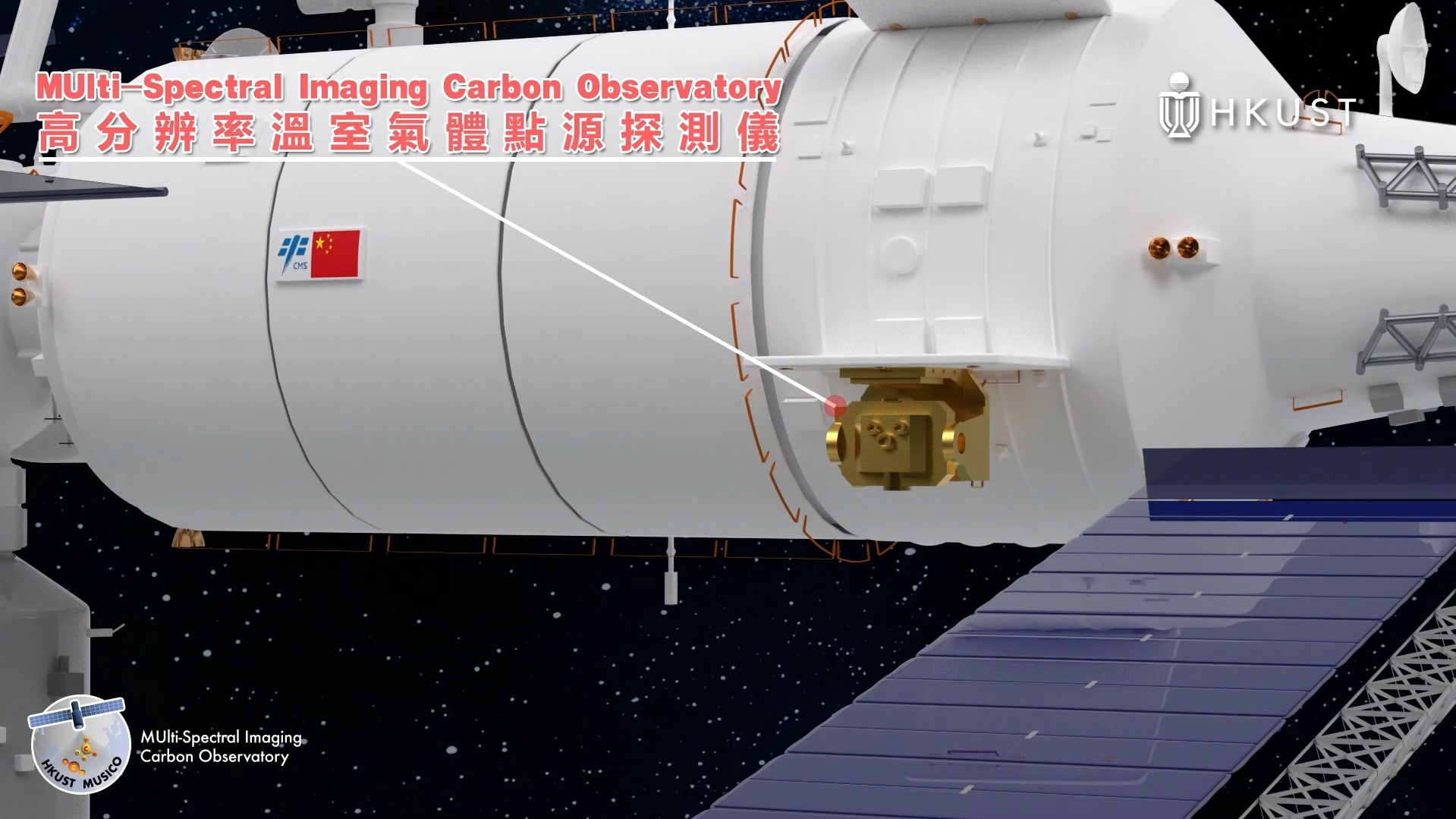
A device developed by a leading Hong Kong university to precisely track industrial greenhouse gas emissions arrived at the core module of the Tiangong Space Station on Monday, becoming the first scientific payload developed from the city to be aboard the Chinese orbiting laboratory.
The Multi-Spectral Imaging Carbon Observatory (MUSICO) is among the 67 sets of devices delivered by the Tianzhou 10 cargo spacecraft, launched successfully on Monday morning from Wenchang Space Launch Center in Hainan province.
Developed by the Hong Kong University of Science and Technology (HKUST), MUSICO can simultaneously detect concentrations of carbon dioxide and methane from space — a capability that no existing orbital system can match at comparable resolution, according to its developers.
Regina Ip Lau Suk-yee, convenor of Hong Kong’s Executive Council and a leading advocate for the space economy in the city, hailed the project as an “impressive achievement”.
“This project is a perfect illustration of how cross-boundary technological collaboration can make significant contributions toward achieving carbon neutrality goals,” Ip told China Daily.
While most space-based monitoring systems operate at kilometer-scale resolution, MUSICO can identify carbon dioxide emission sources within a 100-meter grid, which is precise enough to distinguish individual power plants, coal mines, landfills, and oil installations.
The instrument weighs around 80 kilograms and fits within a cube roughly the size of a domestic washing machine. It carries four optical lenses that can scan for CO2, methane, oxygen and airborne particulates, covering visible and shortwave infrared bands. The system generates what the researchers describe as unique “optical fingerprints” for each gas — a scientific reference the team hopes will prove critical to China’s environmental ambitions in the years ahead.
HK an active contributor
The project is co-led by Su Hui, director of HKUST’s Institute for Space Science and Technology, and Zhang Limin, chair professor and head of the Department of Civil and Environmental Engineering at HKUST. Announcing the project in January, the university said that its scientists were willing and ready to contribute to the nation’s essential space initiatives.
“This is the first time China’s Space Station has conducted experiments in the field of Earth science,” said Fang Man, senior engineer at the Chinese Academy of Sciences’ Center for Space Utilization. “Its significance is immense.”
Su, a fellow of the Asia Oceania Geosciences Society who serves as the scientific lead on the project, developed the remote-sensing methodology that enables MUSICO’s high-precision detection.
The project aligns with China’s carbon neutrality commitments — to peak carbon emissions before 2030 and achieve net-zero by 2060. Progress toward these targets depends, in large part, on the reliability of emissions data, a vulnerability that independent researchers and foreign governments have long highlighted. Accurate point-source monitoring from orbit could, in principle, provide a verification mechanism less susceptible to reporting inconsistencies on the ground.
HKUST said it plans to build a greenhouse-gas point-source database based on data from MUSICO, and will share findings with research institutions across the Guangdong-Hong Kong-Macao Greater Bay Area and Belt and Road Initiative participating economies.
The university nicknamed MUSICO “Tianyun”, meaning “Heavenly Music”, as a nod to both its acronym and China’s cultural heritage.
“It is ‘music’ to my ears as another example of a top Hong Kong university science payload, co-led by the excellent professors Su and Zhang, contributing to the burgeoning space science ecosystem in the country,” said Quentin Parker, director of the Laboratory for Space Research at the University of Hong Kong. The Australia-born astrophysicist said Hong Kong was demonstrating both its scientific prowess and its commitment to helping the nation combat climate change.
HKUST has an established history of involvement in national space missions, notably having hosted a high-level delegation from China Manned Space Agency in November 2023 for on-campus exchanges.
Su applied for inclusion when the agency launched a global open call for space station science experiments in June 2023. The project was selected in April 2024 and formally approved seven months later.
Zhang framed the launch in strategic terms, saying the project demonstrated that, with national support, “researchers from Hong Kong and Macao can take on ever-more significant roles in space science”.
Once astronauts aboard Tiangong install MUSICO on the station’s exterior with the station’s robotic arm, the device will begin transmitting real-time greenhouse-gas concentration readings across low-to-mid latitude regions, a swath of the planet that encompasses most of Asia’s major industrial centers.
Contact the writer at jessicachen@chinadailyhk.com
