

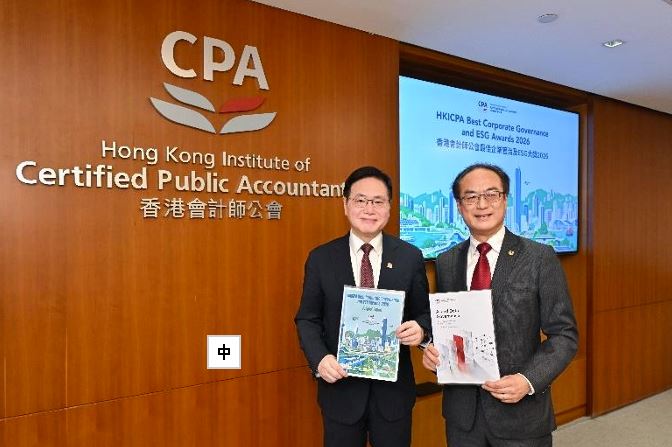
Thirty-five listed companies and public sector organizations have been recognized by the Hong Kong Institute of Certified Public Accountants (HKICPA) for raising their standards and exceling in corporate governance and environmental, social, and governance (ESG) practices.
The awardees comprise 12 elite past winners, 20 other listed companies — including one newly-listed company — and three public sector organizations. Notably, eight of them received the HKICPA’s awards for the first time.
The HKICPA pointed out that this year’s review showed listed companies have continued to strengthen corporate governance reporting gradually. However, it cautioned that more work has to be done to address changes made to the Corporate Governance Code under the Listing Rules and to strengthen board independence and diversity.
The judging panel for the ESG awards also observed a number of good practices among the awardees, including management’s commitment to establishing clear ESG stewardship responsibilities and integrating ESG considerations into major operational processes, the accounting profession’s statutory body stated.
In the elite past winners section, the platinum and gold awards for the most sustainable organizations went to Prudential Plc and Hong Kong Exchanges and Clearing Limited respectively, while CLP Holdings Ltd and Standard Chartered Plc earned commendations.
The corporate governance awards for elite past winners of large-cap companies was presented to Lenovo Group Ltd, while the ESG awards for the same category went to MTR Corp, Swire Properties and The Hong Kong and China Gas Company.
In the main category, HSBC Holdings Plc was honored with the gold award for the most sustainable organization in the financial sector, and AIA Group Ltd secured a corporate governance award in the same industry.
China CITIC Bank Corporation Ltd was awarded the ESG award for large-cap companies in the financial sector, while Sino Land Company Ltd won the same prize in the properties and construction industry sector. For the telecom and information and technology industry, the ESG awards went to Tencent Holdings Ltd and first-time winner Sunny Optical Technology (Group) Co Ltd.
The three award-winning public sector organizations included Mandatory Provident Fund Schemes Authority, which won the corporate governance award, as well as the Airport Authority Hong Kong and the Drainage Services Department, which clinched the ESG awards.
In the newly-listed companies section, Midea Group won the ESG award for the medium-and-small-cap category.
Stephen Law, president of the HKICPA and chair of the judging panel of the best corporate governance and ESG awards 2026, emphasized that the institute’s accolades were among the first in Hong Kong to spotlight corporate governance and ESG.
The awards not only recognized institutions excelling in corporate governance and ESG, but also reflected market trends, driving companies to continuously improve their standards in these areas, Law added.
Meanwhile, amid the growing adoption of artificial intelligence, the HKICPA published a research study titled “AI and Data Governance: Market Observations and Practical Guidance”. The report examines how companies currently apply and govern AI, offering practical guidance to improve AI data management and enhance AI governance in the market.
Reviewing the annual reports of 124 constituent companies of the Hang Seng Composite Large Cap Index, the study analyzed their AI disclosures and governance arrangements. It found that corporate disclosures tend to focus heavily on their use of AI rather than the related governance framework and processes, which makes it difficult for investors to understand critical issues such as data governance and accountability.
Law stressed that businesses must treat AI governance as an integral part of good corporate governance and manage the associated risks through sound data governance, effective controls and clear human oversight.
“Through its practical guidance and tools, the HKICPA aims to support businesses in establishing robust AI and data governance frameworks, and foster a more sustainable AI ecosystem in Hong Kong,” he concluded.
