

Editor’s note: What draws the world’s leading scientific minds to Hong Kong? In this series, China Daily speaks with locally based researchers ranked among the global top 2 percent of scientists, exploring the frontiers of their current research and uncovering why they chose to make Hong Kong their home.
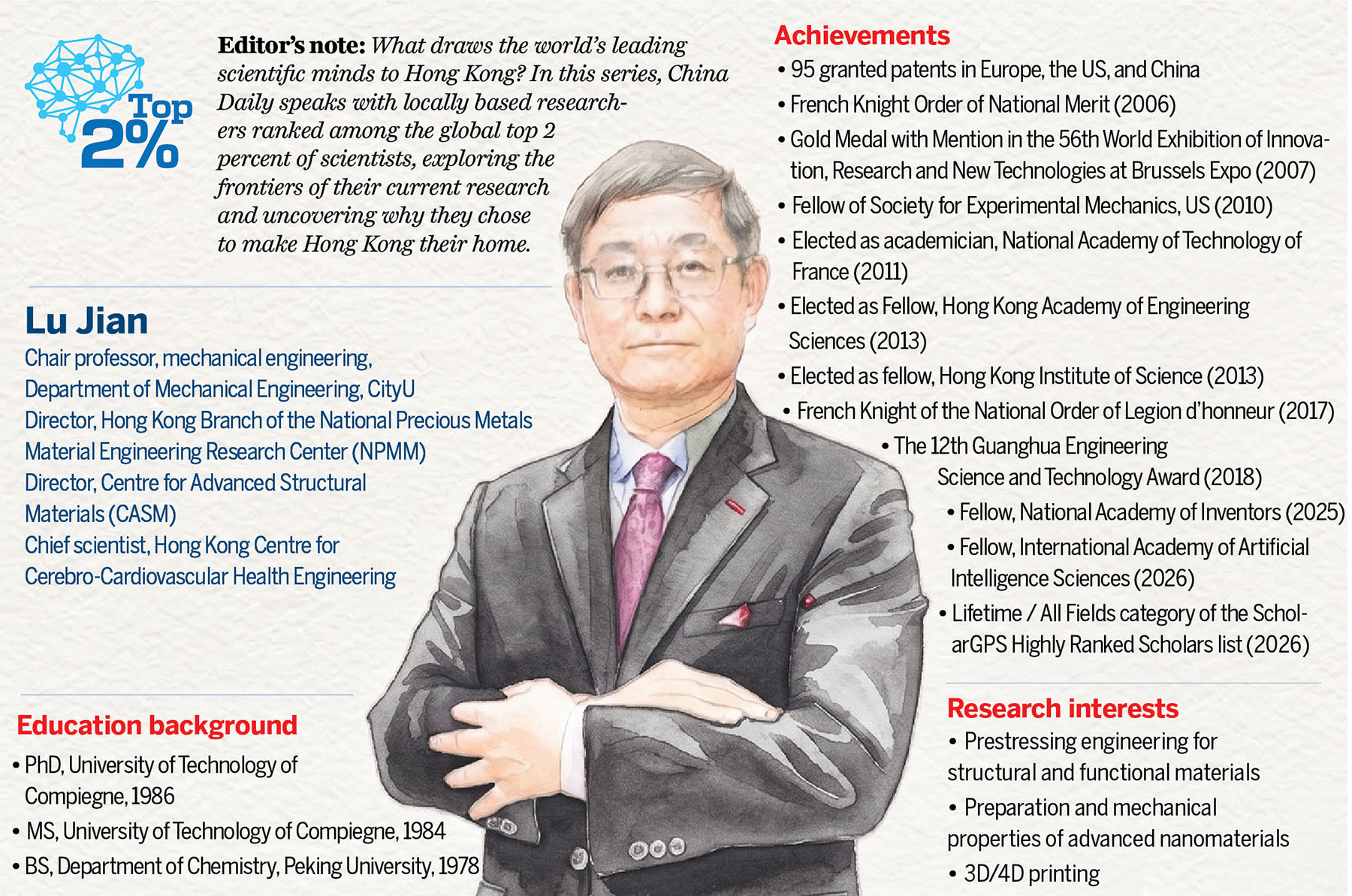
From real-time life-saving bioprobes that can preempt heart attacks to cost-effective catalysts driving China’s hydrogen energy transition, eminent scientist Lu Jian’s research work is right at the intersection of cutting-edge materials science and national priorities.
Since moving to Hong Kong from France more than two decades ago, Lu, now chair professor at City University of Hong Kong, has drawn on his deep involvement in shaping the nation’s science and technology road maps to translate stellar academic breakthroughs into industrial impact in the Guangdong-Hong Kong-Macao Greater Bay Area.
To him, Hong Kong offers exceptional growth opportunities, with its core strengths in knowledge-driven innovation, international connectivity and deep capital reserves perfectly complementing the region’s dynamic industrial base and thriving startup ecosystem.
READ MORE: Leading materials scientist bullish on HK’s future with first five-year plan
The much-heralded development of the mega Northern Metropolis — Hong Kong’s most ambitious urban transformation and economic development project — will effectively address the city’s long-standing land shortages, injecting fresh momentum into downstream industrialization, says Lu.
Materials frontier
Helming the Hong Kong branch of the National Precious Metals Material Engineering Research Center (NPMM), the professor is convinced that advanced materials remain a vital, enduring priority for national development.
Applications in advanced materials yield exceptionally high added value, he says. “In recent years, additive manufacturing, or 3D and 4D printing, has become the fastest-growing sector in the manufacturing business.” His team makes full use of additive manufacturing to significantly expand the range and feasibility of high-performance materials that can be produced.
Traditional manufacturing processes — mainly casting, forging and welding — offer very limited control over microstructural features. In contrast, additive manufacturing enables researchers to precisely manipulate material composition and performance at microscopic scales, with exact temporal and spatial gradient control.
Lu’s team is also involved in developing functional materials. One key domain is new energy centered on hydrogen energy. During the nation’s two sessions this year and in the 15th Five-Year Plan (2026-30), hydrogen energy is hailed as a future energy source and placed prominently within forward-looking future industries and the construction of new energy systems.
Lu notes that at China’s major urban centers, especially in the 11-city Greater Bay Area, new energy vehicles take up about 75 percent of newly sold passenger cars. However, a major paradox accompanies the rapid transition — the massive battery packs required to power these vehicles are making them increasingly heavy.
“Shifting toward hydrogen energy could drastically reduce vehicle weight, and hydrogen fuel cells are also a key focus of national development,” says Lu. China’s 2026 Government Work Report, presented during the two sessions, explicitly proposed creating a national low-carbon transition fund to foster new growth drivers, such as hydrogen energy and green fuels — the third time hydrogen energy has been included in the document.
“A major share of commercial hydrogen catalysts is being supplied by overseas manufacturers or their domestic subsidiaries, leaving the sector highly vulnerable to supply chokepoints,” says Lu. To address the reliance, his team is developing a domestic catalyst to offer substantially higher efficiency at much lower cost.
Hydrogen energy is an exceptionally clean energy source with an energy density far superior to today’s batteries, he says. “If costs can be reduced, it holds great promise.”
In terms of collaboration with national research entities, he says the NPMM, as one of six Hong Kong units of the Chinese National Engineering Research Center, has to demonstrate its latest progress to the Ministry of Science and Technology and the Hong Kong Special Administrative Region government’s Innovation and Technology Commission every five years.
During the evaluation process, relevant authorities take into account the center’s participation in various key national research and development programs, as well as research initiatives aligned with strategic national needs.
The official partner of the NPMM’s Hong Kong branch is the Sino-Platinum Metals Co (SPM) — a publicly listed company in Kunming, Yunnan province. “It’s an enterprise restructured from a national research institute. As a result, it undertakes many national tasks relating to precious metals,” says Lu.
As for the division of labor in the collaboration process, his team focuses primarily on applied basic research, whereas SPM conducts applied research, creating a complementary partnership between the two sides.
Health innovation
Beyond energy and manufacturing, human health is another top priority for the team. At the Hong Kong Centre for Cerebro-cardiovascular Health Engineering — an innovation center under the SAR government-initiated project, InnoHK — researchers led by Lu are developing a novel bioprobe designed to detect heart attack biomarkers faster and with unprecedented precision.
“This breakthrough is critical because cerebro-cardiovascular diseases are the leading cause of death worldwide, with a mortality rate nearly twice that of cancer. These patients mostly die before they are given emergency care,” says Lu.
If early signs of an impending heart attack can be detected, or if a diagnosis can be made right inside an ambulance and appropriate medical intervention taken, more lives can be saved, he says.
Co-leading the Centre for Advanced and Smart Manufacturing at SEAM@InnoHK, the interdisciplinary expert is driving intelligent, precision, and sustainable technologies aligned with Industry 5.0. By putting technology at the service of human well-being, resilience, and environmental sustainability, their work tackles core industry hurdles and paves the way for 3D-printed advanced materials to play a vital role in the nation’s development.
Lu aims to promote industrialization in high-performance material design and simulation methods, as well as environmentally friendly new material manufacturing processes that are of national concern, and attract global advanced manufacturing researchers to the SAR, showcasing China’s manufacturing innovation to the world.
Regional synergy
Under the Greater Bay Area’s growth framework, cross-boundary connectivity and cooperation across all fronts have become significantly smoother. Guangdong province itself has a stable population of around 128 million, making it a powerful economic engine and one of the world’s most dynamic regions.
Hong Kong’s distinct strengths lie in knowledge innovation, global connectivity, and capital resources, says Lu. The Greater Bay Area also has a vibrant ecosystem of highly dynamic enterprises, especially startups that are thriving remarkably well, providing a fertile environment for growth, creating a truly complementary synergy.
With the SAR government expanding the planned Northern Metropolis University Town 10-fold to 1,000 hectares, tertiary educational institutions in Hong Kong and worldwide will gain substantial spatial bandwidth for future expansion, Lu says.
“The Northern Metropolis’ accelerated development will inject fresh vitality into scientific research, especially the industrialization of technology.”
ALSO READ: Northern Metropolis draws global academic interest
On higher education institutions, Lu says their core responsibility is to champion active, student-centric learning, empowering students with the adaptive skills required to thrive in a rapidly changing world.
He hopes young researchers can cultivate a robust theoretical base, highlighting that a deep understanding of fundamentals will allow scholars to easily move across disciplinary boundaries and embrace new research frontiers.
“Although artificial intelligence enables people to acquire knowledge much faster, becoming dependent on AI is very risky as it produces many errors,” he warns.
Two decades on, Lu’s passion for Hong Kong’s unique advantages remains undiminished. As the city fast tracks its Greater Bay Area integration and develops the Northern Metropolis, the veteran materials scientist envisions a clear and compelling trajectory — a future where world-class basic research seamlessly bridges national priorities with a global impact.
Contact the writers at atlasshao@chinadailyhk.com
