

Revival of eco-friendly lodgings blends traditional architecture with modern designs. Tan Yingzi and Qin Feng report in Yan'an, Shaanxi province.
Editor's Note: Using a blend of words and visuals, this series explores unique communities and reveals the heart of China through food, architecture, craftsmanship, landscapes and traditions.
In the summer of 1936, American journalist Edgar Snow rode into the dusty canyon of Northwest China and discovered the yaodong, a traditional cave dwelling that he would immortalize as a triumph of human resilience. Writing in his seminal book Red Star Over China, Snow marveled at a Red Army university, describing it as "probably the world's only seat of 'higher learning' whose classrooms were bombproof caves".
Inside these hollowed-out loess hills, he saw future leaders decoding the destiny of a nation by the dim light of kerosene lamps, sleeping on stone beds, and writing on clay walls. Ninety years after the epic victory of the Long March (1934-36), a strategic transfer of the Central Red Army to break through the Kuomintang's encirclement, these legendary cave dwellings in Yan'an, Shaanxi province, have transcended their wartime role.
Once the Spartan cradle of the Chinese revolution, this timeless vernacular architecture is being rediscovered today as a master class in green, sustainable design.
"Yaodong is probably the most environmentally friendly and healthiest human living form on Earth," said Wang Wenquan, cave-dwelling research expert at Yan'an University who has devoted years to the research and preservation of the cave dwelling culture in northern Shaanxi.
Wang, 60, was born and raised in his family's earthen yaodong, a cave dwelling carved into the loess which has stood steady over 260 years. "As long as people continue to live in them, the yaodong will endure," he said. "Some yaodong have stood for a thousand years, while many ordinary houses may not last even a century."
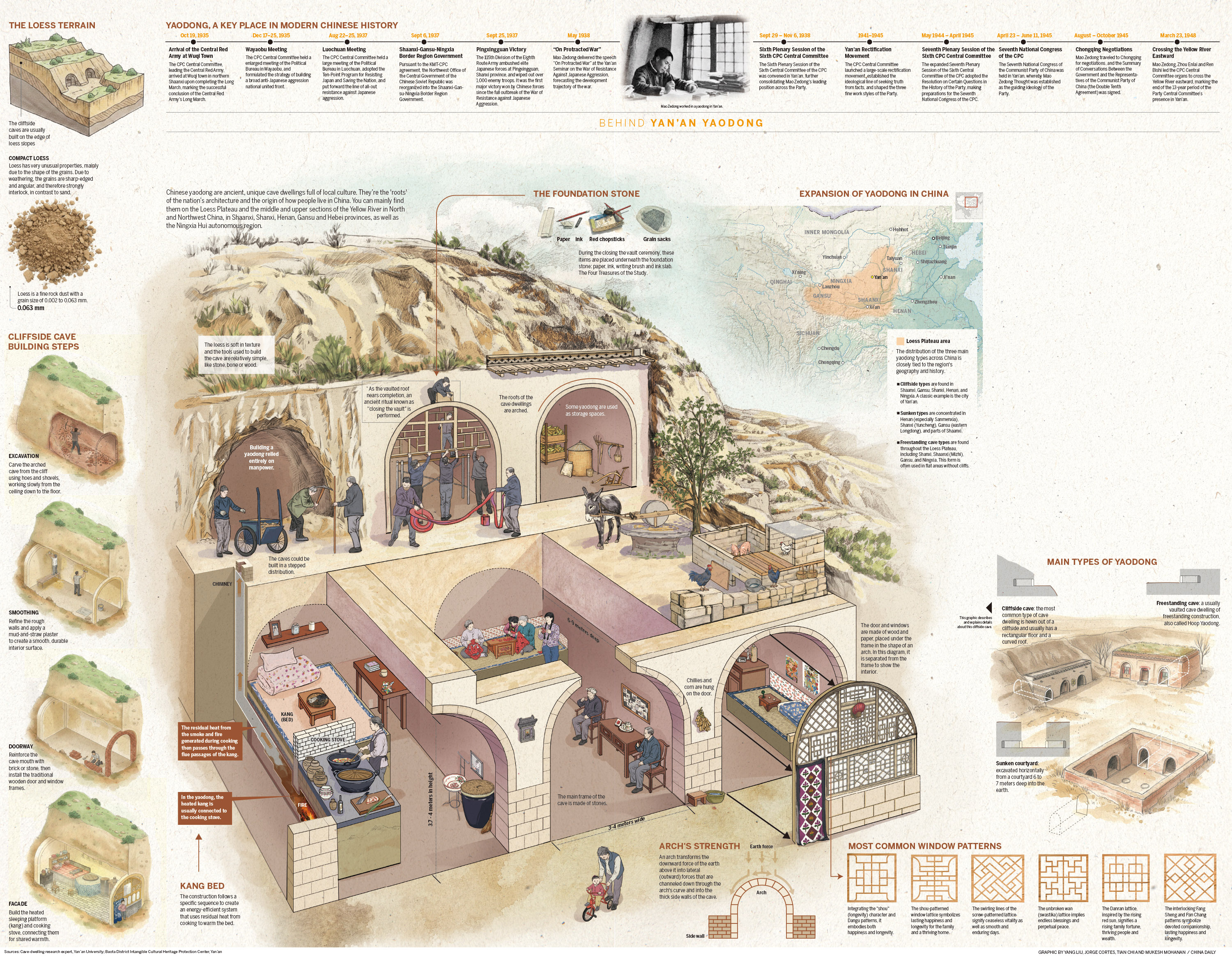
The yaodong boasts a history of over 4,000 years in the Loess Plateau region of North and Northwest China, such as Shaanxi, Shanxi, Henan and Gansu provinces. For centuries, local residents have carved these arched homes directly into the thick, yellow hillsides, creating a highly sustainable living space with zero carbon footprint.
"Building a yaodong is cheap and time-efficient without using a lot of construction materials. Back in the 1970s and 80s, about 90 percent of people in northern Shaanxi lived in yaodong," Wang said.
The brilliance of the structure lies in its thermal design. Utilizing the exceptional insulation of the loess soil, these dwellings function as natural air conditioners — remaining pleasantly cool during hot summers and retaining warmth during freezing winters. Structurally, the signature semicircular arches not only distribute weight evenly to prevent collapse but also maximize the entry of natural sunlight through intricate wooden lattice windows, which are traditionally covered in breathable rice paper.
Nowadays, local residents still believe in the ancestors' wisdom and regard building yaodong as one of the most important tasks after getting rich, said Gao Hui, a young yaodong designer in Yan'an. "It is not cheap to build a yaodong now. Modern yaodong are very sophisticated, combining traditional architecture techniques and contemporary designs," he said.
"They have higher-quality and moisture-resistant materials, air-conditioning, modern furniture, smart electric appliances and spacious rooms with plenty of daylight."
Contact the writers at tanyingzi@chinadaily.com.cn
