

From Vientiane to Tianjin, one cross-border journey becomes a story of language, cultural discovery and connections that transcend borders.
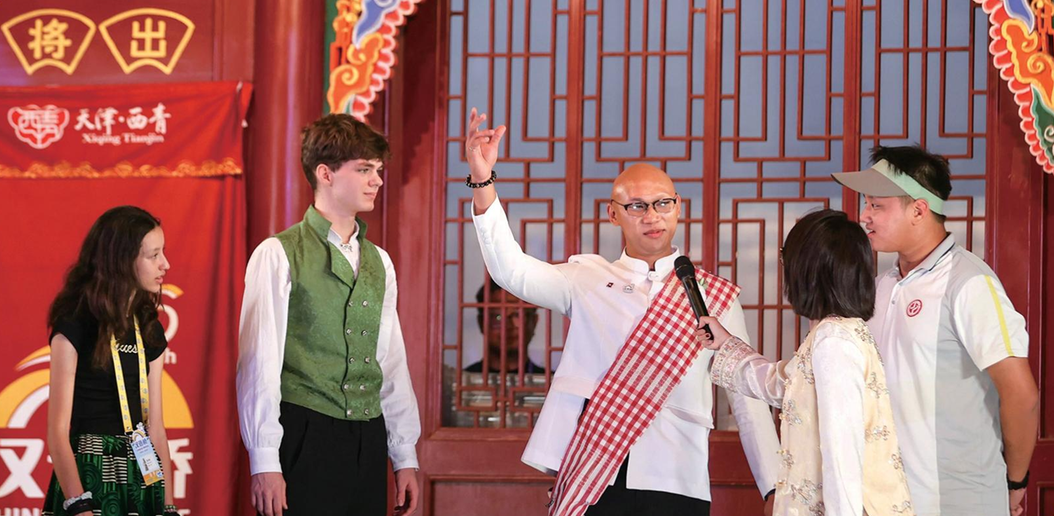
Rather than fly to Tianjin for this year's "Chinese Bridge" competition, Inthavong Hongphakdy chose a journey that would take him across countries and thousands of kilometers of railway.
The student from Vientiane Liaodu Chinese School in Laos traveled from Vientiane, the capital of Laos, to Kunming, Southwest China's Yunnan province, along the China-Laos Railway before connecting to China's high-speed rail network north to Tianjin.
A returning visitor to China, he became the first contestant in the competition's history to make the journey from Vientiane to Tianjin entirely by rail.
Hongphakdy's destination was the final round of the 19th Chinese Bridge — Chinese Proficiency Competition for Foreign Secondary School Students — which concluded in Tianjin on Monday.
READ MORE: Cross-border tourism on the right track
Some 120 contestants from 101 countries gathered in the city throughout September for cultural exchange activities and the final-stage competition, with continental champions from five regions competing for the overall title.
This year also marks the 25th anniversary of the Chinese Bridge program, which has reached more than 160 countries and regions and drawn over 1.8 million young participants worldwide.
For contestants such as Hongphakdy, the event offers more than a test of linguistic ability. It gives young Chinese-language learners from different parts of the world an opportunity to experience Chinese culture firsthand and meet others brought together by a shared interest in the language.
During their time in Tianjin, contestants explored Yangliuqing Ancient Town, tried their hand at painting lacquer fans, practiced tai chi and joined tongue-twister challenges aboard the special "Tianjin Tour Time" themed train carriage.
For many, deeper engagement with the Chinese language reveals layers of cultural meaning.
"Over my years learning Chinese, I have come to realize how fascinating Chinese characters are," said Melina Christopoulos, a Canadian contestant. "Each character resembles a painting or a short story."
She took the word hezuo (cooperation) as an example, describing how the character he contains elements of ren (person) and kou (mouth), which to her evokes an image of people gathering to talk and exchange ideas.
"Learning Chinese characters means more than mastering writing — it offers insights into how Chinese people perceive the world," Christopoulos said.
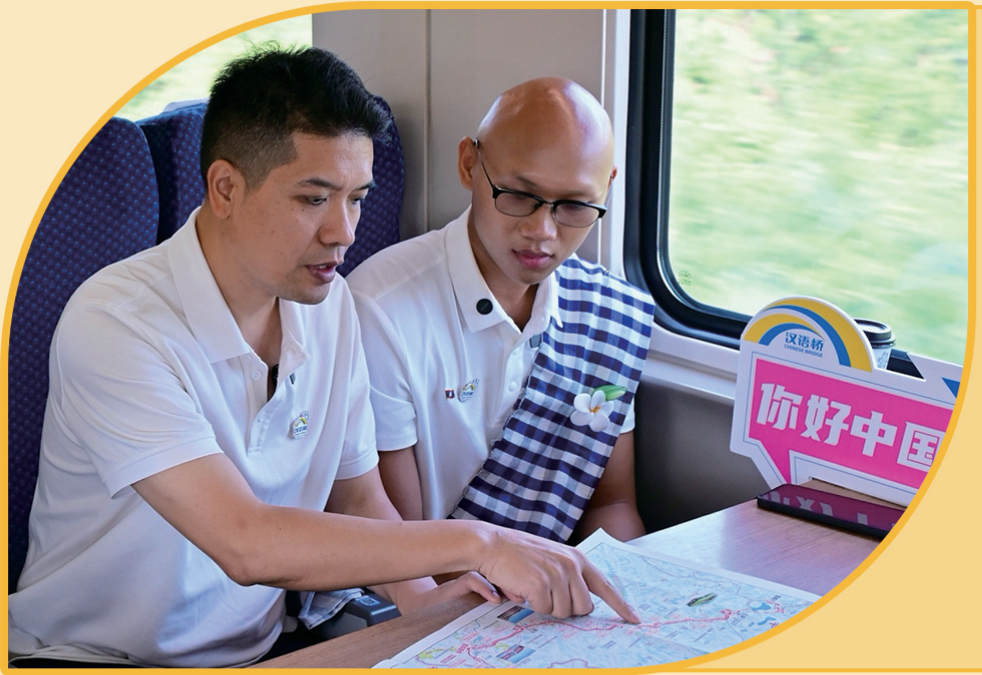
Connections in motion
Over the past quarter-century, the Chinese Bridge has developed from a language contest into a platform for cultural and people-to-people exchange, bringing together generations of overseas teenagers interested in Chinese language and culture.
"It's such a precious opportunity. I have made many Chinese friends here," said Quentin Vuletich, a contestant from New Zealand.
"I shared stories about life in New Zealand with them, and we talked about classical Chinese poetry and our dreams. The experience will stay with me for the rest of my life."
For Hongphakdy, however, the journey to the competition carried particular significance.
His trip came during the year marking the 65th anniversary of China-Laos diplomatic relations, the China-Laos Friendship Year and the fifth year of operation of the China-Laos Railway.
Stretching from Kunming to Vientiane, the cross-border railway was jointly built by the two countries. It has become an important transport link between them, carrying passengers and goods while connecting Laos with China's wider railway network.
The connection is visible even in some of the railway's smallest details. The Friendship Tunnel, which crosses the China-Laos border, stretches 9,595.41 meters in total, with 7,170.41 meters on the Chinese side and 2,425 meters on the Lao side.
"There are 56 light strips on the Chinese side and 49 on the Lao side, symbolizing the heartfelt bond between China's 56 ethnic groups and Laos' 49 ethnic groups," said Ke Yao, a survey and design engineer of the China-Laos Railway from China Railway Eryuan Engineering Group. "We named this design 'A Long Scroll of Friendship'."
Cultural elements from both countries also appear aboard the trains.
The Fuxing trains departing from Kunming and the Lane Xang trains leaving Vientiane incorporate traditional cultural elements of China and Laos. Painted in a classic shade of green, the Fuxing is nicknamed the "Green Giant", while cabin crew uniforms draw inspiration from flowers found in both countries.
"Since the railway opened, exchanges between China and Laos have grown significantly. Many people travel between the two countries for tourism and business," said Li Yuanyuan, one of the first train captains of the cross-border passenger service on the China-Laos Railway.
For Hongphakdy, that growing connectivity can be seen in something as ordinary as what appears on supermarket shelves.
"I love Luosifen, the stinky rice noodles from Guangxi," he said. "Previously, online deliveries would take more than 10 days to arrive. Now that the China-Laos Railway is in operation, I can buy it easily in supermarkets nearby."
More than 4,300 Lao employees took part in construction work along the full length of the railway. Since its completion, the railway has continued to provide jobs and opportunities in Laos while strengthening transport links with China.
The railway and the Chinese Bridge operate in very different ways, but Hongphakdy's journey brings their purposes together: One reduces the physical distance between cities and countries, and the other gives young people who speak different native languages a means of communicating with one another.
In Tianjin, contestants from around the world shared stories of their homelands in Chinese, exchanged ideas and learned about each other through a language they had chosen to study.
For Hongphakdy, the railway that carried him there offered another form of connection between his home country and China.
"This has been my most special and unforgettable journey," he said, adding that he hoped to continue using his own voice to tell stories of China-Laos geographical proximity and people-to-people amity.
Wang Wei, Meng Jiarui and Zhang Wenjing contributed to this story.
Contact the writers at yandongjie@chinadaily.com.cn
