

We grew up hearing moving stories of the Long March (1934-36), of Red Army soldiers' courage and their unwavering revolutionary ideals amid unimaginable hardship.
"Climbing over snowcapped mountains and trekking across the grasslands."
This description is often associated with the Long March, recalled by Red Army veterans. Behind these seemingly simple words lay harsh realities. The soldiers crossed more than 20 mountains rising above 4,000 meters above sea level. The so-called grasslands were vast marshlands stretching across 15,000 square kilometers at an altitude of about 3,500 meters.
With little oxygen and scant supplies — some soldiers had to eat grass roots — and their exhausted bodies pursued by Kuomintang troops, the journey was brutal. Before the Red Army reached its revolutionary base in Northwest China, more than 10,000 soldiers had perished on the snowy mountains and grasslands.
READ MORE: A red thread runs through it
For modern Chinese people, the Long March has become almost a heroic epic.
Most of the snowcapped mountains and grasslands the Red Army crossed are in present-day Sichuan province, as are many of the sites of key battles along the route.
This summer, I traveled through Sichuan along several routes where Red Army soldiers left their footprints about 90 years ago. From January 1935 to August 1936, the three main forces of the Red Army — the First, Second and Fourth Front Armies — passed through 72 counties in present-day Sichuan, more than in any other province.
Standing in the wilderness where the soldiers once demonstrated such determination, and breathing the same thin mountain air, I suddenly felt that the familiar stories we have heard for years were more than a grand historical epic. They were also stories about individuals with hopes, fears and great expectations.
In the footsteps of heroes
Our journey began in Chengdu, Sichuan's provincial capital. A three-hour drive took us to the mountainous area of Baoxing county, Ya'an, through one tunnel after another. It may take minutes to cross a mountain now, but for Red Army soldiers then, it was a difficult threshold.
Baoxing was where the panda was first discovered in 1869. Panda statues decorate the county seat, while Red Army-related sites are another attraction for tourists.
Our first destination was a temple dating to the Ming Dynasty (1368-1644), a place made significant by Chen Yun (1905-95), then one of the leaders of the Communist Party of China.
After the Zunyi Conference in Guizhou province in January 1935, which helped steer the revolution away from a wrong direction, the CPC Central Committee needed information on the conference sent confidentially to the Communist International in Moscow.
Leaving this temple in June 1935, Chen disguised himself as a merchant and was escorted by a local primary school principal. He evaded Kuomintang surveillance, left Sichuan via Ya'an and Chengdu, boarded a ship in Chongqing, and arrived in Shanghai before reaching the Soviet Union.
That was the first time that the course of the Long March had been systematically reported to the Communist International, helping expand the march's influence beyond China.
Chen was only 30 then.
Standing in the temple and listening to the guide recount the story in the scorching heat, we sensed the tension of that moment. An ordinary site had witnessed a pivotal event in revolutionary history.
That night, we continued our rugged journey through the mountains to Yaoji, a township inhabited by Tibetans. Close to the snowy mountains, it was also a place where Red Army soldiers once stayed.
Local villagers welcomed us as they had the Red Army during the Long March. We gathered around a bonfire and listened to old stories. A tenor in our group taught us a song about the Long March. Altitude sickness eased for a while.
Crossing sacred mountains
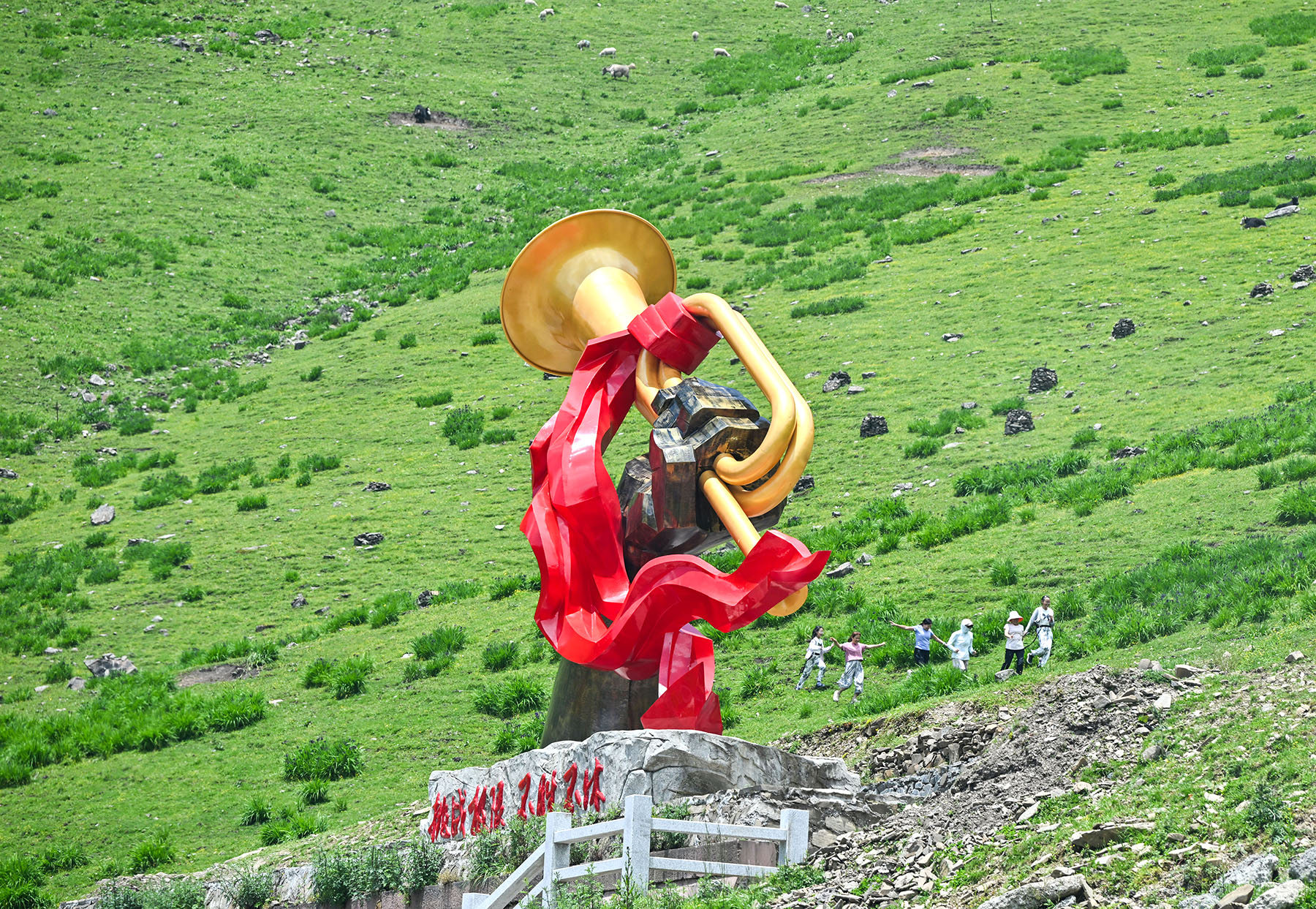
The next morning, we finally headed for Jiajin Mountain, the first major snowcapped mountain the Red Army soldiers crossed during the Long March in June 1935.
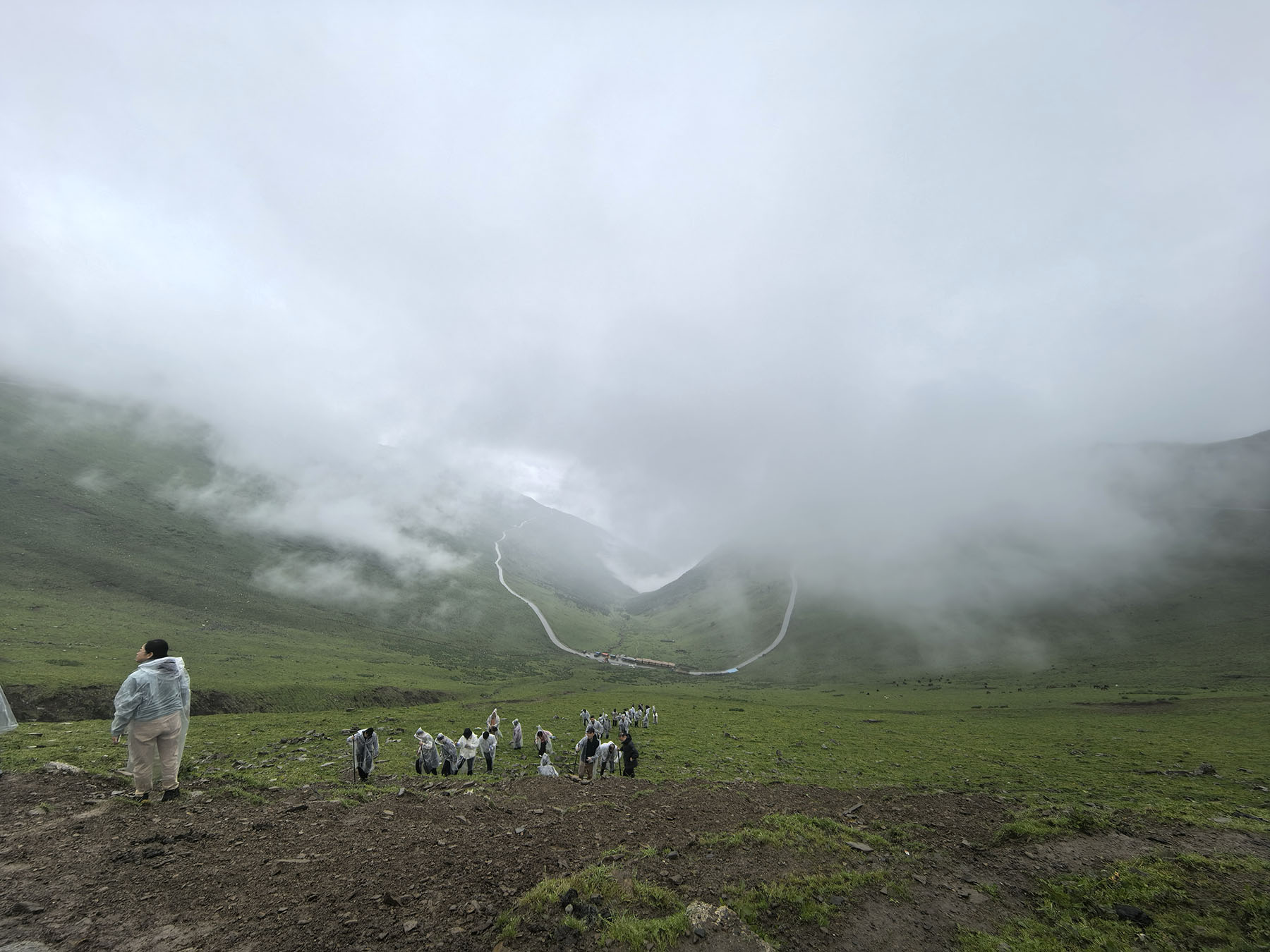
Altitude sickness returned, and it rained. As the bus climbed higher, the summer heat gave way to a chill, and I began to sense the hardship the soldiers faced. Grass covered the slopes, while cattle grazed peacefully. I imagined the soldiers had little time to appreciate the scenery.
The bus stopped at an altitude of about 3,600 meters. It was time to climb. I had assumed that decades of tourism development would have brought stairways or other facilities to make the route easier for visitors. There were none. Everything was almost as the soldiers had encountered it: a bare slope leading to a mountain pass about 300 meters higher.
We sang songs to encourage one another, but the climb became increasingly difficult as the slope grew steeper. A trek expected to take 40 minutes stretched to an hour and a half. One group member even spotted a badge in the grass, which he guessed might be a Red Army relic.
We completed our journey to the top of Jiajin Mountain by bus. The summit is 4,114 meters above sea level. Perhaps due to climate change, there was no snow at the summit in summer.
ALSO READ: Following old and new connections
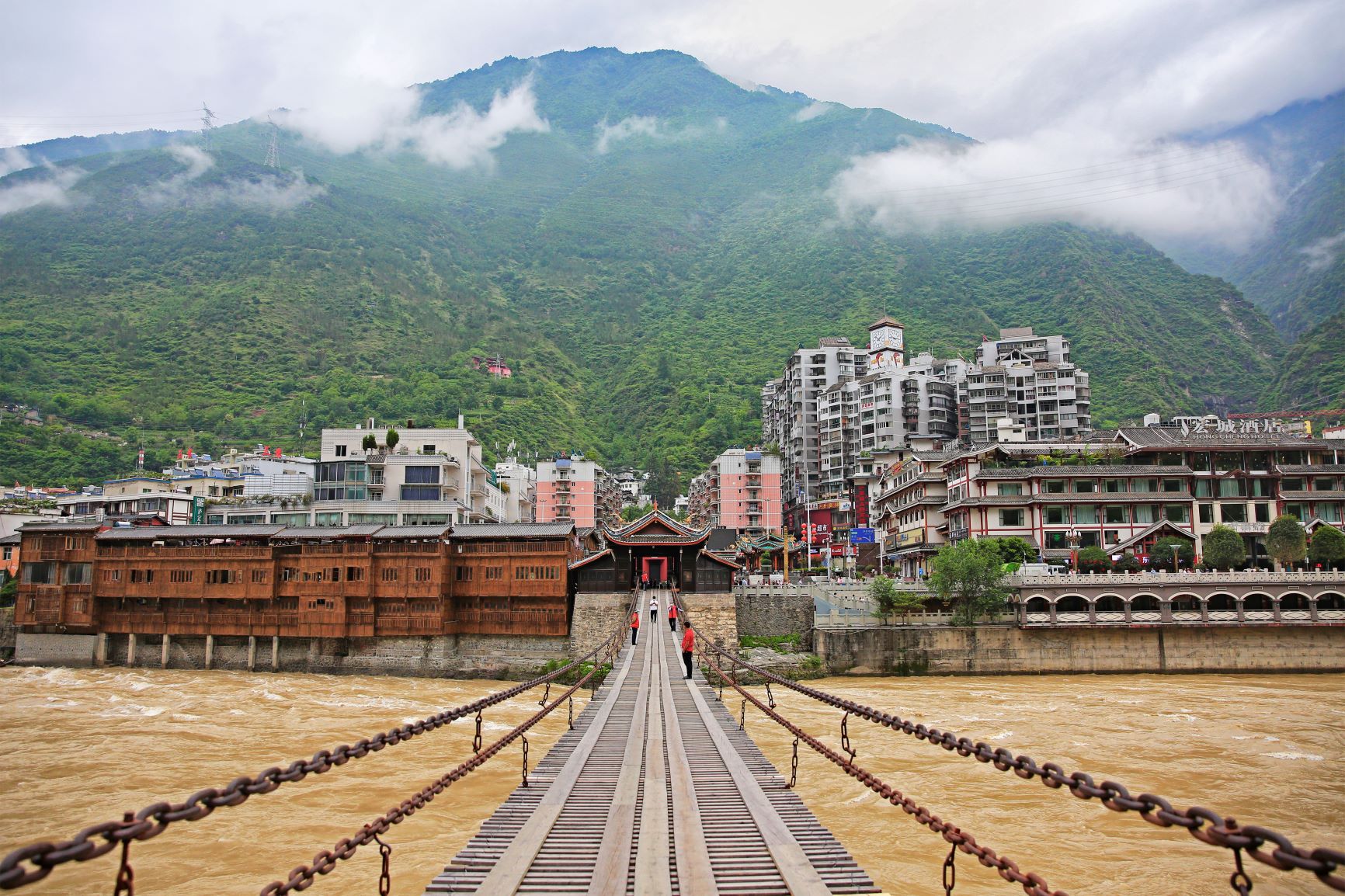
We then continued our own "march" to Luding county, Garze Tibetan autonomous prefecture. Luding Bridge across the Dadu River was strategically important during the Long March. On May 29, 1935, a 22-member commando unit broke through enemy fire to cross the bridge.
Walking across the 103-meter-long suspension bridge over the roaring Dadu River in the rain still requires courage today. Wooden planks now cover the bridge, while Red Army soldiers had only iron chains to hold as they advanced under fire.
The story of Luding Bridge is widely known in China. Although the commando members were later hailed as national heroes after New China was founded in 1949, some soldiers' identities remain unknown. They may have sacrificed their lives in later battles, or simply become unsung heroes.
On the way back, we crossed the Dadu River again, passing a highway bridge completed in 2018, one of the major bridges on the route from Sichuan to the Xizang autonomous region.
The magnificent infrastructure marks another milestone on the Long March in our new era.
Contact the writers at wangkaihao@chinadaily.com.cn
