

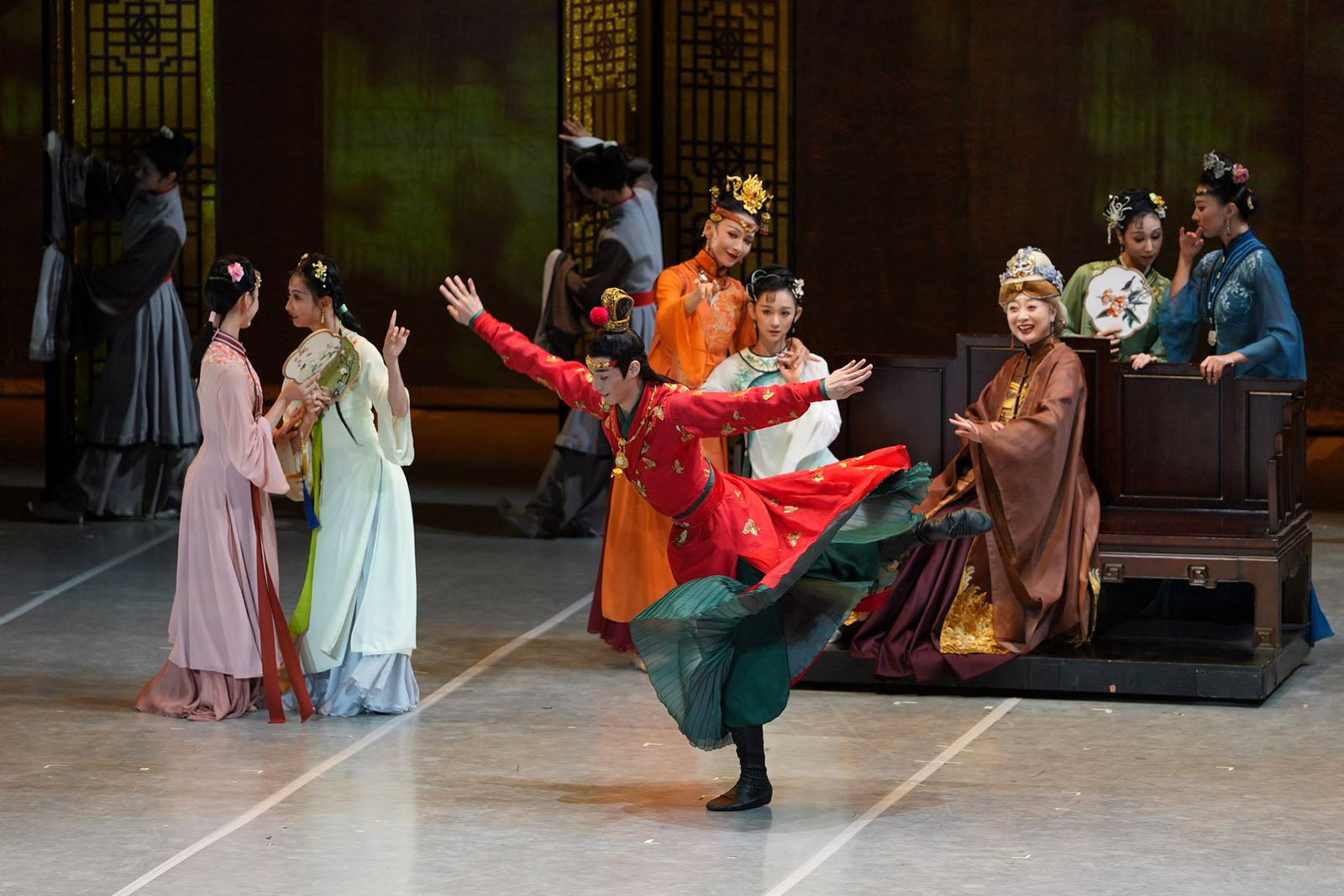
The folk dance drama adaptation of the Chinese literary classic A Dream of Red Mansions concluded its three-day run in New York on Sunday, offering theatergoers a luminous visual spectacle that distills one of China's most revered masterworks into pure, expressive movement.
Running for four performances, the show opened on Friday at the David H. Koch Theater at Lincoln Center, marking its US stage debut.
Over the centuries, the masterpiece written by Cao Xueqin (1715-63) during the Qing Dynasty (1644-1911), also known as The Story of the Stone, has served as an inexhaustible wellspring of artistic reinvention, inspiring countless adaptations across film, television, and traditional Chinese opera.
Produced by the Jiangsu Centre for the Performing Arts and codirected and choreographed by Li Xing and Li Chao, the production arrives on US shores backed by extraordinary momentum.
Since its 2021 premiere, the production has staged more than 480 performances across China and Singapore, and captured two of China's top cultural honors: the China Dance Lotus Award and the Wenhua Award for theater, according to a statement from the Jiangsu center.
As the cultural engagement wrapped up on Sunday, Liao Yi, general manager of the center and producer of the dance drama, said he hopes the production will build lasting cultural bridges.
He noted that for many New Yorkers, the performance offered an eyeopening entrance into one of China's most celebrated literary works.
"We are thrilled to present A Dream of Red Mansions at Lincoln Center and to reunite with so many old friends," Liao said. "We hope to perform in New York again, and we warmly invite American artists and productions to perform at our stage in Jiangsu so we can continue to strengthen international exchange through the power of art."
Drawing on traditional Chinese cultural symbols, the latest production renders Cao's epic into a purely visual language, converting its intricate romantic tragedy and meditations on life's impermanence into sweeping, dynamic choreography.
The performance reimagines iconic literary vignettes through an immersive visual and auditory experience.
The production's visual scale and emotional depth resonated with prominent figures in the US dance world.
Mira Nadon, a principal dancer with the New York City Ballet, said the production's inventive stagecraft and emotional weight made an immediate impact on her.
"It was beautiful. It was very moving," Nadon said. "The sets and costumes and the production were gorgeous. I loved the way they had the interactive set — it was really creative, and all the costumes were just so visually stunning."
Fred Teng, president of the America China Public Affairs Institute and a fellow of the Foreign Policy Association, noted that the production's real triumph lies in making an 18th-century Chinese narrative resonate as a modern, universal story.
"When the music of A Dream of Red Mansions sounded in New York, I saw not only an exquisitely crafted dance drama, but a cultural bridge linking China and the United States, tradition and modernity," Teng said.
ALSO READ: Tapestry of longing and love transcends borders
For the dancers on stage, bridging the cultural divide demanded trusting in the universal language of emotion, rather than expecting international audiences to decipher every 18th-century literary reference.
Li Wenxin, the dancer who plays the central protagonist Jia Baoyu, said he approached the New York debut without fixed expectations about how Western theatergoers would react to a contemporary reinterpretation of a Chinese classic.
"I didn't enter this with a prescribed notion of what the audience should experience," Li told China Daily. "We took a cornerstone of Chinese literature and deconstructed it through a modern aesthetic. What I do know is that love, youth, and fate are universal human experiences."
Li, a graduate of Chinese classical dance at the Beijing Dance Academy, added that playing the role of Jia Baoyu has fundamentally transformed his own artistic and personal worldview.
In a striking coincidence, the Metropolitan Museum of Art in New York has opened City of Memory: Nanjing in the Seventeenth Century, an exhibition exploring the very birthplace of Cao Xueqin, running through January next year.
While the exhibition focuses on the 17th century, the decades surrounding the violent fall of the Ming Dynasty in 1644, it is expected to offer New Yorkers crucial background and an invaluable historical bridge for Cao's 18th-century epic.
Contact the writers at huanxinzhao@chinadailyusa.com
