

Beijing, other SCO members join hands on AI to address real-world challenges
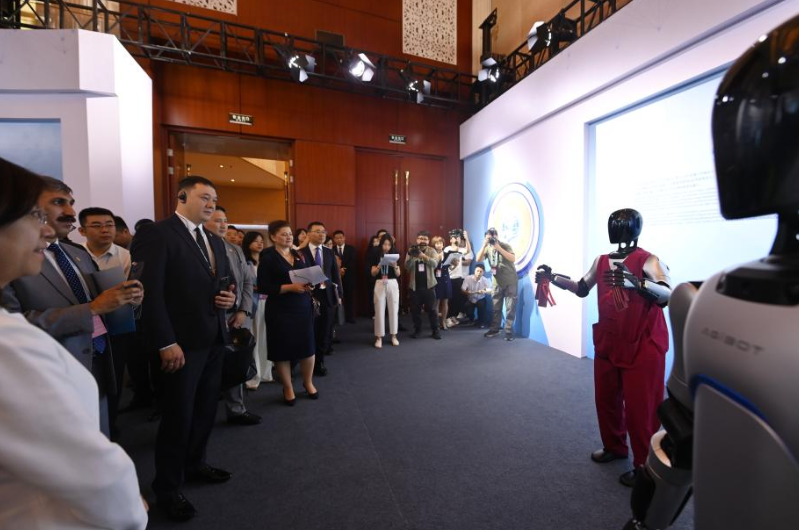
When Usman Ahmed first arrived in China in 2017, his ambitions were modest — to learn Mandarin, experience a new culture and broaden his horizons.
Nine years later, the 32-year-old from Pakistan is pursuing a PhD focusing on AI at Yangzhou University in Jiangsu province. His journey took an unexpected turn as he witnessed China's rapid technological evolution up close.
"Living in China gradually changed my plans," said Ahmed, who first joined a Chinese-language program at Shandong Normal University in Shandong province.
"What particularly impressed me — coming from a software engineering background — was how deeply technology was already integrated into everyday life," he said.
READ MORE: Toward Higher-Quality Development of the Shanghai Cooperation Organization
This observation propelled him to pursue a master's degree in software engineering, and later, a doctorate focusing on AI.
"What I appreciate most is that AI in China is not limited to academic discussion," Ahmed said. "There is a strong connection between research, industry and real-world applications. That environment suits the kind of researcher I want to become."
Looking ahead, Ahmed hopes more young people can benefit from educational exchanges with China, much like his own experience. He also sees particular promise in AI cooperation under the Shanghai Cooperation Organization framework.
"SCO member countries are at different stages of technological development, and this creates opportunities for complementary cooperation through shared research programs, student and researcher exchanges, and collaborative AI applications addressing common development challenges," Ahmed said.
"Looking 10 years ahead, I hope we will have moved beyond simply exchanging students and researchers toward actually building things together and solving real problems across different countries."
Broader goals
This hope for practical AI cooperation resonates with the broader strategic goals outlined by China.
At the 26th Meeting of the Council of Heads of State of the SCO held in Bishkek, Kyrgyzstan, President Xi Jinping called on the organization to stay committed to putting development first and deepen, substantiate and upgrade regional cooperation.
The SCO should consolidate cooperation in traditional areas such as trade, investment and connectivity and expand cooperation in emerging areas such as AI, Xi said.
Last year at the SCO Plus Meeting held in Tianjin, China pledged to work with all parties to establish an AI application cooperation center and share the dividends of progress in the technology.
That pledge led to the creation of the China-SCO Countries Artificial Intelligence Application Cooperation Center, said Pan Jingyu, the center's director.
Since its establishment, the center has made major strides in international AI cooperation within the SCO framework. Pan highlighted multilateral efforts, including continuous coordination with the SCO Secretariat and engagement with more than 20 foreign embassies in China to build regular liaison channels.
"On the bilateral front, a stable collaboration mechanism has been established with Kazakhstan, with plans to adapt mature Chinese AI technologies and products in local industrial scenarios, facilitate institutional exchanges and explore exclusive China-Kazakhstan tech cooperation service platforms," Pan said.
Similar collaboration in other Central Asian countries is also envisioned, he added.
Drawing on the center's firsthand experience, Pan highlighted significant enthusiasm for Chinese AI technology among partner countries.
He outlined two principal demands from the SCO and Global South countries regarding AI advancement. The first is "scenario empowerment", which leverages AI as a productive force in livelihood-oriented sectors, including digital agriculture, smart education and healthcare.
The second is "capacity building", which underscores the need for affordable AI infrastructure and the cultivation of homegrown AI expertise.
To meet these needs, the center plans to prioritize cooperation in AI language localization and AI-driven industry digital transformation, Pan said.
"Chinese companies possess mature model training and optimization experience, which can help Global South countries develop multilingual large language models suited to local languages and cultural characteristics," he said.
"Furthermore, China has a rich portfolio of application scenarios, such as AI+Industrial Manufacturing ... These mature solutions can be directly replicated, fine-tuned and localized for industrial upgrades in partner countries."
Nurturing talent
Talent development is another focal point of the center.
"We plan to establish an 'SCO Artificial Intelligence Summer School' project next year to bring students from SCO member states to China for AI training," Pan said.
"The project will integrate AI technology development, industrial applications and international governance to enhance the professional AI capabilities of young students," he said.
The enthusiasm and specific demands for Chinese AI technology, as observed by Pan, are not coincidental but deeply rooted in the unique institutional advantages and practical foundations for AI cooperation within the SCO, a point emphasized by Jiang Tianjiao, a research fellow at the Center for Global AI Innovative Governance in Shanghai.
"Political trust is the cornerstone of cooperation," Jiang said, noting that long-standing security and economic collaboration among SCO members has built a solid foundation for collaboration in cross-border data flow, cybersecurity and governance alignment, while respecting each member state's data sovereignty.
He highlighted resource complementarity within the SCO as the intrinsic driver of cooperation.
ALSO READ: Strengthen genuine partnerships through dialogue, cooperation and concrete results
"The SCO includes digital powerhouses like China, as well as rapidly growing markets in Central and South Asia with urgent digital transformation needs, enormous demographic dividends and diverse application scenarios. This creates a synergistic loop of 'technology supply-scenario uptake-outcome conversion'," he said.
SCO AI cooperation offers member states a dual benefit of development dividends and capability building, Jiang said. Economically, the effective application of AI can reduce operational costs and create new growth drivers, he added.
"In terms of people's livelihoods, deploying AI in healthcare, agriculture and education can tangibly improve the quality of life," he said.
"Meanwhile, China, through open-source large language models, joint research and development, and talent cultivation, helps member states bridge the digital divide."
Contact the writers at yangran1@chinadaily.com.cn
