

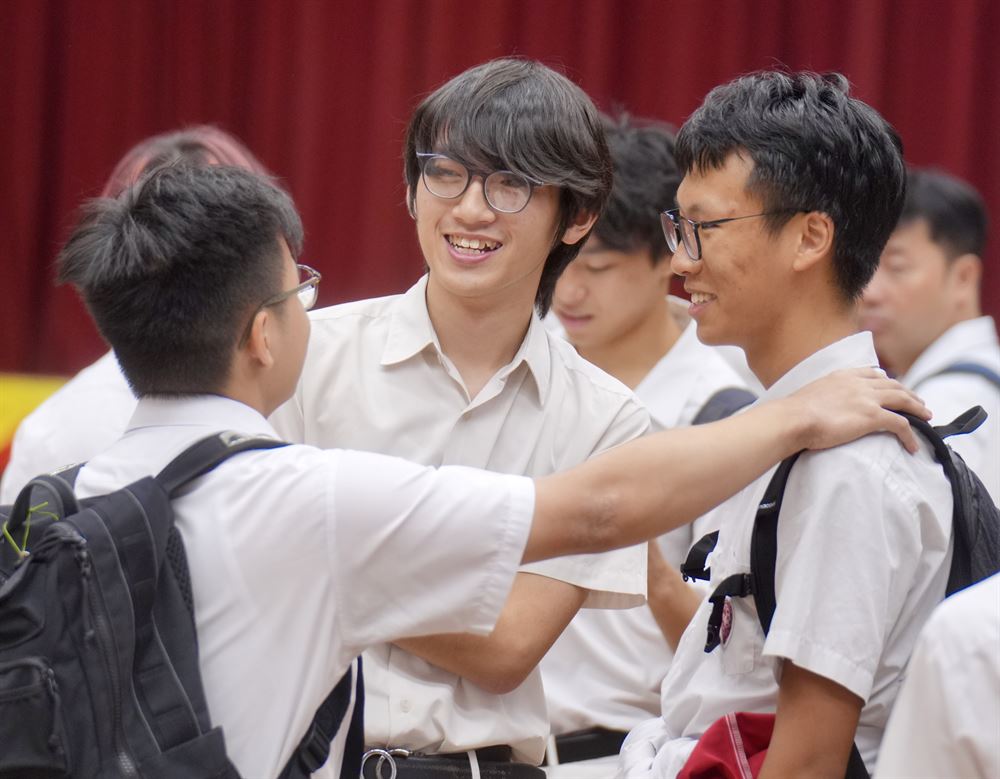
Hong Kong students showed outstanding performance in digital learning in the Programme for International Student Assessment (PISA) 2025, while their performance in mathematical, scientific and mother-tongue reading literacy surpassed the international averages.
The assessment results, released on Tuesday, showed the city’s students performed exceptionally well in the innovative domain "Learning in the Digital World", achieving a score of 545, which is significantly higher than the international average of 500.
In the core domains of mathematical, scientific and mother-tongue reading literacy, Hong Kong students scored 522 in mathematical literacy, 496 in scientific literacy and 480 in mother-tongue reading literacy, compared to the international averages of 463, 482 and 461, respectively.
Organized by the Organisation for Economic Co-operation and Development (OECD), the international assessment is conducted every three years. Total 91 countries or economies participated in PISA 2025 globally.
The Education Bureau commissioned the University of Hong Kong to conduct the main study in the city from May to July 2025, which involved 6,445 15-year-old students from 230 secondary schools.
According to the OECD's report, Hong Kong was one of the top-performing education systems globally in the innovative domain "Learning in the Digital World", with over 40 percent of participating students attaining high proficiency levels, and capable of undertaking moderate to sophisticated programming and modelling and effectively applying computational logic for analysis.
RELATED ARTICLES
- 4 HK students among 15 honored by Tencent for outstanding AI research
- 25 HK students get scholarships for academic excellence, I&T dedication
- HK universities lead Asia’s Top 10 rankings
- HK students win 6 gold, 4 silver medals at physics, maths Olympiads
- HKMU equips next-generation talent with real-world skills & global horizons
The Education Bureau said Hong Kong students’ outstanding performance demonstrates the tangible results achieved through Hong Kong's vigorous promotion of STEAM (science, technology, engineering, arts and mathematics) education.
In a statement, the bureau said it will continue to focus on artificial intelligence education, building on the Blueprint for Digital Education Development in Primary and Secondary Schools announced earlier.
“Efforts will be directed towards developing curriculum frameworks, supporting teacher training, optimizing infrastructure and supporting facilities, as well as promoting cross-sector collaboration to strengthen students' digital literacy and equip the younger generation to meet the opportunities and challenges of the digital era,” said a spokesman for the bureau.
Regarding educational equity, the EDB said the assessment results reaffirm that Hong Kong's education system excels in achieving educational equity, consistently ranking among the top three countries or economies with high academic achievements.
“In addition to establishing a broad and balanced 15-year school curriculum framework, the government is also committed to providing a diverse range of life-wide learning activities, various programs to support e-learning, comprehensive learning support for non-Chinese-speaking students, and promoting the Whole School Approach to Integrated Education,” the spokesman said, adding that these efforts provide all students with high-quality and equal education opportunities, thereby promoting social mobility.
The EDB said it will conduct analyses across various sub-indicators to gain an understanding of students' learning needs, with a view to formulating measures to improve assessment arrangements and enhance students' assessment literacy.
It has established an Expert Group on Educational Performance Evaluation, aiming to conduct a more comprehensive review of Hong Kong's performance in major international assessments and studies. The group will conduct an integrated analysis of international and local assessment data, taking into account the current stage and trends of educational development in the city, and will formulate recommendations on how to systematically incorporate assessment results into education policies.
