

As the Guangdong-Hong Kong-Macao Greater Bay Area goes to great lengths to make itself a major computing network center, Hong Kong can chip in as a ‘superconnector’, compliance hub and a gateway to world capital and customers. Li Xiaoyun reports from Hong Kong.
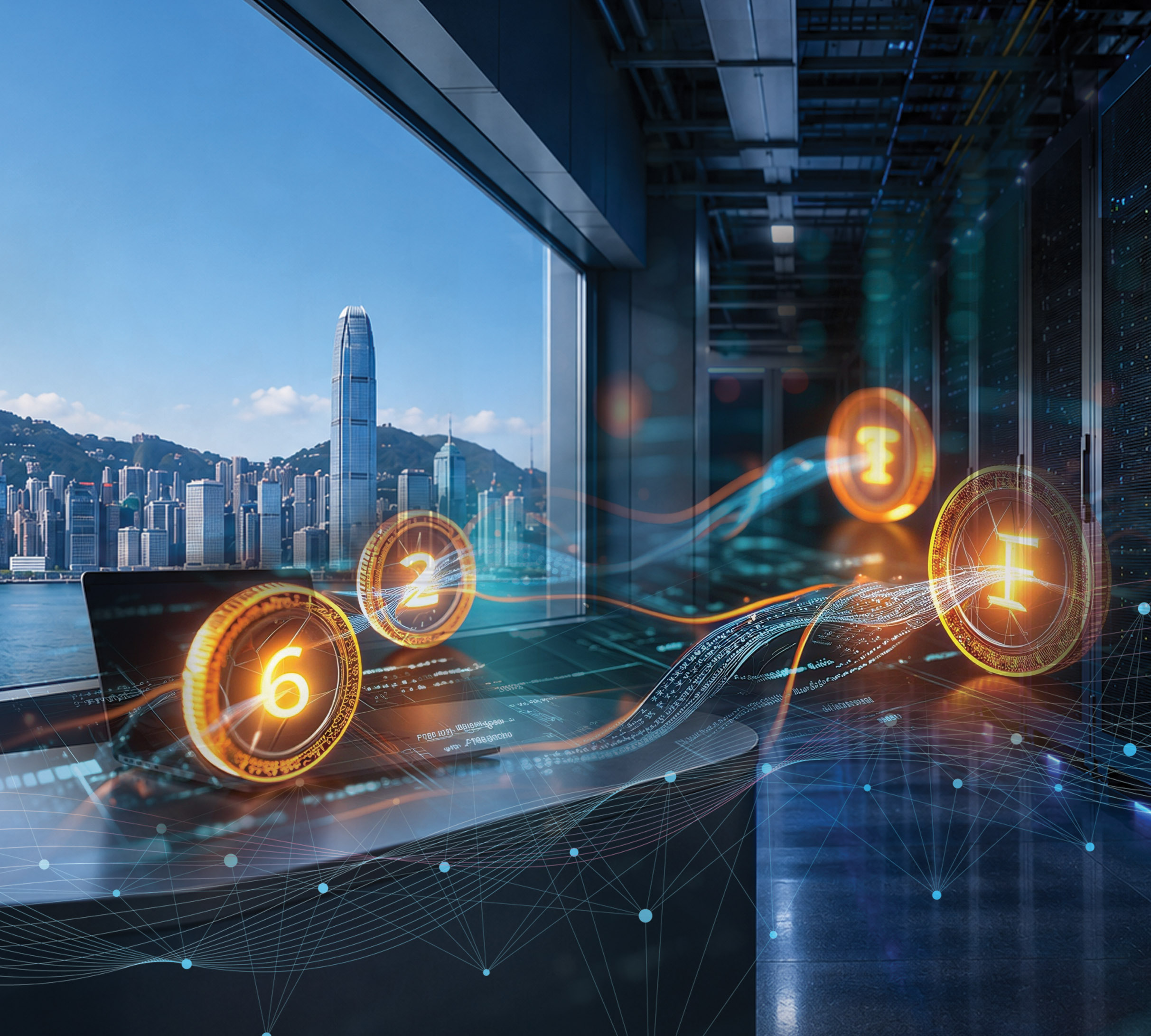
At Hong Kong’s artificial intelligence accelerator Cyberport, Lawrence — a digital employee — races through a legal contract spanning hundreds of pages, responding to its user almost instantly.
But, behind the sleek interface, much of the heavy lifting is happening outside the special administrative region.
Lawrence is an AI agent developed by Hong Kong legal-technology startup WiseLaw. Each time Lawrence receives a complex instruction, thousands of tokens — the basic units through which large language models process and generate text — are created and interpreted. The task travels over a dedicated, encrypted line to Shaoguan, a city in northern Guangdong province more than 300 kilometers from Hong Kong.
At data halls there, servers powered by domestic computing clusters run day and night. They clean and label data, support model training and inference, generate tokens and send the results back to the HKSAR.
The model is dubbed “processing with supplied data”. The phrase echoes 1978 when the Chinese mainland’s opening-up to the outside world was in its infancy. A Hong Kong businessman started the mainland’s first “processing with supplied materials” handbag factory in Guangdong.
READ MORE: Multinational firms step up AI data center investment in HK
Hong Kong supplied raw materials and overseas sales channels, while Guangdong provided labor and manufacturing capacity. The formula helped power the province’s rise as a production base and pushed Hong Kong toward a more services-led economy.
Nearly half a century later, with the world racing to harness AI and companies hunting for cheaper, reliable computing power, Guangdong and Hong Kong are reviving that old model. This time, the materials being sent north aren’t leather, cloth or metal fasteners. It’s data.
‘A digital bonded zone’
Arthur Lei, WiseLaw’s chief operating officer, says token calls under the “processing with supplied data” model cost about 20 percent less than those offered by Hong Kong service providers.
The company had long wanted to make greater use of mainland computing power, he says, but sending customer contracts or other sensitive files directly to mainland servers would have triggered complex cross-boundary data compliance procedures. “It’s not that it can’t be done,” Lei says. “It means more compliance costs.”
That’s the problem the Shaoguan pilot intends to solve. On June 1, a dedicated cross-boundary computing zone for “processing with supplied data” began operations in the city. The zone is situated within the Shaoguan cluster of China’s national integrated computing network for the Guangdong-Hong Kong-Macao Greater Bay Area. The setup functions as a digital enclave. Physically, the machines sit in Shaoguan. Technically, they are sealed off from the rest of the city’s network.
“Throughout the process, raw data is strictly confined within the zone. It doesn’t leave, and it’s not mixed with other data. Once processing is completed, the results are returned directly to Hong Kong, with no retention on the mainland side,” explains Feng Lanxiao, chairman and CEO of China Unicom Global.
Feng, who is also the dean of the China Unicom (Hong Kong) Innovation Research Institute, describes the model as a form of bonded processing for the digital economy. Server rooms, equipment and network exits are isolated from the mainland’s ordinary business environment, he says.
The system uses end-to-end encryption and full-process logs to track data from entry to computation and final output so as to satisfy Hong Kong’s audit requirements for data access, processing and traceability.
Token crunch
The experiment comes as the economics of AI are changing fast. Early chatbots largely followed a simple pattern — a user asked a question, the system identified the intent, produced an answer and stopped. AI agents like Lawrence are more demanding. They can break a task into steps, call external tools, inspect interim results, critique their own output and try again if the answer is unsatisfactory. That loop of planning, execution and self-correction can burn through tokens at a far higher rate than a conventional chatbot.
After OpenClaw’s viral rise thrust AI agents into the spotlight earlier this year, global token usage has surged. According to New York-based token marketplace OpenRouter, worldwide token calls had exceeded 75 trillion by mid-August — about 13 times the level at the end of 2025.
Hong Kong is feeling the strain as well. It is a global financial center and an emerging technology hub with strong demand for model training, inference and data-intensive research. But, its land and electricity are expensive, and intelligent computing racks are in short supply. For some small and medium-sized technology companies, computing costs can exceed 30 percent of revenue, says Feng.
Land and power, however, are among the strengths mainland cities can bring to AI development. Shaoguan is trying to make itself southern China’s “city of intelligent computing”. Huashao Data Valley — the first hyperscale data center to come online in the Shaoguan computing cluster — covers 231 mu, or about 15.4 hectares, roughly the size of over 20 soccer fields. Its first phase, launched in November 2022, has more than 2,700 racks of housing servers, networking and other information technology hardware.
The business mix has changed quickly. Lao Yuting, the company’s deputy general manager, says AI model training and media rendering clients have become core customers over the past two to three years, accounting for about 60 percent of overall business. Traditional storage clients — those renting cabinets mainly to store data rather than running computations — now make up less than 10 percent.
Shaoguan has ample electricity supply and lower prices than Guangzhou and Shenzhen. Its annual average temperature is about 24 C — among the lowest in Guangdong — allowing data centers to use natural cooling for three to four months a year, reducing energy and operating costs.
Since 2025, as Chinese mainland’s computing network has expanded and the cost advantage has become more apparent, inquiries from the HKSAR’s telecom companies, universities and research teams have risen significantly, according to Lao.
“Expansion is inevitable,” she says. Huashao Data Valley plans to start construction this year on a second phase about four times the investment of the first. Its design has been revised several times to keep up with the needs of rapidly evolving large AI models.
Token gateway
The ambition is not just to build more data centers, but to make computing power easier to buy and move around the Greater Bay Area. Wang Lizong, a member of the National Committee of the Chinese People’s Political Consultative Conference and chairman of the Guangdong High-Tech Industry Chamber, calls for a more integrated computing power allocation platform for the region.
Scattered computing resources should be pooled into a giant resource reservoir so companies could use them as conveniently and cheaply as electricity, he says.
As the 11-city cluster builds up a much larger computing network, there is broad agreement within the industry about where Hong Kong fits in. Official data show the HKSAR has about 5,000 peta-floating point operations per second (PFLOPS) of computing capacity. The Sandy Ridge Data Facility Cluster under construction is expected to add another 180,000 PFLOPS by 2032. But few in the industry expect Hong Kong to win a race based purely on racks and electricity. Its value lies as a “superconnector”, a compliance hub and a gateway to global capital and customers.
The HKSAR’s Innovation, Technology and Industry Bureau says Guangdong’s “Hong Kong/Macao Data, Shaoguan Compute” initiative has opened up new opportunities for Hong Kong’s universities, research institutions and enterprises to undertake suitable computing-intensive work through a broader regional computing-power ecosystem.
It says Hong Kong will continue to build local computing capacity while promoting complementary collaboration with the mainland. “Local computing infrastructure remains essential for supporting research, sensitive workloads, low-latency applications and the development of a vibrant AI ecosystem.”
For ultra-low-latency high-frequency trading, core systems are still expected to remain at Hong Kong data centers to protect speed and stability. But tasks that consume large amounts of computing power and can tolerate millisecond-level latency could be moved to the Shaoguan zone, including AI inference, bulk analysis of historical data, and public-opinion monitoring, Feng says.
“The development priorities of Hong Kong and mainland cities in the Greater Bay Area are naturally different,” he says. “In practice, a differentiated pattern of collaboration has already taken shape.”
Feng notes that Hong Kong has abundant submarine cables and land-based cross-boundary links, making it one of the most connected cities in the Asia-Pacific region. The city’s legal, compliance and business environment is aligned with international standards, giving it an advantage in serving overseas clients that need computing-related business services, compliance support and cross-boundary settlement.
Teething troubles
For now, WiseLaw mainly uses Shaoguan computing power to demonstrate Lawrence’s capabilities to prospective clients, rather than in its day-to-day operations. Lei says the company’s current business model is like “selling cars without fuel” — it sells digital employees, while customers choose and pay for tokens themselves.
The company plans to shift its approach and offer packages that will include tokens. “At that point, we’ll certainly consider using ‘processing with supplied data’ on a large scale,” Lei says. “If there’re other channels with even lower costs, we’ll consider them too.”
“What I worry about most is still compliance,” says Lei. Given that the Shaoguan model is still a pilot, he hopes formal laws and regulations could be introduced to give the market long-term policy expectations and stability so that users in Hong Kong and overseas “can feel more confident”.
ALSO READ: HK’s largest AI supercomputing center opens
At the same time, challenges in chip supply have yet to be fully resolved. Exports of advanced chips to the mainland remain restricted. While homegrown silicon is making strides, particularly in inference performance, chipmakers are operating on tight production schedules and may struggle to deliver quickly enough to meet demand, according to people familiar with the matter.
Lao calls the current stage a “transition period”. As the mainland’s computing infrastructure scales up and supply constraints ease, exporting computing power to offshore markets will naturally gather momentum, she believes.
Still, Lao’s company is already testing the waters. Huashao Data Valley is working with a Hong Kong cultural group to use Shaoguan’s computing power and AI tools to adapt major Hong Kong comic intellectual properties, including Oriental Heroes, into AI-generated comic dramas.
The project is a “concrete” experiment in both exporting digital content and token-based computing services. “Eventually, all token computing capacity must materialize in actual applications, creative works, or finished products,” says Lao.
“Policymaking and market adaptation take time,” she says, and expects 2027 to bring a genuine breakthrough as domestic chip supply expands and the national computing network matures.
Contact the writer at irisli@chinadailyhk.com
