

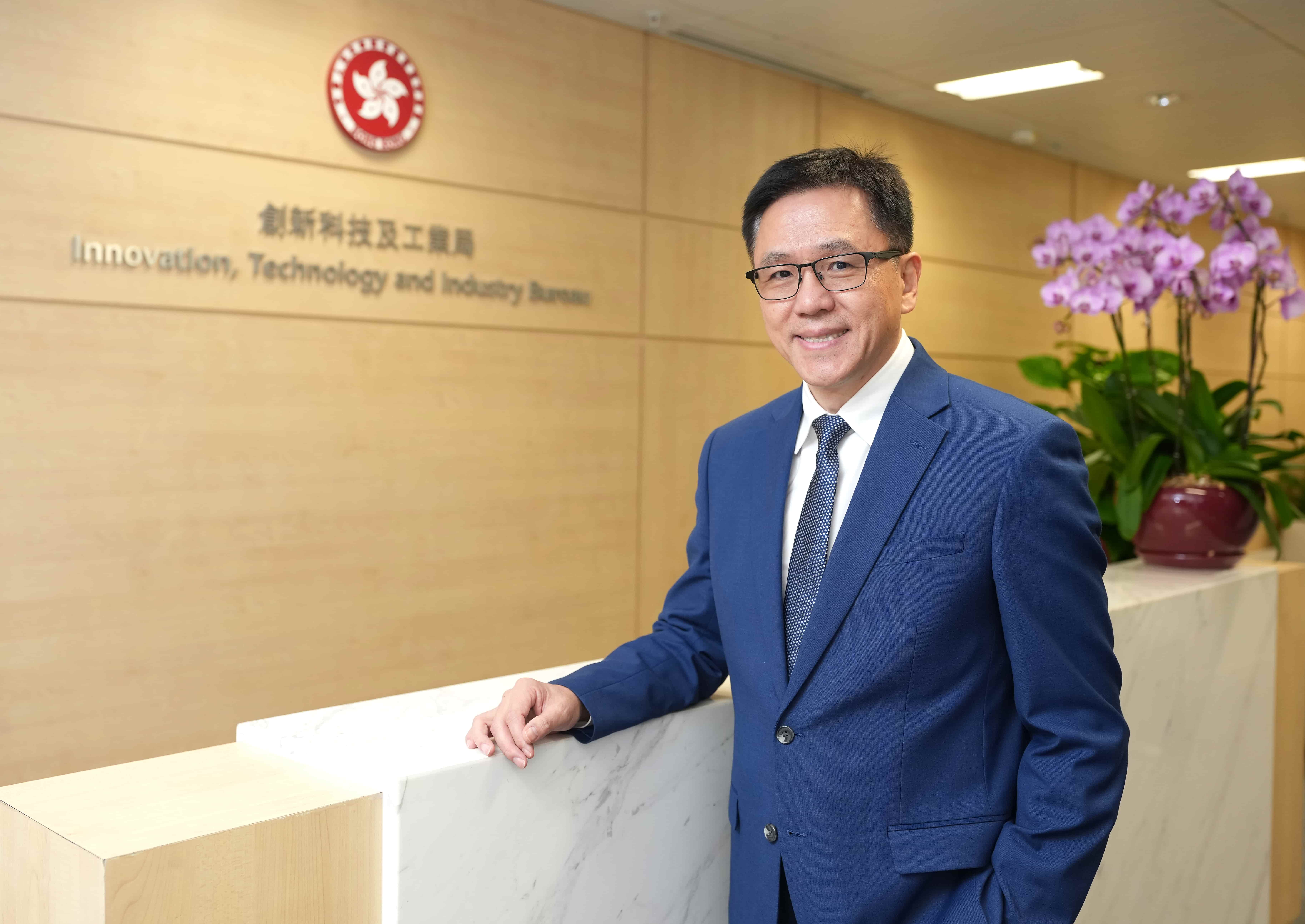
Doubling research and development expenditure to align with the average national level is likely to be an integral part of Hong Kong’s upcoming first five-year plan, according to the city’s innovation chief Sun Dong.
And, attaining such a target needs to rely heavily on boosting private-sector investment through sustained incentives, he told China Daily in an exclusive interview.
Sun, secretary for innovation, technology and industry of the Hong Kong Special Administrative Region, said that the expenditure target is a “must-do” for Hong Kong to live up to the nation’s expectations of the city shining as a global innovation hub, and likely to be among the key performance indicators of its inaugural development blueprint.
ALSO READ: Major scientific event deepens Hong Kong's status as global I&T hub
As part of the SAR’s broader drive to integrate with the nation’s 15th Five-Year Plan (2026-30), the homegrown blueprint is set to advance the Northern Metropolis development and other projects that are crucial to long-term interests. The city also aims to upgrade industries, boost regional integration and cooperation, and improve people’s livelihoods.
To further elevate Hong Kong’s innovation and scientific research sectors, which have been identified by policymakers as key growth drivers, the development plan will introduce both macro directions and specific key performance indicators, Sun said.
He added that the five-year plan is a guiding framework with broad strategic directions. “However, I believe some major key performance indicators still need to be highlighted, particularly those concerning key development strategies the public cares about.”
READ MORE: Cyberport unveils ‘AI for All’ to drive digital inclusion in HK
Hong Kong measures its research and development spending through the concept of gross domestic expenditure on research and development (GERD), and its gross domestic product ratio. Yet, the city’s lack of industrial activities in the past has led to a situation where GERD reflected heavily on the research spending of universities, part of the 0-to-1 process, Sun said.
Hence, the figure has failed to reflect the reality for Hong Kong’s booming startups in the past decade.
According to the HKSAR government, the number of local startups had surged from 1,500 in 2015 to 5,200 last year, with more than half of them specializing in innovation and technology.
The growth was a direct result of the government’s proactive efforts in the past decade. The authorities established the HK$10 billion ($1.28 billion) Innovation and Technology Industry-Oriented Fund to channel private investment into emerging fields like healthcare technology, artificial intelligence, robotics and smart devices. This follows the 2023 launch of the HK$10 billion Research, Academic and Industry Sectors One-plus Scheme aimed at commercializing R&D outcomes from local universities. Another HK$10 billion initiative — the InnoHK platform — is dedicated to promoting research and development in life sciences, as well as AI and robotics.
In order to map out a clear target, the SAR introduced a new concept called “total domestic expenditure on innovation activities” on June 15 — the same day it launched a two-month public consultation exercise to garner residents’ views on the local five-year plan.
READ MORE: HK to set up national manufacturing innovation center
The new metric factors cover the GERD method, as well as expenditures on enterprises’ application development and other related innovation activities, such as software development and pilot testing. Under the new algorithm, the city’s total domestic expenditure on innovation activities stands at HK$51.7 billion, taking up 1.63 percent of its GDP in 2024 and representing a surge of 9 percent over 2023.
Sun said the new calculation method draws on practices from the Chinese mainland and overseas, particularly Sweden and Finland, to better reflect the evolving nature of R&D and the “1-to-10” scaling phase.
Expressing confidence in doubling the local R&D spending to match the national average of 2.7 percent of GDP within five years — a goal proposed by Sun in June — the technology and innovation chief said the target remains daunting despite a higher baseline with the recalibration of algorithm.
“The mainland’s expenditure will also continue to grow. Rapid growth in other economic sectors could dilute R&D’s overall share of the GDP even if absolute spending goes up,” he said.
READ MORE: Industry-academia synergy sparks rise of HK unicorns
Setting such a target also signals the SAR government’s expectation that enterprises will increase their own R&D investments, Sun said, adding he hopes to see more spending on designing new products and establishing pilot testing and manufacturing lines.
He said driving greater corporate participation in R&D is in line with the national strategy for technological and industrial innovation, which emphasizes an industry-led approach.
The KPIs to be unveiled in the upcoming blueprint will not be radical surprises for the sector, Sun said. Instead, they are built on existing progress to help local innovators achieve new milestones. The targets are also designed to meet the expectations of both the nation and the local community. “Once these KPIs are announced, the SAR government must treat them as a serious commitment and take full responsibility for delivering them.”
While the metrics themselves may be expected, the strategic framework — the first of its kind — is a breakthrough, Sun said.
“If you are looking for new elements in the local five-year plan, the government’s forward-looking road map and clear KPIs for the innovation and technology sector will certainly be among them,” he added.
Contact the writer at williamxu@chinadailyhk.com
