

Sister cities in China and Germany strive together to keep old houses alive and promote urban development
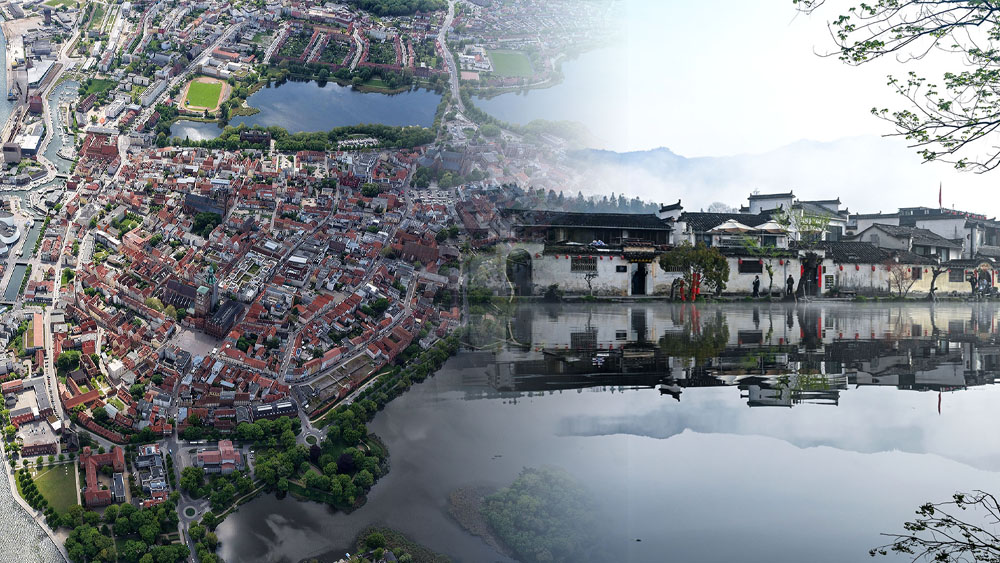
In a traditional courtyard, sunlight streamed through carved wooden windows, falling onto a table covered with bamboo strips and colorful paper. The courtyard belongs to a workshop in Hongcun, a historic village at the foot of Huangshan Mountain in East China's Anhui province.
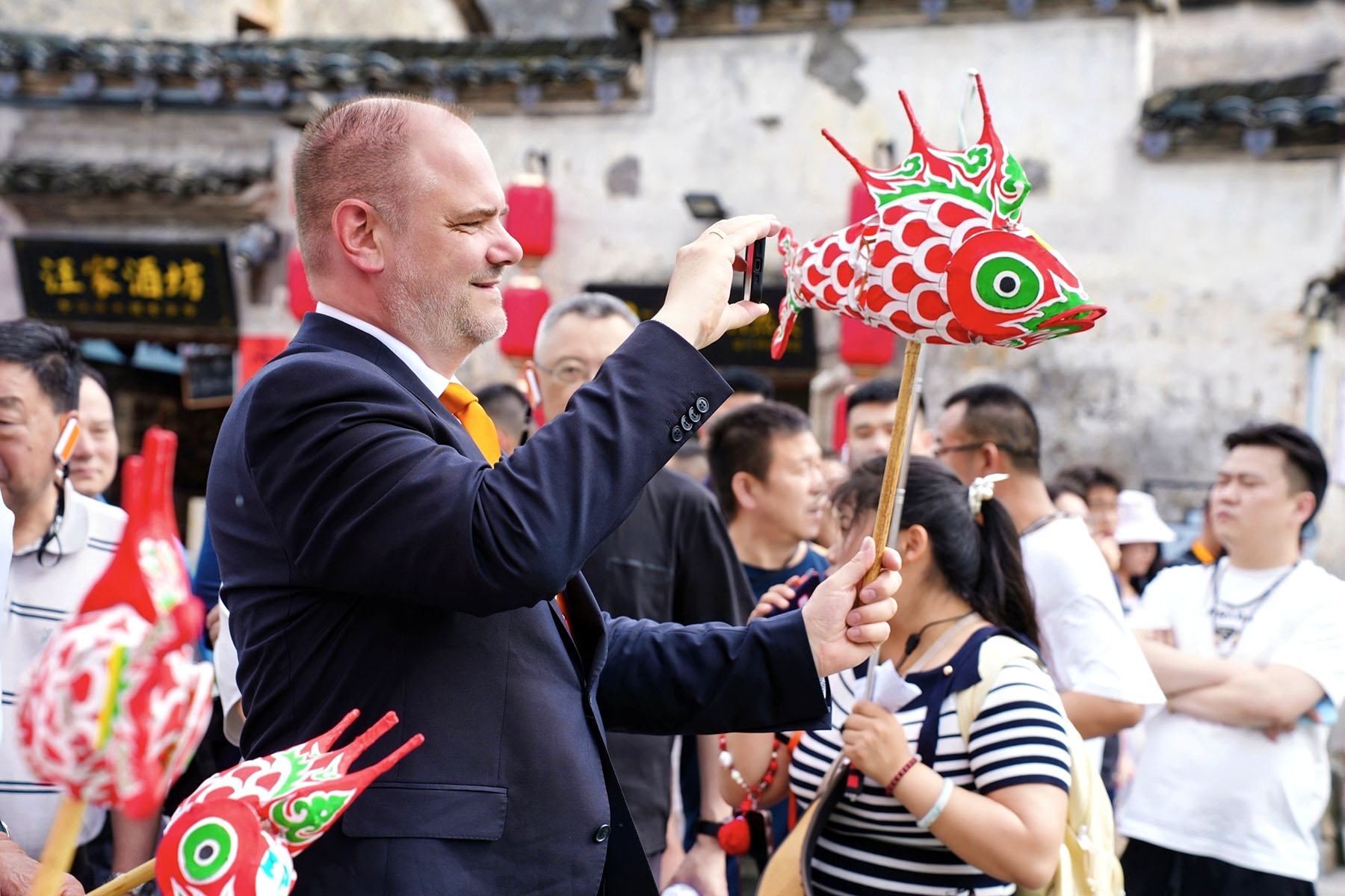
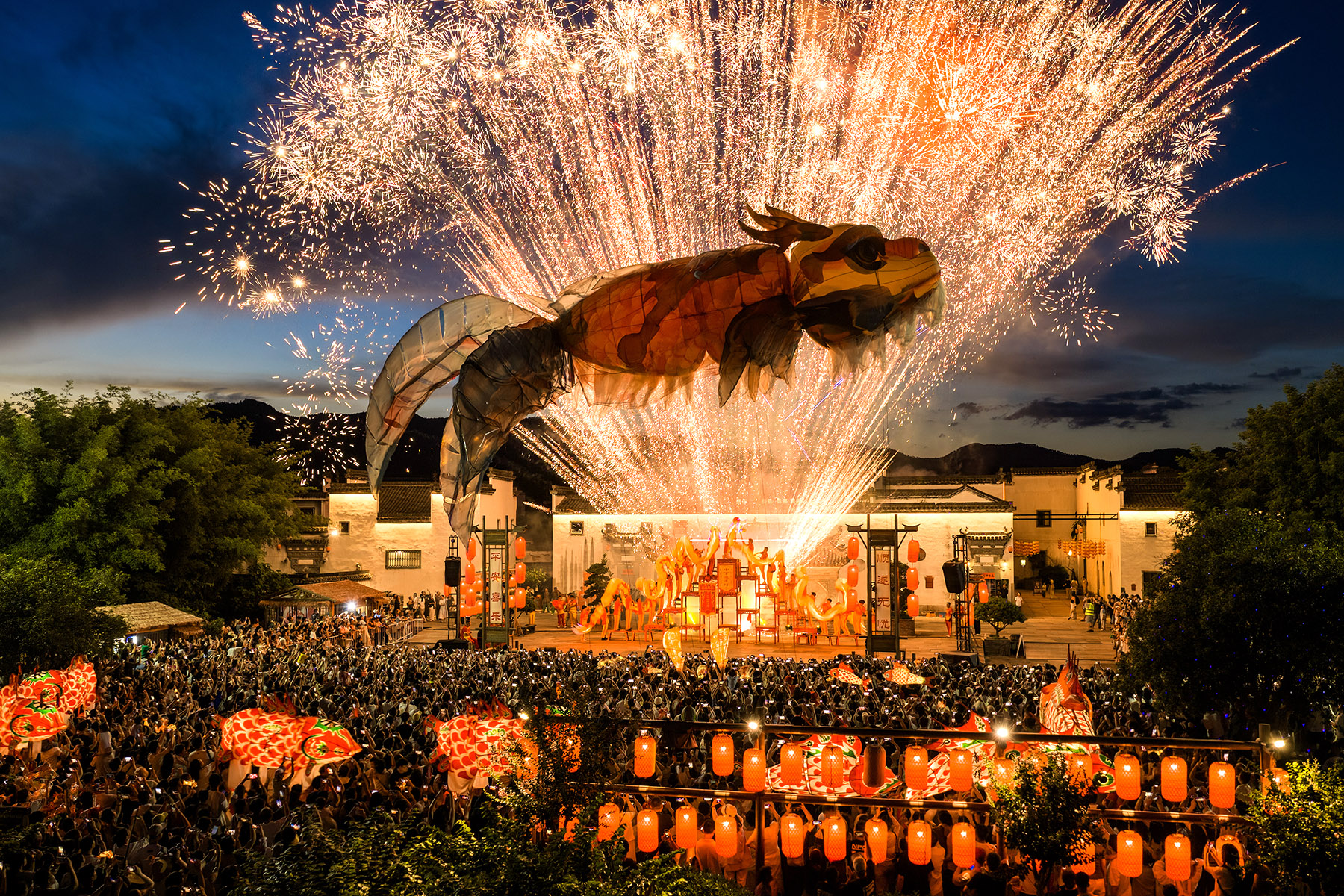
At the workshop for the intangible cultural heritage, where experts impart skills for making fish lanterns, a mayor from Germany carefully inserted the final bamboo frame into the lantern's body.
When the lantern was completed, its maker, Alexander Badrow, mayor of Stralsund, was expected to write his name on it. But he did not sign his own name. Instead, he wrote two letters: "HS", the abbreviation for Huangshan.
The fish lantern has become a symbol of a much larger connection: a mayor from a European city had linked his hometown with Huangshan through China's traditional cultural artifacts.
READ MORE: China, Germany urged to tap cooperation potential in emerging fields
Behind those two letters was a decade-old friendship. In 2015, Stralsund and Huangshan established a sister-city relationship.
Huangshan is a mountain city; Stralsund is a coastal city, while both rose through trade and cross-regional exchanges.
Stralsund was a major Baltic trading hub in the Middle Ages, while Huizhou — a historical region that roughly corresponds to Huangshan today — stood as a commercial center of the Ming (1368-1644) and Qing (1644-1911) dynasties in ancient China, with its merchants playing a prominent role in commerce for more than three centuries.
Their commercial past has left both cities with remarkable cultural heritages. Huangshan Mountain was inscribed on the UNESCO World Heritage List in 1990, while Xidi and Hongcun, two ancient villages at the foot of Huangshan Mountain, were added in 2000 as cultural heritage sites. Stralsund's historic old town, with its brick Gothic architecture, joined the World Heritage list in 2002 as part of the "Historic Centers of Stralsund and Wismar".
For Badrow, who first visited Huangshan in 2015 and returned for his fourth visit in May, the two old cities are not merely preserved historical sites — they are living communities, where past and present coexist in everyday life.
"Brick Gothic architecture (in Germany) and traditional Chinese architecture may be very different, but both are magnificent testaments to the craftsmanship of earlier generations and to the care taken in their restoration today," Badrow said.
"I was particularly struck by the detailed restoration and preservation of the wonderful buildings in Huangshan — something we have also attempted in Stralsund. I was also deeply impressed by the fact that these are not museums; people actually live and sell goods there."
His impression is echoed by the people who make these old buildings their home. For the residents, heritage is not a relic behind glass.
Li Shengtao, who runs a homestay out of his ancestral house in Xidi, said: "Our houses, which are hundreds of years old, are alive here."
He said that every hall displays inscribed plaques and couplets, through which ancestors passed down their life wisdom.
Job creation
Wu Yuming, director of Xidi Intangible Cultural Heritage Experience Center, spent over two decades as a tour guide before taking on her current role.
After the villages were inscribed on the UNESCO list, residents developed a community agreement governing the renovation and maintenance of historic homes.
"If you need to repair any part of it, you must submit a proposal and apply for approval. Any interior decoration or beautification must be done without compromising the main structure," Wu said.
She said the revival of these ancient villages has created abundant local jobs — many villagers now run guesthouses, homestays, private kitchens or coffee shops right on their doorsteps.
"As we protect the old houses, it brings tangible economic benefits to villagers," she said. "We don't have to go out — we can earn a living right here. That gives us even more motivation to protect our ancestral homes."
He Yi, mayor of Huangshan, frames this approach in broader terms. "We cannot sidestep the new demands and challenges that modern life brings," he said.
"Instead, we must enable our historical buildings to actively embrace contemporary living. We want the original owners, the local villagers, to become the guardians, operators, and beneficiaries of these ancient structures.
"Only when those who protect the heritage truly benefit from it can preservation be sustained over the long run," He said.
"It is not easy to keep an old city vibrant while preserving its historical character," said Frank-Bertolt Raith, head of the Office for Planning and Construction of Stralsund, who visited Huangshan with Badrow in May. "I think Huangshan has done an excellent job."
He said the underlying philosophy — honoring the historical fabric while embedding modern urban functions — mirrors the approach taken in Germany.
For Olaf Fromme, chairman of the association "Save the Old Town of Stralsund", preservation is ultimately a dialogue between past and future. "The preservation needs a sensible, healthy balance between the past and the future. It makes little sense to reproduce a historic house unchanged if people cannot live in it properly."
Olaf said cooperation with Huangshan could help through an exchange of experience. Both cities have followed different paths, and each can learn from the methods the other has developed to protect historic buildings and keep its old town attractive and alive.
For Fromme's organization, that principle is translated into practical, sometimes small-scale action.
Heiko Werner, its treasurer, said the association encourages owners to retain and restore their properties, sometimes by supporting repairs to a door, a window or a small fresco.
For Dagmar Fromme, Olaf's wife and a local tour guide in Stralsund, such preservation is deeply personal. The historic center is not simply a collection of protected buildings, but the setting of memories that have shaped her own life.
"The Alter Markt (a historic square in Stralsund) is deeply personal to me. My grandmother lived nearby, and my husband and I met here more than 40 years ago.
"The square and surrounding buildings were once badly deteriorated, but over the past 30 years they have been restored with enormous effort. Today people can sit here, watch the world go by and enjoy the old town's special atmosphere," she said.
Citizen participation
Fang Qian, deputy director of the Huangshan Municipal People's Government's Office of Foreign Affairs, said Stralsund has done an excellent job in engaging its citizens. The city has a dedicated heritage institution which provides professional guidance for heritage protection decisions.
She highlighted the high level of citizen participation — residents weave their everyday lives into conservation efforts, achieving a seamless blend of preservation and development.
"This is something we can learn from," she said.
This kind of cross-border exchange is not new.
Decades before Stralsund and Huangshan became sister cities, a Huizhou-style garden had already taken root in Frankfurt, Germany.
Its chief designer was Cheng Jiyue, an expert in traditional Huizhou architecture from Huangshan.
In 1988, Cheng led the garden's design, refining every detail with his team. The design drew on the ancient villages of Huangshan, but had to be adapted to Frankfurt's soil, climate and locally available materials. As Cheng put it, the project was about "planting the soul of Huizhou in German soil".
Cheng remembered working alongside German stonemasons and carpenters, exchanging techniques and solving problems together. He said the garden has endured because its care has always been a shared responsibility.
Throughout decades, artisans from Huangshan brought the seeds of Huizhou culture to Germany. Those seeds have taken root and, with care from both sides, blossomed into new avenues of collaboration.
ALSO READ: Friendship in wine-derland
In May, the Huangshan Municipal Bureau of Culture and Tourism signed a memorandum of cooperation with the cultural heritage department of Stralsund during the Global Mayors Dialogue.
Looking ahead, the bureau said Huangshan plans to establish a cultural tourism promotion center in Germany.
It also intends to partner with Huangshan Vocational and Technical College to launch a training program for tour guides specializing in European languages.
Fang said that building on shared cultural heritage, the two sister cities aim to deepen collaboration in tourism, cultural exchanges, and economic and trade ties.
"Whether it is Huangshan or Stralsund, these are shared treasures of all humanity — we have a common duty to protect them, safeguard them, and pass them on," Fang said.
Xia Ji in Huangshan, Anhui, contributed to this story.
Contact the writers at houchenchen@chinadaily.com.cn
