

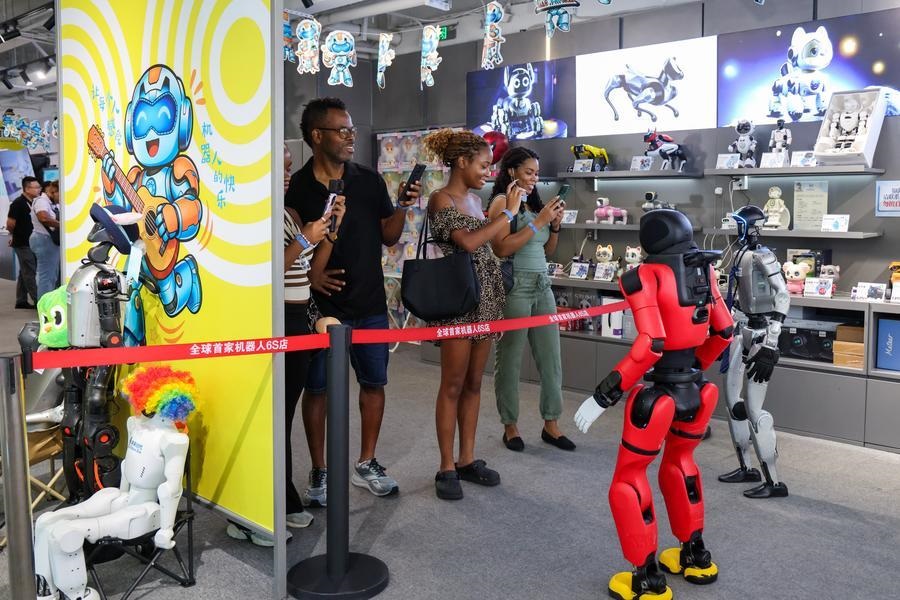
By leveraging the respective strengths of cities in the Guangdong-Hong Kong-Macao Greater Bay Area, the innovation cluster is well positioned to pave the way for the export of China’s new “New Three” high-tech products — artificial intelligence, robots, and innovative drugs — the country’s fresh calling card for foreign trade, experts believe.
From the “Old Three” of foreign trade — clothing, furniture, and household appliances — to the “New Three” of electric passenger vehicles, lithium-ion batteries, and solar cells, China’s manufacturing industry has shifted from primary processing to mid- and high-end smart manufacturing. The rise of the latest generation of high-tech products further demonstrates China’s strength in competing at the forefront of global cutting-edge technology.
Relying on China’s increasingly robust innovation capabilities, these state-of-the-art products are accelerating their expansion into overseas markets. China ranked first globally in downloads of open-source large AI models, with 10 billion downloads accounting for 41 percent of the worldwide total, according to AI community site Hugging Face’s 2026 spring report.
READ MORE: Tech firm releases new humanoid robot, eyeing HK’s promotion role
In the first half of this year, China’s industrial robot exports grew by 18.6 percent, reaching 141 countries and regions. The value of China’s licensing deals for innovative drugs reached approximately $110 billion, and Chinese pharmaceutical companies accounted for eight of the top 10 spots in global pharmaceutical transactions.
However, exporting these new technologies also faces multiple challenges, such as technology blockades under trade protectionist policies; weak innovation-to-commercialization capabilities among small and medium-sized enterprises; and a regulatory and standards framework that lags behind the pace of industrial expansion.
Hu Gang, a professor of Jinan University, said that as an international hub for technology and innovation, the Greater Bay Area carries the responsibility for institutional opening in high-tech industries.
With a complete industrial chain spanning research and development, pilot production, mass production, and export, combined with the institutional advantages of the “one country, two systems” framework, it serves as the core platform for these cutting-edge technologies to go global, he said.
ALSO READ: HSTECH to expand constituent stock number, tech themes
Calling for improved division of labor, he said he hopes that Shenzhen can focus on technology breakthroughs of large-scale models, humanoid robots, and surgical robots, and serves as a headquarters base for companies expanding overseas. Meanwhile, Guangzhou — leveraging its abundant clinical resources — can support clinical trials for innovative drugs and medical robots, and accelerate the commercialization of research findings.
He urged Dongguan and Foshan to strengthen their advanced manufacturing foundations to facilitate the mass production of products. Other Chinese mainland cities in the Greater Bay Area should expand their industrial capacity and further improve supply chain systems, taking on the production of supporting machine components and active pharmaceutical ingredients.
Wing Chu, a deputy director of research at the Hong Kong Trade Development Council, said that global demand for China’s AI products has also boosted the Hong Kong Special Administrative Region’s economy.
In the first half of 2026, Hong Kong’s real GDP grew by 5.1 percent year-over-year, the highest rate in nearly five years. AI products accounted for as much as 70 percent of the city’s total merchandise exports.
Currently, about one-third of the mainland’s AI-related products are exported via Hong Kong. As a world-leading transshipment hub, Hong Kong plays a key role in the transportation of high-value-added goods. With comprehensive supporting services in areas such as insurance, financing, and legal affairs, the city has become a springboard for the global foray of many tech companies, Chu said.
READ MORE: Profitability takes center stage as AI stocks swing in Hong Kong
He added that, amid efforts to vigorously develop science and technology, there is also significant local demand in Hong Kong for emerging technology products from the mainland that offer good value for money and stable quality.
Chu encouraged mainland tech firms to introduce their solutions and products to the Hong Kong market first before expanding globally, as this would allow them to benchmark against international standards and effectively showcase their offerings to the outside world.
Wang Zhen, director of the Department of Regional Development and Planning at the China Development Institute, highlights Hong Kong’s opportunities in the innovative drugs field.
He noted that the real bottleneck for innovative drugs entering foreign markets lies not in R&D, but in the international acceptability of clinical data. If companies can only meet the requirements of the mainland regulatory system, they will have to repeat clinical trials overseas, which entails extremely high time and cost burdens.
In the international mutual recognition of clinical trial data and alignment of drug and medical device registration rules, Hong Kong possesses unique advantages, he believes, adding that the city is ideal to conduct clinical trials for the mainland’s innovative drugs to accelerate the entire translation process.
Although the mainland cities in the Greater Bay Area excel at translating technology into real-world applications, Hong Kong’s universities and research institutions can provide significant support in terms of technological breakthroughs in underlying AI algorithms and foundational models, Wang said.
The expert strongly urged that smooth cross-boundary data circulation be established as a new priority for cooperation between Guangdong, Hong Kong, and Macao. He noted that channels for the flow of capital and talent are relatively well-established. Given its equal significance for technology development, however, data flow still lacks adequate institutional support.
Contact the writer at bingcun@chinadailyhk.com
