

Set-jetters flock to Mount Qingcheng to see Taoist landmark featured in Chinese animated hit movie
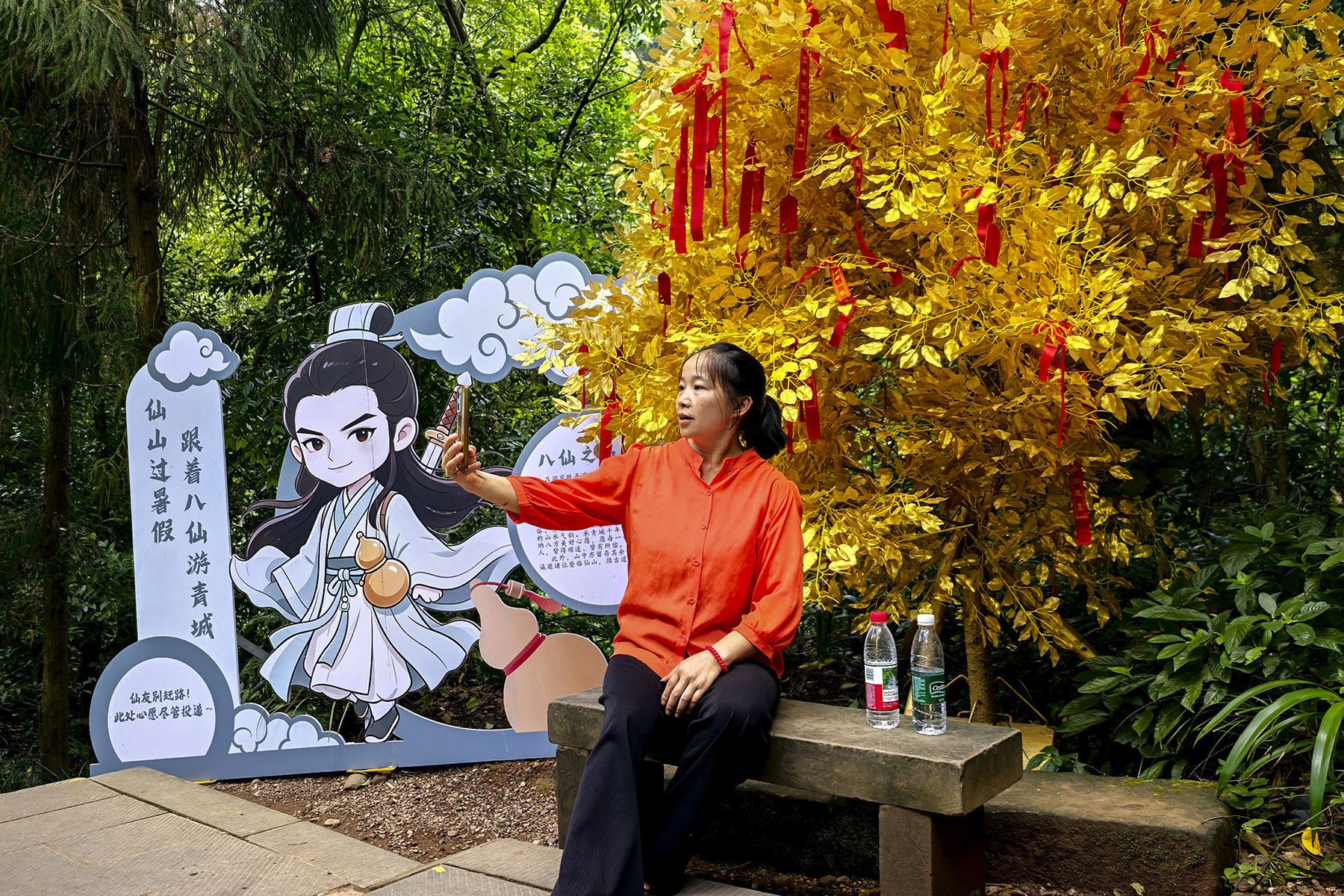
It is a ginkgo tree that has outlasted dynasties. For around 1,900 years, it has stood quietly, bearing witness as the world came and went.
Legend has it that Zhang Ling, founder of Tianshidao (Way of the Celestial Masters) — an early school of Taoism — planted the tree during the Eastern Han Dynasty (25-220).
Reaching it takes more than 40 minutes of climbing from the entrance to Tianshi Cave on Mount Qingcheng in Southwest China's Sichuan province.
When visitors arrive, they find the tree is already festooned with red silk ribbons bearing the heartfelt wishes of those who came before.
READ MORE: Ancient trees treasured in Chongqing
That sight — a striking blend of reverence for the supernatural and hope for a better life — stayed with Mu Zhengyang, director of All Wishes Come True!.
It would later inspire a defining scene in his hit animated film, where the protagonists gather around a stone table for a hot pot feast beneath a ginkgo tree patterned after the ancient one at Mount Qingcheng.
Scheduled for release in more than 15 countries and regions, the film — in which eight ordinary people become unlikely heroes as they foil a villain's plot to endanger humanity — has already raked in 1.4 billion yuan ($195 million), making it the highest-grossing Chinese animated film of the year so far.
The film's popularity has, in turn, prompted viewers to seek out the real-life inspiration for the scene.
"After its release, many fans made special trips to Mount Qingcheng. There has been a notable increase in visitors coming to take photos with the tree," said He Zhen, deputy director of the scenic spot's administrative center.
According to He's office, the scenic spot received 30,800 foreign visitors between July 1 and Aug 6, up 25.2 percent year-on-year. To enhance accessibility for international tourists, it now offers audio guides in multiple languages.
But Mount Qingcheng's appeal extends far beyond a single film — or even a single tree.
There is a mythic dimension involved as well. Ancient folklore holds that the peak was once a place where Xiwangmu, also known as Queen Mother of the West, cultivated herself spiritually.
In Taoist legend, she presided over female immortals. Perhaps that explains why, even amid crowds and selfie sticks, an otherworldly aura still lingers.
The ginkgo tree itself carries further Taoist significance. It is revered by some Taoist practitioners as an "immortal tree".
One legend holds that Laozi (Lao Tzu), the founder of Taoism, planted a ginkgo at Louguantai, a Taoist temple complex in Shaanxi province. The shape of its leaf — split at the edge but united at the stem — is seen as a Taoist symbol of "harmony", said Wang Guoping, a scholar of Sichuan culture.
Today, ancient culture is intersecting with a thoroughly modern phenomenon: set-jetting.
Zeng Min, director of the Dujiangyan's Bureau of Culture, Radio, Television, Sports and Tourism, said the trend is reshaping the way people travel, turning passive sightseeing into deep cultural immersion.
And All Wishes Come True! is not the first production to cast Mount Qingcheng in the spotlight.
ALSO READ: Ancient legends captivate modern audiences
Three iconic sequences from the 1986 TV series Journey to the West, including an episode in which Sun Wukong, or the Monkey King, masters his supernatural arts, were filmed on the mountain. The sites continue to draw die-hard fans who return year after year to recreate shots.
The 2016 Hollywood blockbuster Kung Fu Panda 3 also drew heavily on the mountain's natural scenery and the architectural style of its Taoist temples, Zeng noted.
Ying Xujun, president of Pearl Studio and chief producer of All Wishes Come True!, said the film also drew inspiration from the murals of Yongle Palace, the ethereal seascapes of Penglai Pavilion and the cliffside wonders of Xuankong Temple.
"The film is not only a cinematic presentation of Chinese culture, but also a vivid invitation to explore China's cultural and tourism riches," Ying said.
She added that if overseas audiences, inspired by the film, feel a pull to come to China to visit these sites in person, then its role as a cultural bridge will be fulfilled.
Contact the writers at xufan@chinadaily.com.cn
